Facts
The parties married on 26.01.2023 and separated in January 2024
Source reference: p. 1-2The respondent-husband filed a petition for divorce under Section 13(1)(ia) of the Hindu Marriage Act (HMA) on grounds of cruelty
Source reference: p. 2The appellant-wife filed a written statement and a counter-claim under Section 23A of the HMA, also seeking divorce on the ground of cruelty by the husband
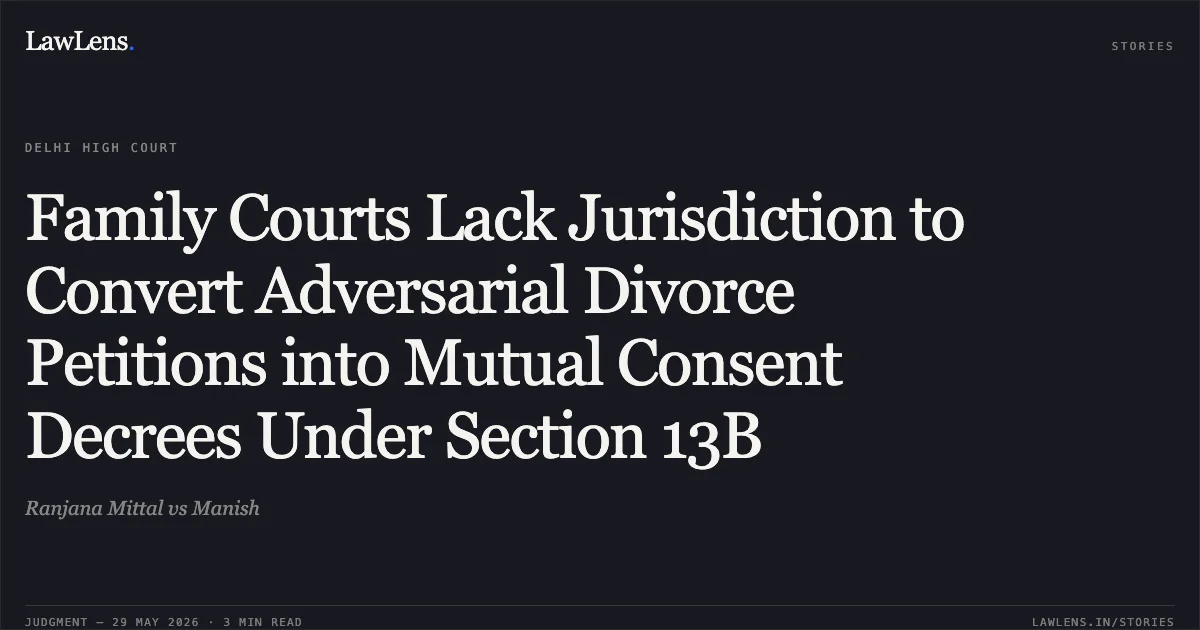
Source reference: p. 2On 18.03.2025, the Family Court, noting that both parties sought divorce, converted the contested proceedings into a mutual consent proceeding and dissolved the marriage under Section 13B of the HMA on the same day the pleadings were taken on record
Source reference: p. 2The appellant challenged this, arguing the court lacked jurisdiction to convert contested proceedings into a mutual decree without a joint petition or compliance with statutory cooling-off periods
Source reference: p. 2-3Issues
1. Whether a Family Court can convert a contested divorce proceeding under Section 13(1)(ia) into a decree of divorce by mutual consent under Section 13B merely because both parties have filed rival claims for dissolution of marriage
Source reference: p. 4-52. Whether the procedural flexibility granted to Family Courts under Section 10(3) of the Family Courts Act allows for the bypassing of substantive statutory requirements under the HMA
Source reference: p. 3, 8Law Applied
The court applied Section 13 of the HMA regarding fault-based divorce and Section 13B regarding divorce by mutual consent, emphasizing that the former is adversarial while the latter requires a joint petition "by both the parties together" and a second motion after a statutory interregnum to ensure "mutual agreement"
Source reference: p. 5-7The power to waive statutory periods or convert Section 13 proceedings into Section 13B is an extraordinary power under Article 142 of the Constitution reserved exclusively for the Supreme Court as held in Anil Kumar Jain v. Maya Jain (2009)
Source reference: p. 9-10Coordinate Bench decision in Upinder Kaur Malhotra v. Teghjeet Singh Malhotra (2025), establishing that rival fault-based claims do not constitute the "meeting of minds" required for mutual consent
Source reference: p. 10-11Reasoning
The High Court reasoned that Sections 13 and 13B of the HMA operate in distinct fields: fault-based versus consensus-based
Source reference: p. 6The court observed that the Family Court erred by assuming that rival allegations of cruelty—where both parties want "out" but on different terms and accusations—could substitute for the joint, voluntary agreement required by Section 13B
Source reference: p. 7The High Court noted that the mandatory requirements of a joint petition, a first motion, and a second motion after six months are substantive safeguards to ensure consent is informed and continuous
Source reference: p. 6-7, 9Section 10(3) of the Family Courts Act provides procedural flexibility but does not empower a judge to override the substantive requirements of the HMA
Source reference: p. 8-9By converting the matter, the Family Court effectively deprived the parties of the opportunity to lead evidence and adjudicate ancillary reliefs like permanent alimony under Section 25
Source reference: p. 3, 7Holding
The Court answered the issues in the negative, holding that a Family Court cannot unilaterally convert contested divorce proceedings into a mutual consent decree
The High Court set aside the impugned judgment and decree dated 18.03.2025, restored the original petition and counter-claim under Section 13(1)(ia), and directed the Family Court to adjudicate the matter on its merits after framing issues and allowing evidence, with parties directed to appear on 14.07.2026
Source reference: p. 12Acts & Sections Cited
4 provisions across 2 statutes referred to in this judgment. Each provision opens on LawLens.
Family Courts Act, 19842
Hindu Marriage Act, 19552
Original Court PDF
Ranjana MittalvsManish
Click to open original judgment
Original judgment, available to read, download and summarize on LawLens.in