Facts
The appellant, a juvenile, was accused in Parbatta P.S. Case No. 86 of 2023 for offences under Sections 302, 120(b), 341, 323, 325/34 of the IPC and Section 27 of the Arms Act.
Source reference: para. 2The prosecution alleged the appellant was part of an unlawful assembly involving his father, mother, and brother, which resulted in the murder of the informant’s wife.
Source reference: para. 2While the appellant allegedly engaged in indiscriminate firing, no injuries were directly attributed to his shots.
Source reference: para. 4The appellant has been in an Observation Home since April 17, 2025.
Source reference: para. 7He challenged the order dated October 17, 2025, passed by the Children Court, Khagaria, which rejected his bail application citing the "seriousness of the offence" and "complicity" in the crime.
Source reference: para. 1Issues
1. Whether the seriousness of the alleged offence and the complicity of the juvenile are valid grounds to deny bail under Section 12 of the Juvenile Justice (Care and Protection) Act, 2015.
Source reference: para. 52. Whether the release of the appellant would "defeat the ends of justice" given that his immediate family members are co-accused in the same murder case.
Source reference: para. 9, 32Law Applied
Section 12 of the Juvenile Justice (Care and Protection) Act, 2015, which mandates that a juvenile "shall" be released on bail unless such release brings them into association with known criminals, exposes them to danger, or defeats the ends of justice.
Source reference: para. 10-11Section 3 of the J.J. Act, emphasizing the "Principle of best interest" and "Family responsibility".
Source reference: para. 21-25Juvenile in Conflict with Law v. State of Rajasthan (2024) and Lalu Kumar @ Lal Babu v. State of Bihar (2019), establishing that the gravity of the offence is irrelevant to juvenile bail and that any denial must be based on specific material findings rather than the nature of the crime.
Source reference: para. 12, 15, 18Reasoning
The court observed that the Children Court erred by rejecting bail based on the "seriousness of the offence," as Section 12 of the J.J. Act overrides general criminal procedure and makes bail the rule regardless of the nature of the crime.
Source reference: para. 11, 31The "ends of justice" in juvenile law refers to the welfare and rehabilitation of the child rather than punishment.
Source reference: para. 20, 24In this case, since the appellant’s father, mother, and brother are all co-accused in the same murder trial, the Court determined that the home environment was not conducive to the appellant's reformation or protection.
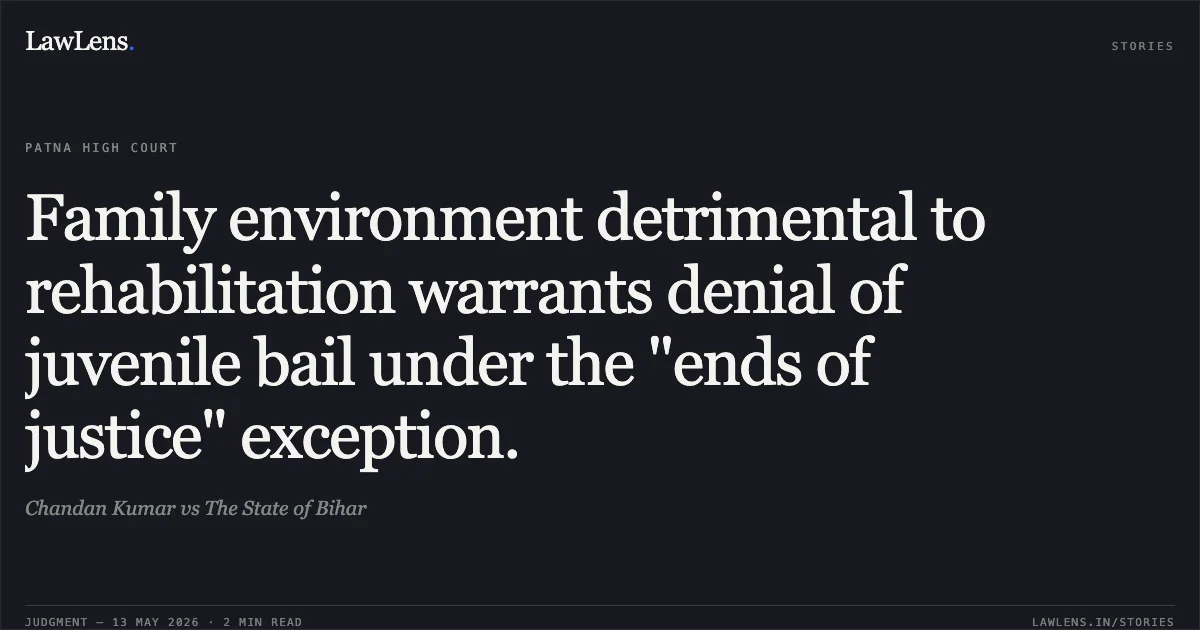
Source reference: para. 32The Court reasoned that releasing the child to a family currently facing serious criminal charges would be detrimental to his development, thus invoking the exception that the release would "defeat the ends of justice" by undermining his rehabilitation.
Source reference: para. 33Holding
The Court dismissed the appeal and upheld the denial of bail, holding that while the lower court's reasoning regarding the "seriousness of the crime" was legally unsustainable, the specific family circumstances justified detention in an Observation Home for the juvenile's best interest.
The Court directed the Children Court to conclude the trial within six months and ordered the return of lower court records.
Source reference: para. 36-37Acts & Sections Cited
11 provisions across 3 statutes referred to in this judgment. Each provision opens on LawLens.
Indian Penal Code, 18605
Arms Act, 19591
Juvenile Justice (Care and Protection of Children) Act, 2015.5
Original Court PDF
Chandan KumarvsThe State of Bihar
Click to open original judgment
Original judgment, available to read, download and summarize on LawLens.in