Facts
The petitioner’s father, a Constable (GD), died in harness on February 4, 2011
Source reference: para. 2The petitioner applied for a compassionate appointment, which the respondent authorities rejected because two of the petitioner's brothers were already in government service
Source reference: para. 2In a previous round of litigation (WPS No. 7039 of 2016), the High Court directed a factual inquiry to determine if the petitioner received financial support from his employed brothers
Source reference: para. 2Although the inquiry confirmed that the brothers provided no financial assistance, the respondents again rejected the petitioner’s application on November 25, 2020, citing Clause 3(8) of the compassionate appointment policy
Source reference: para. 2-3The petitioner challenged this rejection, seeking relaxation under a 2013 notification
Source reference: para. 1.2Issues
1. Whether a dependent is eligible for compassionate appointment under the State’s policy if other family members of the deceased government servant are already in government service
Source reference: para. 32. Whether the Court, under Article 226 of the Constitution, can direct an inquiry into the financial dependency of a claimant when the applicable policy expressly prohibits appointment due to the employment of another family member
Source reference: para. 7Law Applied
The Court primarily applied Clause 3(8) and Clause 6A of the Compassionate Appointment Policy, which stipulates that if any family member of a deceased government servant is already in government service, other dependents are ineligible for appointment
Source reference: para. 3, 5It relied on the Division Bench precedent in State of Chhattisgarh v. Muniya Bai (Writ Appeal No. 33 of 2022), which held that the policy does not envisage inquiries into the financial condition of family members
Source reference: para. 3, 5Furthermore, the Court followed the Full Bench decision in State of Chhattisgarh Ors. v. Umesh Thakur (Writ Appeal No. 236 of 2022), establishing that courts cannot reword or revise policy terms to mandate dependency inquiries when an express bar exists
Source reference: para. 7Reasoning
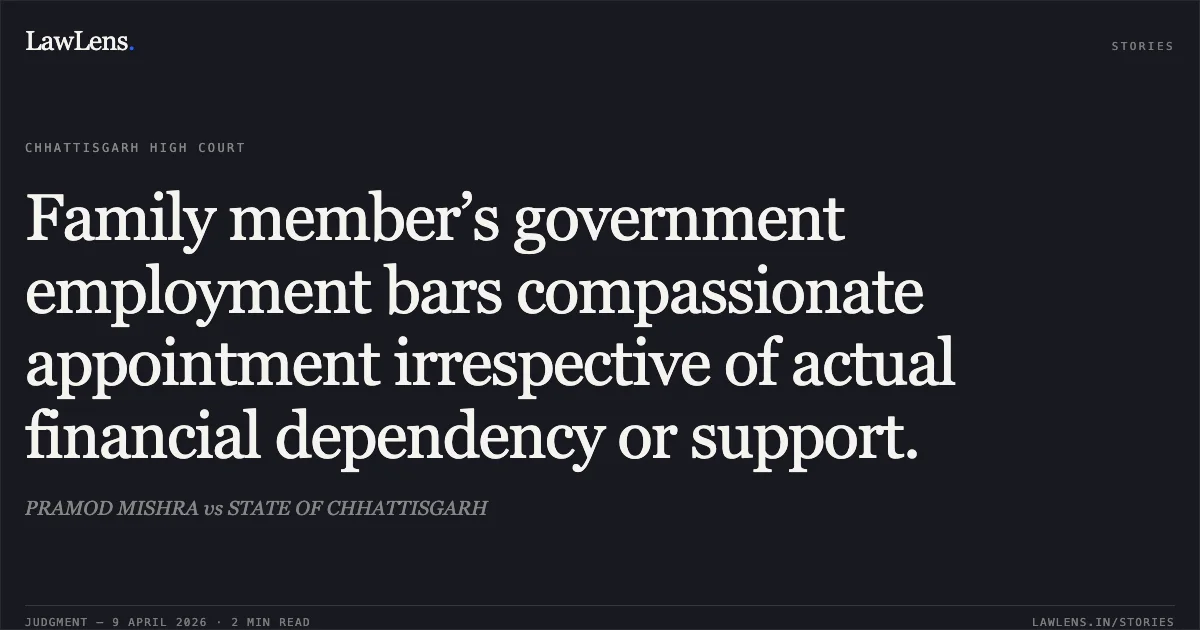
The Court reasoned that compassionate appointment is not a general right but a benefit governed strictly by the prevailing policy
Source reference: para. 8Under Clause 6A of the Scheme, the definition of "family" includes sons; since the petitioner’s brothers (sons of the deceased) were already government employees, the petitioner became ineligible regardless of their lack of financial support
Source reference: para. 5The Court emphasized the Full Bench's holding in Umesh Thakur, noting that once a policy bar is established, any judicial direction to conduct a "factual inquiry" into financial dependency amounts to an impermissible rewriting of the policy
Source reference: para. 7The petitioner’s plea regarding his brothers’ failure to maintain the family was deemed legally insufficient to bypass the express prohibitive conditions of the scheme
Source reference: para. 6Holding
The Court answered the issues in the negative, holding that the petitioner was ineligible for compassionate appointment due to the existing government employment of his brothers
The Court concluded that it cannot grant relief contrary to the express terms of the recruitment policy
Source reference: para. 8Consequently, the writ petition was dismissed as devoid of merit
Source reference: para. 9Original Court PDF
PRAMOD MISHRAvsSTATE OF CHHATTISGARH
Click to open original judgment
Original judgment, available to read, download and summarize on LawLens.in