Facts
The petitioner’s father, Sukhiram Usendi, served as a Head Constable and died in harness on 26.05.2017
Source reference: para. 1The petitioner, the son from the deceased's first marriage, applied for a compassionate appointment. His application was initially rejected in 2020, leading to a previous writ petition (WPS No. 1706 of 2021) where the court directed the authorities to inquire into the dependency aspect
Source reference: para. 1On 18.08.2021, Respondent No. 3 again rejected the claim on two grounds: the petitioner’s name was absent from service records, and his elder brother (from the deceased’s second marriage) was already in government service
Source reference: para. 1-2The petitioner contended that the elder brother lived separately and provided no financial assistance to him or his mother
Source reference: para. 2Issues
1. Whether a dependent is eligible for compassionate appointment under Clause 6A of the policy dated 29.08.2016 when another family member is already in government service
Source reference: para. 3, 52. Whether the High Court, under Article 226, can direct an inquiry into the financial dependency or lack of support from an already employed family member to bypass restrictive policy clauses
Source reference: para. 6Law Applied
The Court primarily applied Clause 6A of the compassionate appointment policy dated 29.08.2016 issued by the General Administration Department, Government of Chhattisgarh, which prohibits appointment if any family member is already in government service
Source reference: para. 3It relied on the Division Bench judgment in State of Chhattisgarh v. Muniya Bai (Writ Appeal No. 33 of 2022), which held that policies do not envisage inquiries into the financial condition of other members
Source reference: para. 3, 5It further followed the Full Bench decision in State of Chhattisgarh & Ors. v. Umesh Thakur (Writ Appeal No. 236 of 2022), which established that judicial interference to reword or rephrase policy terms regarding dependency is impermissible
Source reference: para. 6Reasoning
The Court reasoned that compassionate appointments are not a general right but are governed strictly by the prevailing executive policy
Source reference: para. 9Applying Clause 6A, the Court found that the admitted government employment of the petitioner's elder brother acted as an absolute bar to the petitioner’s claim
Source reference: para. 8The Court noted that the Full Bench in Umesh Thakur explicitly prohibited the use of Article 226 to mandate inquiries into whether an employed family member actually supports the dependents; such a direction would constitute an impermissible "rewording" or "rephrasing" of the policy
Source reference: para. 6Since the petitioner did not challenge the validity of the 2016 circular, the Court held it was bound to apply the policy as written, regardless of the petitioner's claim that his brother lived separately without providing financial aid
Source reference: para. 7-8Holding
The Court held that the petitioner was ineligible for compassionate appointment because his brother was already in government service
The Court answered that claims of non-support from an employed family member cannot bypass express policy prohibitions
Source reference: para. 7Consequently, the High Court dismissed the writ petition as devoid of merit
Source reference: para. 10Original Court PDF
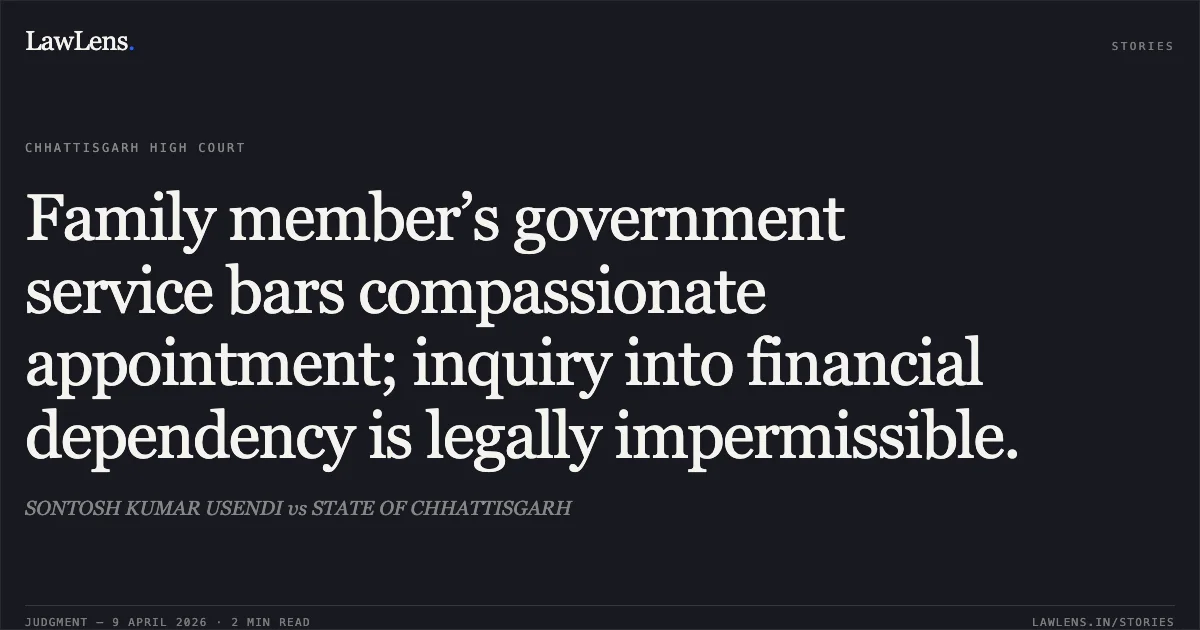
SONTOSH KUMAR USENDIvsSTATE OF CHHATTISGARH
Click to open original judgment
Original judgment, available to read, download and summarize on LawLens.in