Facts
The appeals arose from the same motor accident and challenged the judgment and award dated 13 December 2012 in M.A.C.P. No. 78 of 2009, by which the Motor Accident Claims Tribunal, Nainital, awarded ₹6,61,256 with interest at 7% per annum and fastened liability on Oriental Insurance Company.
Source reference: para. 2The Insurance Company contended that respondent no. 6, Sanjay Kumar, and not respondent no. 8, was driving the offending vehicle; it argued that Sanjay Kumar was a minor and did not possess a valid driving licence.
Source reference: paras. 4–5The Tribunal, relying principally on respondent no. 8’s testimony and driving licence, found that respondent no. 8 was driving at the time of the accident.
Source reference: paras. 9–10The claimants filed the connected appeal seeking enhancement, contending that the Tribunal had wrongly deducted family pension from the deceased’s income and had failed to award future prospects.
Source reference: paras. 15–18Issues
Whether the Tribunal correctly found that respondent no. 8, rather than respondent no. 6, was driving the offending vehicle at the time of the accident, thereby fastening liability on the Insurance Company?
Source reference: paras. 4–13Whether the family pension received by the claimants could be deducted while calculating the deceased’s loss of dependency?
Source reference: paras. 15–17Whether the claimants were entitled to an addition towards future prospects and, consequently, enhancement of compensation under the principles laid down in Pranay Sethi?
Source reference: paras. 18–20Law Applied
The Court applied the principles governing compensation under the Motor Vehicles Act, including the rule that proceedings before the Motor Accident Claims Tribunal are independent of criminal proceedings and that a criminal court’s judgment is not binding on the Tribunal; the standards of proof in the two proceedings are also different.
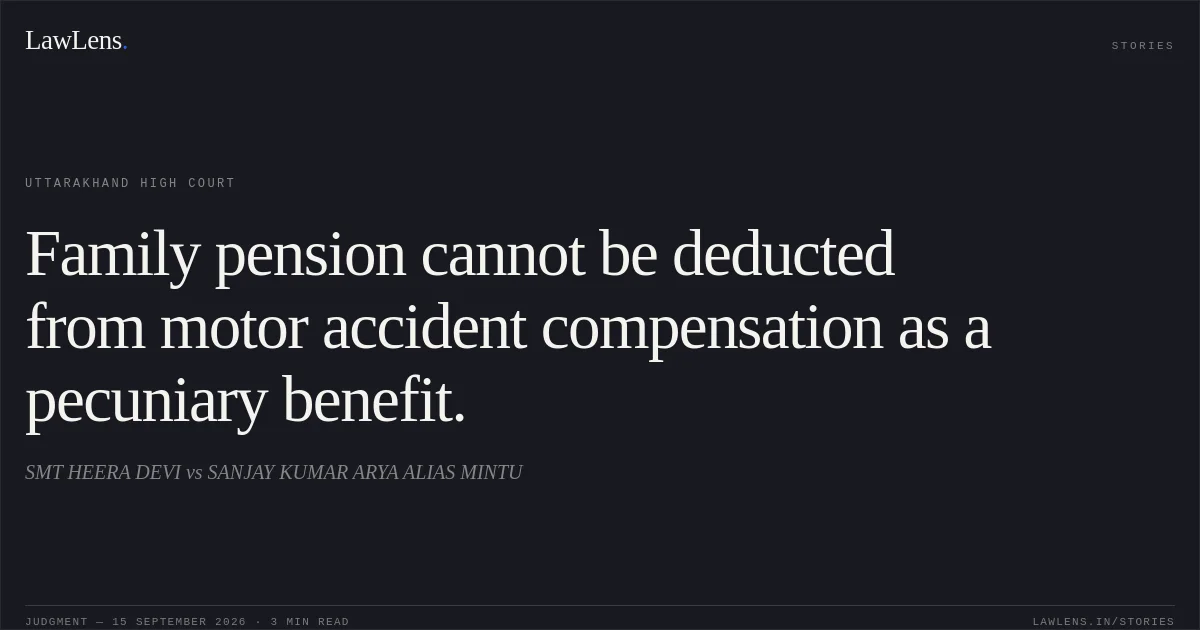
Source reference: para. 12Relying on Sebastiani Lakra v. National Insurance Co. Ltd., (2019) 17 SCC 465, the Court held that family pension is a service-related benefit and is not a pecuniary advantage arising from the accidental death; therefore, it cannot be deducted from the compensation.
Source reference: paras. 16–17Applying National Insurance Co. Ltd. v. Pranay Sethi, the Court held that eligible future prospects must be added having regard to the deceased’s age and nature of employment.
Source reference: paras. 18–19Compensation was accordingly assessed by deducting one-fourth towards personal expenses, applying a multiplier of 11, and awarding amounts under the conventional heads of consortium, loss of estate and funeral expenses.
Source reference: para. 20Reasoning
The Court upheld the Tribunal’s finding regarding the driver because respondent no. 8 had categorically testified that he was driving the vehicle and had produced his driving licence; the Insurance Company failed to elicit anything material in cross-examination or produce independent, cogent evidence proving that respondent no. 6 was the driver.
Source reference: paras. 9–11The acquittal of respondent no. 6 in the criminal case was insufficient to displace the Tribunal’s factual finding because the claim proceedings were independent and governed by a different standard of proof.
Source reference: paras. 11–13On quantum, the Court held that family pension could not be treated as an accidental-death benefit and therefore should not reduce the dependency claim.
Source reference: para. 17Taking the deceased’s monthly income as ₹17,019, the Court calculated annual income at ₹2,04,228, deducted one-fourth for personal expenses, added 30% towards future prospects for a deceased aged approximately 50 years, and applied the multiplier of 11. This produced a loss of dependency of ₹21,90,342, besides ₹2,00,000 for consortium, ₹15,000 for loss of estate and ₹15,000 for funeral expenses.
Source reference: para. 20Holding
The Insurance Company’s appeal, AO No. 100 of 2013, was dismissed because the finding that respondent no. 8 was driving the vehicle was neither perverse nor contrary to the evidence.
The claimants’ appeal, AO No. 299 of 2013, was allowed. The total compensation was enhanced from ₹6,61,256 to ₹24,20,342, with interest at 7% per annum, subject to adjustment of amounts already paid or deposited.
Source reference: paras. 20–21The Insurance Company was directed to deposit the enhanced amount with applicable interest before the Tribunal within eight weeks of production of a certified copy of the judgment; the statutory deposit was to be remitted for adjustment, after which the Tribunal was directed to disburse the amount in accordance with law.
Source reference: paras. 21–23Acts & Sections Cited
3 provisions across 1 statute referred to in this judgment. Each provision opens on LawLens.
Indian Penal Code, 18603
Original Court PDF
SMT HEERA DEVIvsSANJAY KUMAR ARYA ALIAS MINTU
Click to open original judgment
Original judgment, available to read, download and summarize on LawLens.in


