Facts
The applicant’s father, a retired Railway employee, died on 28 September 2010; her mother thereafter received family pension until her death on 18 May 2021.
Source reference: para. 2–3, 10The applicant had married in 1999.
Source reference: para. 2–3, 10After her husband went missing in 2011, a Family Court granted her judicial separation under Section 10 of the Hindu Marriage Act, 1955, on 19 December 2018.
Source reference: para. 2–3, 10Her husband was traced in 2022 and died on 19 July 2022.
Source reference: para. 2–3, 10The applicant sought family pension as a dependent, widowed or divorced daughter under Rule 75(6)(iii) of the Railway Services (Pension) Rules, 1993.
Source reference: para. 2–3, 10The Railway authorities rejected her claim, and she challenged the rejection order dated 12 June 2025 before the Tribunal.
Source reference: para. 2–3, 10Issues
Whether the applicant was eligible for family pension as a divorced or widowed daughter under Rule 75(6)(iii) of the Railway Services (Pension) Rules, 1993.
Source reference: para. 9Whether the rejection order dated 12 June 2025 was liable to be set aside as a non-speaking order.
Source reference: para. 9Law Applied
Rule 75(6)(iii) of the Railway Services (Pension) Rules, 1993, read with Railway Board Circular RBE No. 99/2013 dated 26 September 2013, governs family-pension eligibility for widowed or divorced daughters.
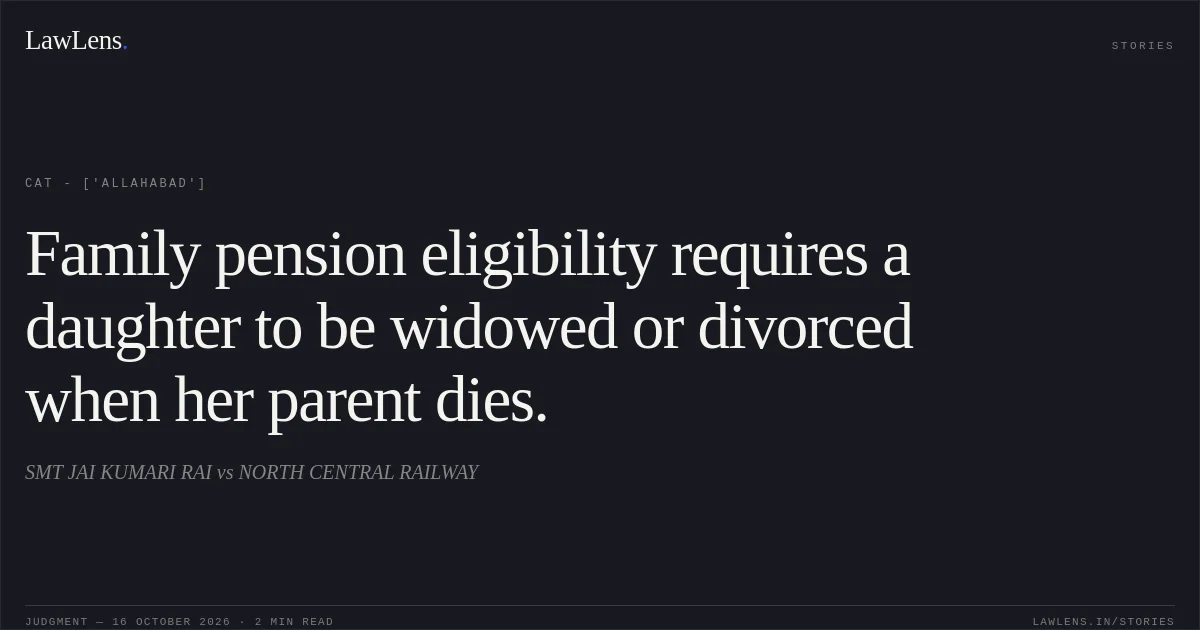
Source reference: para. 17–18The Tribunal applied the principle that the prescribed eligibility conditions must be met at the relevant parent’s death; a daughter whose husband is then alive does not qualify as a widow merely because she becomes widowed later.
Source reference: para. 17–18A decree of judicial separation under Section 10 of the Hindu Marriage Act, 1955, permits spouses to live separately but does not dissolve their marriage; dissolution occurs through a decree of divorce under Section 13.
Source reference: para. 11The Tribunal relied on Smt. Rukaiya Khatoon v. Union of India and Others, Writ-A No. 19022 of 2023, decided 9 November 2023, which upheld the requirement that eligibility be established at the parent’s death.
Source reference: para. 17–18Reasoning
The 2018 Family Court order was one of judicial separation, not divorce, and therefore did not make the applicant a divorced daughter.
Source reference: para. 11Her husband remained alive until 19 July 2022, after her mother’s death on 18 May 2021; she therefore did not meet the widowed-daughter condition at the relevant time, notwithstanding her separation from him or her dependency on her parents.
Source reference: para. 13–14, 18Applying Rukaiya Khatoon, the Tribunal held that later widowhood could not cure the failure to satisfy the eligibility condition at the relevant parent’s death.
Source reference: para. 17–18It also rejected the challenge to the order as non-speaking, finding that the authority had considered her claim under the applicable Rules and instructions.
Source reference: para. 20Holding
The Tribunal held that the applicant was neither divorced nor widowed at the relevant time and was therefore ineligible for family pension under Rule 75(6)(iii).
It found no basis to interfere with the rejection order, dismissed the Original Application as devoid of merit, and made no order as to costs; associated miscellaneous applications were also disposed of.
Source reference: para. 22Acts & Sections Cited
3 provisions across 2 statutes referred to in this judgment. Each provision opens on LawLens.
Administrative Tribunals Act, 19851
Hindu Marriage Act, 19552
Original Court PDF
SMT JAI KUMARI RAIvsNORTH CENTRAL RAILWAY
Click to open original judgment
Original judgment, available to read, download and summarize on LawLens.in