Facts
The applicant, Smt. Usha Sharma, filed an Original Application seeking family pension following the death of her husband, Late Mahatam Vishwakarma.
Source reference: no citationShe claimed to be his legally wedded wife, having married him in June 1985.
Source reference: p.2Prior to this, Late Mahatam Vishwakarma was married to Respondent No. 4, Smt. Ugna/Ugni Devi, in 1973.
Source reference: p.2The applicant asserted that Respondent No. 4 and her husband had decided to separate by consent due to Respondent No. 4's inability to bear children, and Respondent No. 4 provided an affidavit on January 10, 1986, permitting her husband to remarry.
Source reference: p.2Both the applicant and her deceased husband belonged to the Shudra Community, where divorce by consent is permissible.
Source reference: p.2The applicant and Late Mahatam Vishwakarma had three daughters and one son.
Source reference: p.2The service book of the deceased employee listed the applicant, his mother, and their children as dependents in a declaration made on September 27, 2005.
Source reference: p.2Respondent No. 4 had filed Suit No. 296 of 2009 for dissolution of her marriage, which resulted in a decree acknowledging the divorce by custom in 1983.
Source reference: p.2Upon his retirement on May 31, 2014, Late Mahatam Vishwakarma inadvertently named Respondent No. 4 as his wife in the pension form.
Source reference: p.3After this, the official respondents noticed the absence of Respondent No. 4's details in the service book and sought an explanation via letter dated January 5, 2015.
Source reference: p.3The deceased employee replied on March 12, 2015, requesting the applicant's name be entered as his wife, but he passed away on April 22, 2015, before further action could be taken.
Source reference: p.3Subsequently, Respondent No. 2 demanded a succession certificate from the applicant through letters dated July 7, 2015, and July 24, 2015.
Source reference: p.3Respondent No. 4 contested the applicant's claims, asserting that the affidavit and court order of divorce were forged, and she never consented to the divorce or participated in Suit No. 296 of 2009.
Source reference: p.4She noted that her name was recorded and intact in the deceased's service record and that he himself filled out pension forms in 2014, nominating her for family pension.
Source reference: p.5She further stated that a registered will dated April 29, 2011, declared that the applicant and their daughters would not receive service benefits, which were instead bequeathed to a daughter born from Smt. Ugni alias Ugna Devi (Respondent No. 4).
Source reference: p.5The official respondents maintained that the applicant was asked for a succession certificate because she could not prove herself to be the legally wedded wife, and the BSNL is not competent to weigh evidence regarding marital status.
Source reference: p.6They emphasized that the deceased's marriage to Respondent No. 4 was dissolved only on October 20, 2010, meaning any prior marriage to the applicant was illegal.
Source reference: p.7They also highlighted that family pension is not a debt or security, and thus, insistence on a succession certificate is unsustainable.
Source reference: p.9, 11-13Issues
1. Whether the applicant, Smt. Usha Sharma, was the legally wedded wife of Late Mahatam Vishwakarma, thereby entitling her to family pension?
Source reference: p.7, 112. Whether the production of a succession certificate can be insisted upon for the grant of family pension?
Source reference: p.6, 9, 11-133. Whether the will (वसीयत नामा दिनांकित 29.04.2011) of Late Mahatam Vishwakarma could validly exclude the applicant from receiving family pension?
Source reference: p.5Law Applied
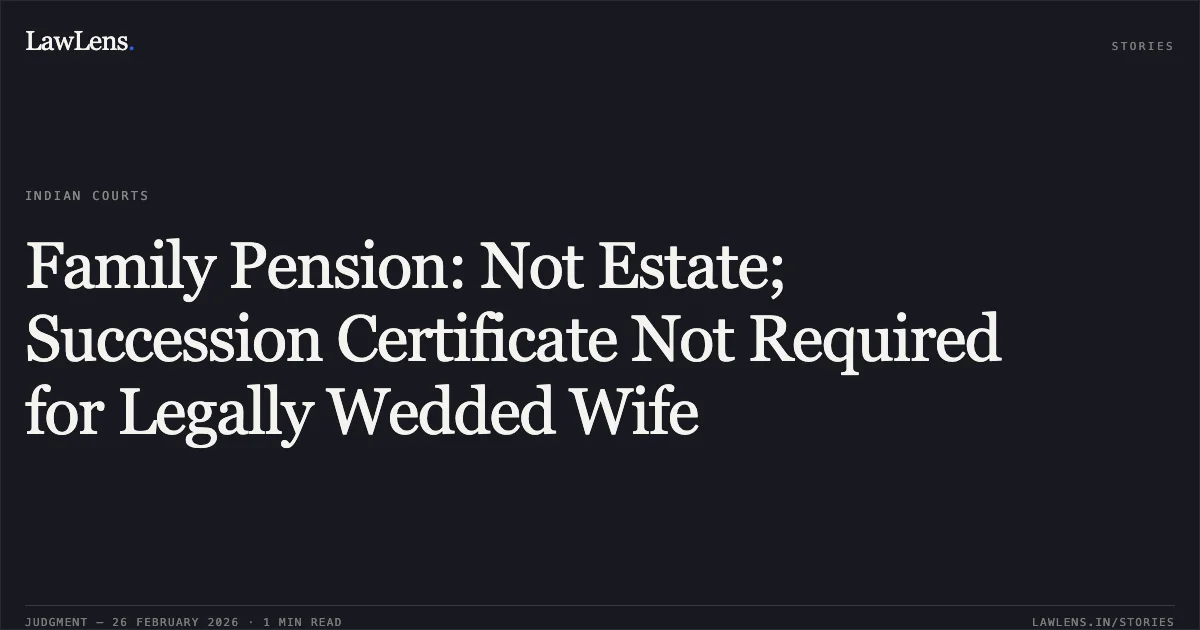
The court primarily applied the principle that family pension, being a welfare scheme, is not property or part of the deceased's estate, and therefore, an employee cannot dispose of it through a will or testamentary disposition.
Source reference: no citationThis was established through judicial precedents, including Jodh Singh v. Union of India [(1980) 4 SCC 306], which stated that what is not payable during the lifetime of the deceased, and over which he has no power of disposition, cannot form part of his estate.
Source reference: p.8This principle was reaffirmed in Smt. Violet Issaac and others v. Union of India and others [(1991) 1 SCC 725] and Nitu v. Sheela Rani and Ors. [2016 KHC 6646], which held that family pension does not form part of the deceased's estate, and thus, an employee cannot exclude their lawful beneficiaries by will.
Source reference: p.8Furthermore, Salma Beevi v. Administrative Officer, Cochin & Ors [2014(3) KHC 820] clarified that family pension is neither a debt nor security, hence a succession certificate cannot be insisted upon for its receipt.
Source reference: p.9, 11-13The court also acknowledged the Hindu law custom in the Shudra Community, where divorce by consent or abandonment, even without formal court decree, could lead to a valid remarriage, as noted in M. Govindaraju v. K. Munisami Gounder(D) and others [AIR 1997 SC 10].
Source reference: p.15-16Reasoning
The Court analyzed the case by first addressing the legal precedents regarding family pension and succession certificates.
Source reference: no citationIt noted that the Kerala High Court, in Union of India Vs. S. Sathikumari Amma [LAWS (KER) 2025 - 1-109], relying on Jodh Singh and Voilet Issac, explicitly held that a succession certificate is not required for family pension as it is not part of the deceased's estate.
Source reference: p.10The Salma Beevi judgment further solidified this, stating that family pension is a welfare scheme and not subject to nomination or testamentary disposition by the employee, and therefore, production of a succession certificate cannot be mandated.
Source reference: p.10This directly contradicts the official respondents' demand for a succession certificate from the applicant.
Source reference: p.6However, despite acknowledging these crucial legal principles, the court found that the applicant failed to clearly establish herself as the "legally wedded wife" of Late Mahatam Vishwakarma at the time of his passing.
Source reference: p.11The court observed that while the applicant presented evidence of long cohabitation and children, and her husband's attempt to update the pension form to include her name, there was a dispute regarding the validity and authenticity of the divorce decree between Late Mahatam Vishwakarma and Respondent No. 4, and the affidavit purportedly given by Respondent No. 4 allowing remarriage.
Source reference: p.4, 7-8, 11The official respondents highlighted that the marriage between Late Mahatam Vishwakarma and Respondent No. 4 was dissolved only on October 20, 2010, implying any prior marriage to the applicant would have been illegal.
Source reference: p.7The court also noted that Late Mahatam Vishwakarma had neither formally informed his employer about the dissolution of his first marriage nor the subsequent marriage to the applicant, which weakened her claim.
Source reference: p.11Despite the ruling in Radha Devi (exercising Article 142 powers) recognizing a second wife's entitlement due to long cohabitation, and the M. Govindaraju case on Shudra divorce customs, the court concluded that the facts of the present case did not clearly support the applicant's claim of being the legally wedded wife entitled to family pension.
Source reference: p.13-14, 15-16, 11The evidence presented by the applicant, including the alleged affidavit from Respondent No. 4 and the court decree, was challenged as forged or mechanically obtained without due process.
Source reference: p.4-5Holding
The Original Application was dismissed.
The court held that while a succession certificate is not required for family pension, the applicant failed to prove that she was the legally wedded wife of Late Mahatam Vishwakarma.
Source reference: p.11The court found no basis to grant the relief claimed by the applicant, concluding that the facts and case laws, in this specific instance, did not support her claim to family pension.
Source reference: p.11Acts & Sections Cited
2 provisions across 2 statutes referred to in this judgment. Each provision opens on LawLens.
Administrative Tribunals Act, 19851
Indian Succession Act, 19251
Original Court PDF
Smt. Usha Sharma v. Bharat Sanchar Nigam Ltd. and Ors. O.A./585/2016
Click to open original judgment
Original judgment, available to read, download and summarize on LawLens.in