Facts
The Applicant (Respondent No. 1), a driver, filed for compensation under the Employee’s Compensation Act, 1923, following an accident on August 13, 2002, which resulted in significant leg injuries and loss of earning capacity.
Source reference: para. 4The vehicle owner (Opposite Party/Respondent No. 2), who is the Applicant's father, admitted to the employer-employee relationship and the payment of a monthly wage of Rs. 4,000.
Source reference: para. 5The Insurance Company (Appellant) contested the claim, alleging that the relationship was fabricated and the proceedings were a collusive effort between father and son to defraud the public insurer.
Source reference: para. 6, 11The Commissioner for Workmen’s Compensation allowed the application, awarding Rs. 5,20,584 with 12% interest.
Source reference: para. 9The Appellant challenged this order under Section 30 of the Act.
Source reference: para. 1Issues
1. Whether the evidence regarding the employment of the Applicant was bogus and unreliable.
Source reference: para. 10, 222. Whether the father and son concocted the story of employment for illicit gains, rendering the proceedings collusive.
Source reference: para. 10, 22Law Applied
The court applied Section 30 of the Employee’s Compensation Act, 1923, which mandates that appeals only lie on substantial questions of law.
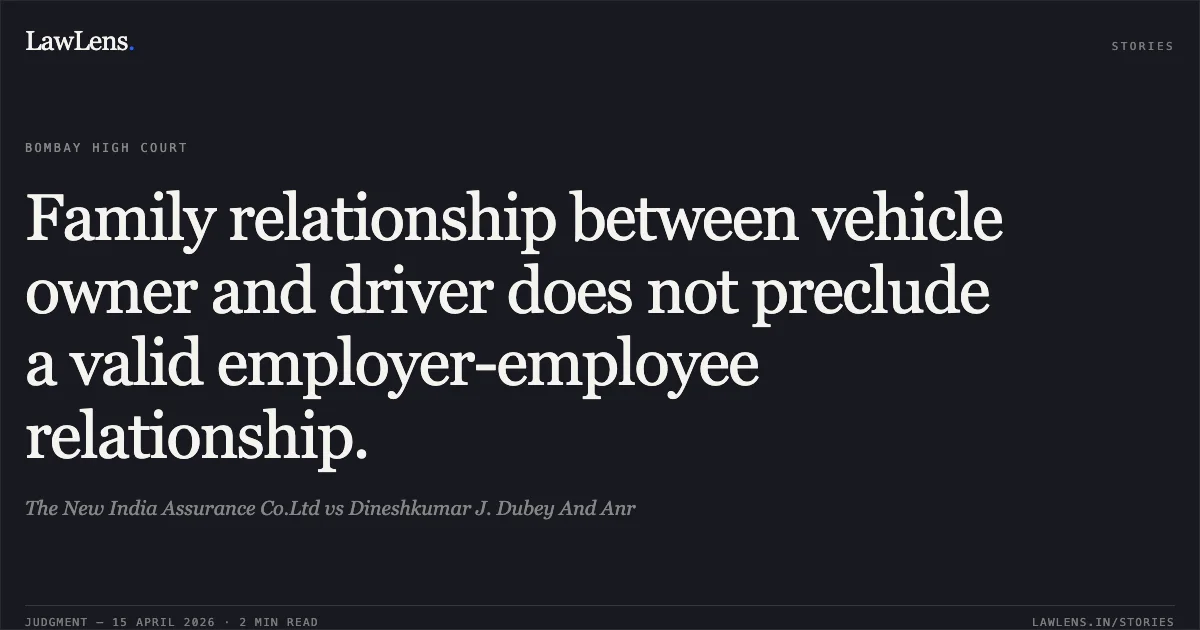
Source reference: para. 10, 18The court relied on the principle established in T.S. Shylaja v. Oriental Insurance Co. Ltd. (2014) and Chitrarekha Chandrarao Chaudhari v. C.R. Chaudhari, holding that a familial relationship between the owner and the driver does not legally preclude an employer-employee relationship.
Source reference: para. 26, 28In family-run businesses, the absence of written contracts or formal documentation for wage payments is common and does not inherently negate the existence of a legal employment relationship.
Source reference: para. 26, 29Reasoning
The Court rejected the Appellant's contention that the lack of documentary evidence of salary proved collusion, reasoning that in the natural course of family-run operations, formal documentation is rarely maintained.
Source reference: para. 31The Court emphasized that the employer (the father) had explicitly admitted the employment and the wage amount in his written statement and provided a Wage Certificate.
Source reference: para. 32Under the law, once an employer admits the relationship and the accident occurs in the course of employment, the burden of proof shifts to the insurer to disprove it.
Source reference: para. 27The Appellant failed to lead any evidence to prove collusion or gainful employment elsewhere.
Source reference: para. 33, 38The Court distinguished Manjusha Others v. United India Assurance Co. Ltd., noting that unlike that case, the employment here was both specifically pleaded and substantiated by oral testimony and written admissions.
Source reference: para. 36-37Holding
The High Court dismissed the appeal and upheld the Commissioner's Judgement and Order dated February 28, 2007.
The Court held that the employer-employee relationship was sufficiently proved through admissions and evidence, regardless of the familial ties between the parties.
Source reference: para. 39The Appellant was ordered to comply with the original direction to deposit the compensation amount with interest.
Source reference: para. 9, 41No order as to costs was made.
Source reference: para. 41Acts & Sections Cited
1 provisions across 1 statute referred to in this judgment. Linked provisions open on LawLens.
Employee1
Original Court PDF
The New India Assurance Co.LtdvsDineshkumar J. Dubey And Anr
Click to open original judgment
Original judgment, available to read, download and summarize on LawLens.in