Facts
The prosecution alleged that on the night of June 11, 1992, miscreants entered the house of Pramila Devi (informant), committed dacoity, and shot dead her daughter, Rekha Kumari
Source reference: p. 2The First Information Report (FIR) was lodged against unknown persons
Source reference: p. 8During the trial, the prosecution examined eleven witnesses, including the father (P.W. 1) and sisters (P.W. 3 and 4) of the deceased
Source reference: p. 3-4While P.W. 1, 3, and 4 named the appellant during their court testimony, they had failed to name him in their initial statements to the police, only identifying him ten days later during supervision by the Superintendent of Police
Source reference: p. 7-8The Trial Court convicted the appellant under Section 396 of the Indian Penal Code (IPC) and sentenced him to life imprisonment
Source reference: p. 1-2The appellant challenged this on grounds of delayed identification, lack of light at the crime scene, and non-examination of the Investigating Officer (I.O.)
Source reference: p. 7Issues
1. Whether the delayed identification of the appellant by witnesses who were previously acquainted with him, without a reasonable explanation for the silence, renders the prosecution's case doubtful.
Source reference: para. 30-332. Whether the non-examination of the Investigating Officer and the informant caused material prejudice to the defense.
Source reference: para. 35-373. Whether the conviction can be sustained in the absence of a proven source of light for identification at the time of the occurrence.
Source reference: para. 38-40Law Applied
The court applied Section 396 of the IPC regarding dacoity with murder
Source reference: p. 2It relied on the principle from Gayadin v. State of M.P. (2005) that witnesses questioned after a significant delay without explanation may be considered "planted"
Source reference: para. 32It followed Govind Mandavi v. State of Chattisgarh (2025) regarding the "belated introduction" of an accused's name due to prior enmity
Source reference: para. 33It applied the rule from Tahsildar Singh v. State of U.P. (1959) and Sections 145 and 155 of the Evidence Act, stating that material improvements in testimony must be confronted with previous police statements via the I.O. to impeach witness credibility
Source reference: para. 34-35It cited Anjani Singh v. State of U.P. (2026) regarding the benefit of doubt when identification occurs in the dark without a proven light source
Source reference: para. 39Reasoning
The High Court found the prosecution's case fundamentally flawed due to the "delayed naming" of the appellant. Despite being a neighbor with known prior enmity, the witnesses did not name the appellant in the FIR or initial Section 161 statements, introducing his name only after ten days
Source reference: para. 25, 30The court observed that the informant was never examined, and the FIR was only formally proved by a court clerk, making it a document of low evidentiary value
Source reference: para. 36Critically, the non-examination of the I.O. prevented the defense from eliciting contradictions between the witnesses' initial silence and their subsequent incriminating testimonies in court
Source reference: para. 35The court also noted the lack of any physical evidence or seized material proving a source of light existed at 2:00 AM to allow for certain identification
Source reference: para. 40Consequently, the improvements in the witnesses' testimonies appeared to be "clear manipulation" devised due to prior business rivalry
Source reference: para. 33Holding
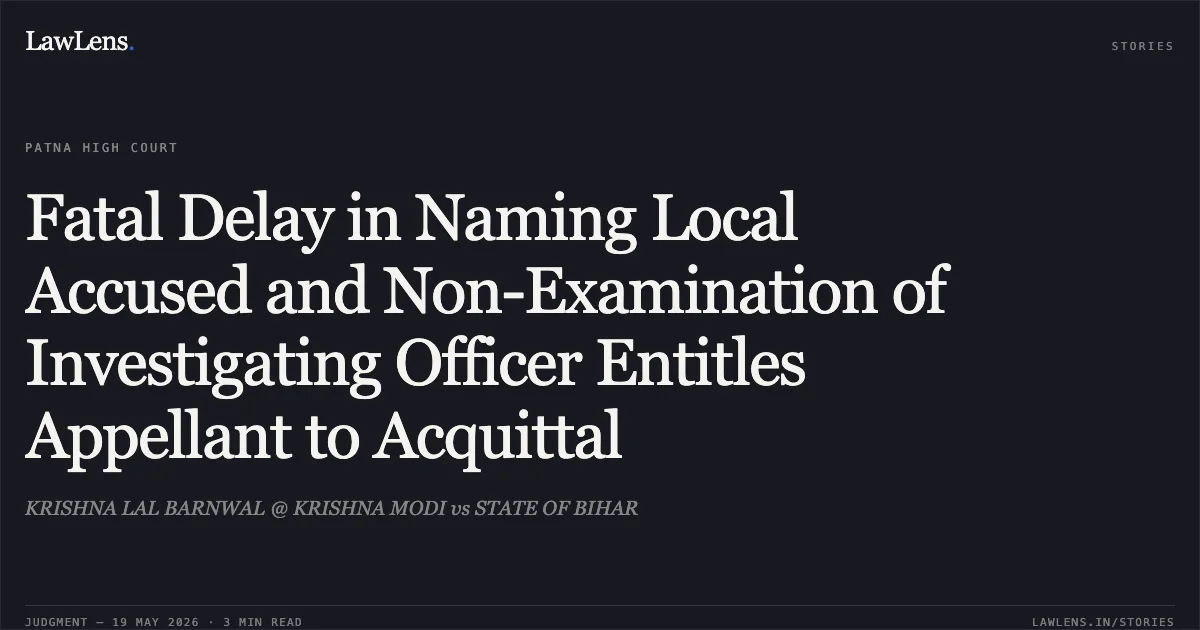
The court answered the issues in the affirmative, holding that the prosecution failed to prove the case beyond a reasonable doubt.
The court held that the material improvements in witness testimony, the lack of an identification source, and the prejudice caused by the non-examination of the I.O. entitled the appellant to the benefit of the doubt
Source reference: para. 37-41The appeal was allowed, the judgment of conviction and sentence dated 27.02.1999 and 09.03.1999 were set aside, and the appellant was acquitted of all charges under Section 396 IPC
Source reference: para. 42The court ordered the appellant's immediate release and discharge from bail bonds
Source reference: para. 43Acts & Sections Cited
1 provisions across 1 statute referred to in this judgment. Each provision opens on LawLens.
Indian Penal Code, 18601
Original Court PDF
KRISHNA LAL BARNWAL @ KRISHNA MODIvsSTATE OF BIHAR
Click to open original judgment
Original judgment, available to read, download and summarize on LawLens.in