Facts
The parties married on 26 September 2011 and had two children: a son born in 2013 and a daughter born in 2019. The mother left the matrimonial home in 2018 while pregnant and thereafter remained the primary caregiver of both children. The parties initiated several custody and related proceedings, which were transferred to the Family Court, Patiala House Courts, New Delhi.
Source reference: paras. 7–13The mother, an academician, changed employment and locations while attempting to secure financial stability for herself and the children; she subsequently obtained employment at the University of Hull, United Kingdom.
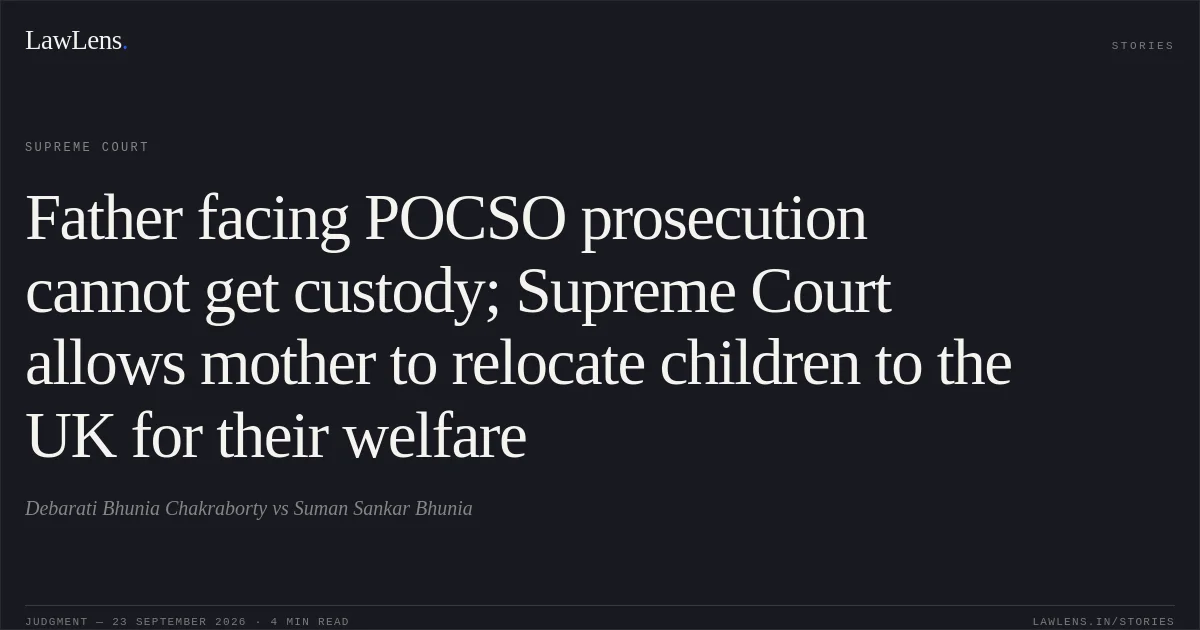
Source reference: paras. 12, 17The Family Court declared the father the sole custodian of the children and granted the mother visitation rights. The High Court of Delhi affirmed that decision, rejected the mother’s request to relocate the children to the United Kingdom, and held that custody with the father would best serve the children’s interests.
Source reference: paras. 3–5, 21–22During the proceedings, the son disclosed alleged sexual abuse by the father at NIMHANS, resulting in registration of a POCSO FIR and filing of a chargesheet against the father. The proceedings arising from that FIR remained pending before the Calcutta High Court.
Source reference: paras. 18–20The Supreme Court interacted with the parties and children and subsequently arranged supervised visitation between the father and the children. The counsellors’ reports recorded the children’s persistent reluctance, fear, emotional distress, and avoidance of interaction with the father, together with their preference to remain with the mother.
Source reference: paras. 24–28Issues
Whether custody of the minor children should be granted to the father when the son had disclosed alleged sexual abuse by him, a chargesheet had been filed under the POCSO Act, and the children exhibited marked fear and reluctance to interact with him?
Source reference: paras. 46, 52–57Whether the mother’s frequent changes of employment and residence justified characterising her conduct as a “nomadic lifestyle” and denying her custody?
Source reference: paras. 44–45, 50Whether relocation of the children to the United Kingdom with their mother would be contrary to their welfare and best interests?
Source reference: paras. 51, 58–62Whether the children’s wishes, emotional condition, safety, and established relationship with the primary caregiver were required to be given due weight in determining custody?
Source reference: paras. 32, 55–60Law Applied
The Court applied Sections 7 and 25 of the Guardians and Wards Act, 1890, under which guardianship and custody must be determined by the welfare and best interests of the minor children.
Source reference: no citationIt relied on the principles in Section 3(iii), (iv), (vi), and (ix) of the Juvenile Justice (Care and Protection of Children) Act, 2015: the child’s right to be heard, the paramountcy of the child’s best interests, the principle of safety from harm or abuse, and the non-waiver of the child’s rights.
Source reference: para. 55The Court held that allegations of sexual abuse, particularly where they had led to a chargesheet under the POCSO Act, could not be disregarded in a custody determination; the safety and welfare of the child take precedence over a parent’s claim to custody.
Source reference: paras. 54–57It further applied the principle that financial capacity, emotional continuity, sibling unity, the child’s wishes, and the quality of the caregiving environment are relevant to determining welfare, while relocation cannot be rejected merely on the presumption that children will lose their cultural identity.
Source reference: paras. 49–51, 60Reasoning
The Court found that the mother had been the children’s primary caregiver for several years and that the children had developed a strong emotional bond with her. Her employment changes were viewed not as evidence of instability but as efforts to obtain suitable employment and provide financial security, particularly in the context of the parties’ continuing litigation and the father’s alleged interference through numerous RTI applications.
Source reference: paras. 44–45, 50The Court considered the son’s disclosure at NIMHANS, the resulting FIR and chargesheet, and the counsellors’ reports documenting the children’s fear, avoidance, and distress in the father’s presence. It held that the High Court had acted improperly by commenting on the credibility of the POCSO allegations while the criminal proceedings were pending; those observations were premature and prejudicial and were therefore expunged.
Source reference: paras. 52–54In light of the statutory principles of participation, best interests, and safety, the Court concluded that custody with a parent facing prosecution for alleged sexual abuse would be inconsistent with the children’s welfare and could impede the son’s ability to give a free and fair deposition.
Source reference: paras. 55–57The proposed relocation was considered beneficial because the mother had secured respectable employment and better financial prospects in the United Kingdom, and no presumption could be made that relocation would destroy the children’s cultural identity.
Source reference: paras. 49–51, 60–61Holding
The Supreme Court allowed the mother’s appeals and made the interim stay against the Family Court and High Court judgments absolute until disposal of the appeals.
It permitted the mother, for the present, to take both children to the United Kingdom and admit them to a suitable school.
Source reference: para. 62(ii)–(iii)She was directed to file details of their schooling within six weeks and furnish an undertaking to produce the children before the Supreme Court or any other competent court whenever required.
Source reference: para. 62(iii)–(iv)The Court held that the father, while facing prosecution under the POCSO Act, could not be entrusted with custody of the children.
Source reference: paras. 53–57, 62(v)The High Court’s observations questioning the veracity of the POCSO allegations were expunged and directed not to influence the pending criminal proceedings.
Source reference: paras. 53–57, 62(v)The appeals were directed to be listed in January 2027.
Source reference: para. 63Acts & Sections Cited
3 provisions across 2 statutes referred to in this judgment. Each provision opens on LawLens.
Guardians and Wards Act, 18902
Juvenile Justice (Care and Protection of Children) Act, 2015.1
Original Court PDF
Debarati Bhunia ChakrabortyvsSuman Sankar Bhunia
Click to open original judgment
Original judgment, available to read, download and summarize on LawLens.in