01Facts
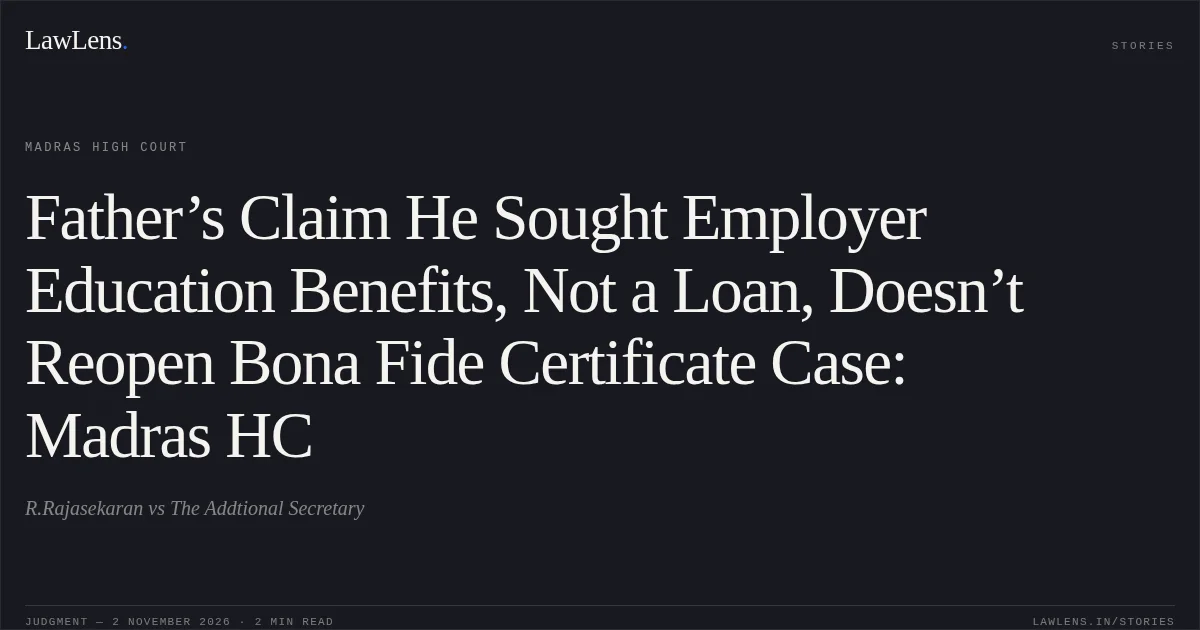
The petitioner sought review of the order dismissing his writ appeal, which had upheld dismissal of his writ petition challenging an order of the Chief Educational Officer.
¶ 1–2, 4–6The writ petition concerned a request for a bona fide certificate relating to his children’s education.
¶ 1–2, 4–6The petitioner contended in review that he had not sought a certificate to obtain an educational loan, but to claim education-related benefits from his employer.
¶ 1–2, 4–6The writ appeal had been dismissed after the Court considered the multiple proceedings between the petitioner and his wife, including pending custody proceedings, and concluded that there was no valid ground to interfere with the Single Judge’s order.
¶ 502Issues
i.1. Whether the petitioner’s contention that the order wrongly described his purpose as obtaining an educational loan disclosed a ground for review.
¶ 2, 6–7ii.2. Whether the review application could be used to reopen or rehear matters already considered in the writ appeal.
¶ 703Law Applied
Section 114 and Order XLVII, Rule 1 of the Code of Civil Procedure provide for review on limited grounds; review is not an appeal in disguise and does not permit rehearing of the matter.
¶ 7The Court relied on Malleeswari v. K. Suguna, 2025 SCC OnLine SC 1927, for the principle that a review court does not sit in appeal over its own order and that rehearing is impermissible.
¶ 7The judgment refers to “Order XVII, Rule 1” when describing the review parameters, although the application itself was brought under Order XLVII, Rule 1 and 2 read with Section 114 CPC.
case heading · ¶ 7Provisions in the judgment · 1 · Linked ones open on LawLens
Code of Civil Procedure, 1908 Section 114
04Reasoning
The Court treated the petitioner’s clarification about seeking employer benefits rather than an educational loan as insufficient to establish a review ground.
¶ 6It noted that the Single Judge and the writ appeal court had considered the broader context, including the parties’ multiple litigations, the child’s custody with the mother, and the pending custody application; the petitioner had been given liberty to raise the relevant issues in the pending proceedings.
¶ 6In light of the restricted scope of review and the prohibition on rehearing, the asserted misdescription did not warrant review of the appellate order.
¶ 705Holding
The Court held that the ground raised did not fall within the permissible scope of review.
¶ 7–8The Court dismissed the review application.
¶ 7–8Original Court PDF
R.RajasekaranvsThe Addtional Secretary
Click to open original judgment
Original judgment, available to read, download and summarize on LawLens.in