Facts
The petitioner filed a complaint under Section 138 of the Negotiable Instruments Act, 1881 (NI Act) following the dishonor of four cheques totaling ₹20 lakhs, which were issued to repay a friendly loan.
Source reference: paras. 3–4During the proceedings, the parties settled for ₹20 lakhs; however, the respondent defaulted after paying ₹13.50 lakhs.
Source reference: paras. 5, 7The Metropolitan Magistrate initially ordered the recovery of the balance as a fine via land revenue arrears.
Source reference: para. 6Subsequently, on November 17, 2022, the Trial Court stayed the criminal proceedings, citing an interim moratorium initiated against the respondent under Section 96 of the Insolvency and Bankruptcy Code, 2016 (IBC) by the NCLT.
Source reference: para. 8The petitioner challenged this stay order before the High Court.
Source reference: para. 9Issues
1. Whether an interim moratorium under Section 96 of the IBC operates as a bar or stay on criminal proceedings initiated under Section 138 of the NI Act.
Source reference: para. 16Law Applied
Section 96 of the Insolvency and Bankruptcy Code, 2016, which mandates an interim moratorium on "legal action or proceedings in respect of any debt" upon the filing of an insolvency application.
Source reference: para. 18The precedent established by the Supreme Court in Rakesh Bhanot v. Gurdas Agro (P) Ltd. (2025), which clarified that the moratorium provisions of the IBC are intended to postpone civil debt recovery and do not encompass criminal prosecutions intended to maintain commercial discipline.
Source reference: paras. 20–21Reasoning
The court examined whether the statutory stay on "proceedings in respect of any debt" under Section 96 of the IBC extends to the penal nature of the NI Act.
Source reference: para. 19Relying on the Rakesh Bhanot ruling, the court reasoned that Section 138 proceedings are criminal in nature and serve a deterrent purpose to preserve the integrity of negotiable instruments.
Source reference: para. 21The court found that the objects of the IBC and the NI Act operate in distinct fields; while the IBC manages insolvency and civil liability, personal criminal responsibility for dishonored cheques persists regardless of the insolvency outcome.
Source reference: para. 21The court found that the Trial Court’s reliance on the NCLT’s moratorium order to halt a criminal trial was a legal error.
Source reference: para. 22Holding
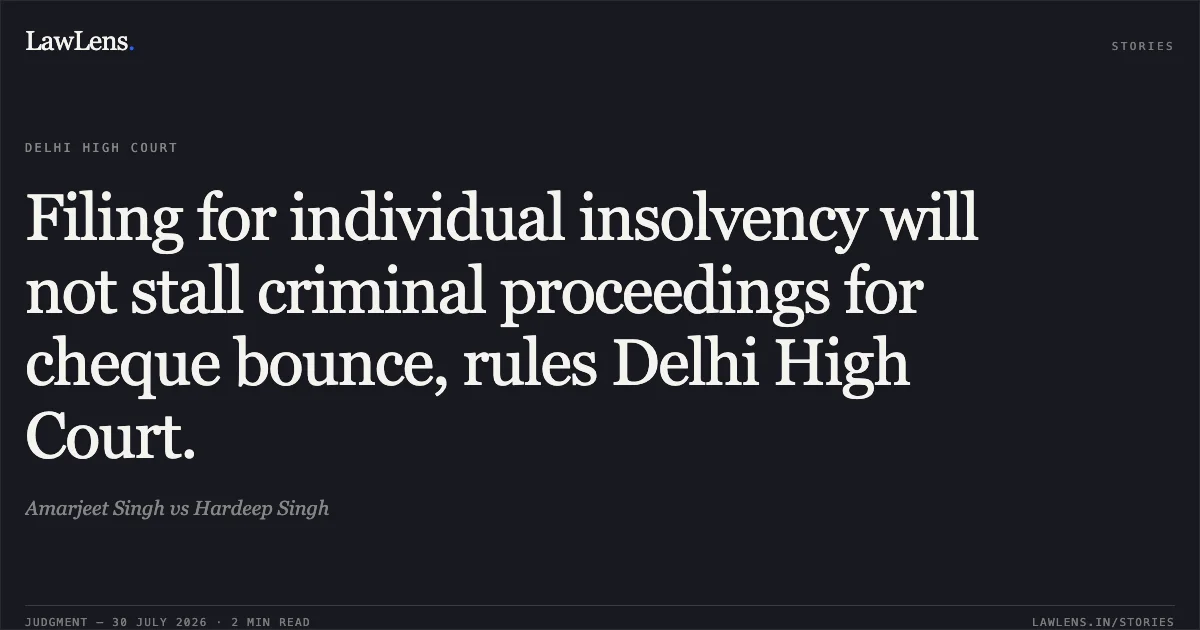
The court answered the issue in the negative, holding that a moratorium under Section 96 of the IBC does not constitute a valid ground for staying a complaint under Section 138 of the NI Act.
The High Court set aside the impugned order dated November 17, 2022, and restored the complaint proceedings to the Trial Court's file, directing it to proceed in accordance with the law.
Source reference: paras. 25–26Original Court PDF
Amarjeet SinghvsHardeep Singh
Click to open original judgment
Original judgment, available to read, download and summarize on LawLens.in


