Facts
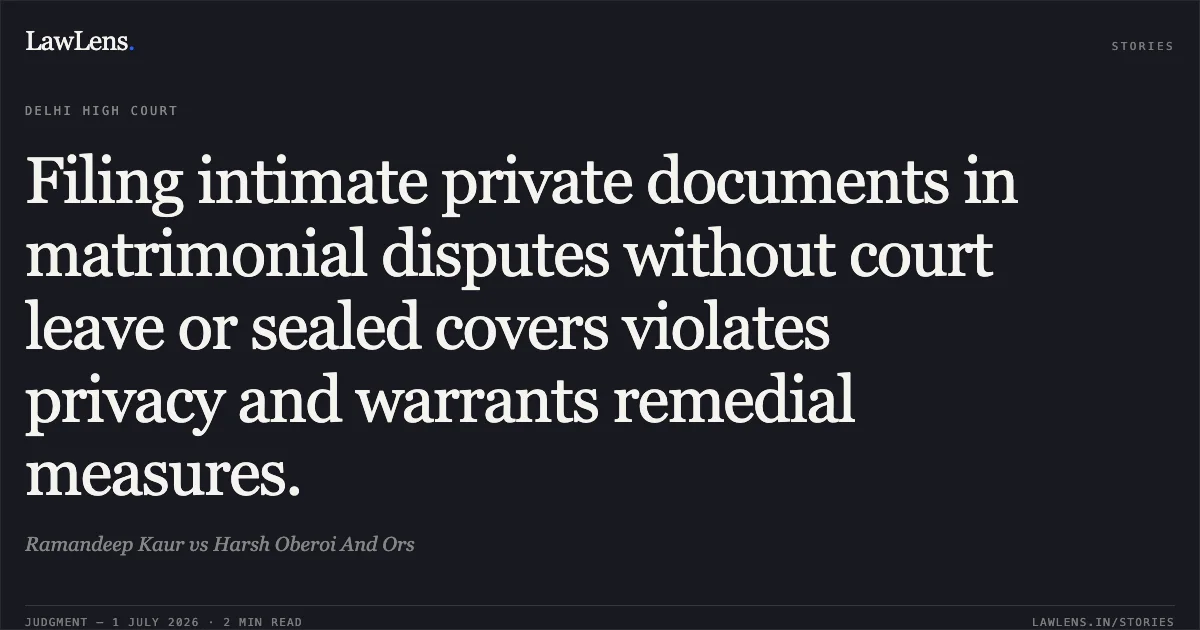
The petitioner filed for contempt against her estranged husband and his legal counsel for violating privacy guidelines established in a 2015 Delhi High Court judgment
Source reference: para 1During matrimonial proceedings, the respondents filed unredacted, intimate photographs of the petitioner as annexures to a divorce petition without seeking leave from the court or placing them in a sealed cover
Source reference: paras 5-6The petitioner initially sought relief under the Domestic Violence Act, which was dismissed, leading to this contempt petition
Source reference: paras 7-8The respondents argued they were unaware of the specific 2015 directions and tendered an unconditional apology
Source reference: paras 9-10Issues
1. Whether the act of filing intimate personal photographs in matrimonial pleadings without judicial leave constitutes willful disobedience of the court’s standing guidelines on privacy
Source reference: paras 8, 122. Whether the respondents should be penalized under the Contempt of Courts Act, 1971, or if their apology and remedial measures are sufficient to purge the contempt
Source reference: paras 14, 15Law Applied
The court applied the general directions established in MAT.APP.(F.C.) No. 78/2015, which mandate that sensitive personal documents in matrimonial disputes must be submitted in sealed covers with prior court leave to protect the right to privacy and dignity
Source reference: para 1, 31The court further considered the Contempt of Courts Act, 1971, specifically regarding the "willful" nature of disobedience
Source reference: para 14Section 11 of the Family Courts Act, 1984, which empowers courts to hold in camera proceedings and anonymize parties to protect privacy
Source reference: para 31(v)Reasoning
The court found that while the respondents committed a "significant lapse" by filing intimate images, the element of "willful disobedience" was not established because the 2015 guidelines were general and not issued in a case involving these specific parties
Source reference: para 12The court noted that the respondents did not attempt to justify their actions; instead, they filed an application to seal the records and offered an unconditional apology, which the court viewed as an effort to purge the lapse
Source reference: paras 13-14The court emphasized that the lawyers (Respondents 2 and 3) held a specific duty of circumspection, stating that a client’s zeal cannot justify sacrificing an opponent's dignity
Source reference: paras 17-18The court observed that "weaponization of private images" is a growing concern that must be curtailed to prevent matrimonial litigation from degenerating into mutual humiliation
Source reference: para 19Holding
The court accepted the unconditional apology and declined to take punitive action under the Contempt of Courts Act, but expressed "strong disapproval" of the conduct
The court directed the Family Court to remove the offending photographs from the open record and place them in a sealed cover. It further ordered the anonymization of the petitioner’s name in all records and restricted access to electronic files to ensure confidentiality. The respondents were specifically restrained from further circulating the materials. The petition was disposed of with a caution to the advocates to exercise greater care in the future.
Source reference: para 17, 21(i)-(iii), 22, 25Acts & Sections Cited
6 provisions across 4 statutes referred to in this judgment. Each provision opens on LawLens.
Family Courts Act, 19841
Protection of Women from Domestic Violence Act, 20052
Contempt of Courts Act, 19712
Hindu Marriage Act, 19551
Original Court PDF
Ramandeep KaurvsHarsh Oberoi And Ors
Click to open original judgment
Original judgment, available to read, download and summarize on LawLens.in


