Facts
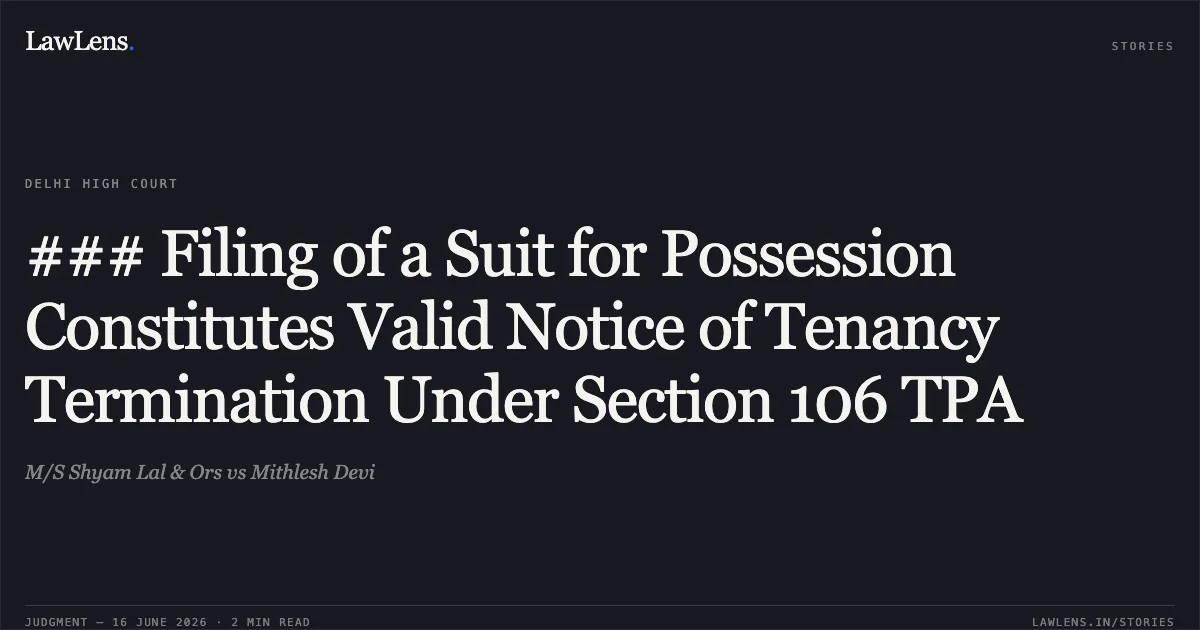
The Respondent (landlady) filed a suit for possession and injunction against the Appellant (tenant) regarding a shop in Nawada, New Delhi.
Source reference: p. 2The shop was let out via a rent agreement dated 01.01.2001 at an initial rent of ₹1,000 per month.
Source reference: p. 2The Respondent sought vacancy for the bona fide needs of her family.
Source reference: p. 2The Appellant contested the suit, claiming the tenancy was "perpetual/non-terminable" because a pagri (advance) of ₹1,48,000 had been paid.
Source reference: p. 5-6, 12The Appellant also argued the suit was barred by Section 50 of the Delhi Rent Control (DRC) Act, 1958, as the rent was below ₹3,500.
Source reference: p. 9The Trial Court decreed the suit under Order XII Rule 6 CPC based on admissions of the landlord-tenant relationship.
Source reference: p. 5The First Appellate Court upheld this and dismissed an application to amend the written statement to include a Memorandum of Understanding (MoU).
Source reference: p. 8Issues
1. Whether a suit for ejectment is maintainable without a formal 'notice to quit' under Section 106 of the Transfer of Property Act, 1882.
Source reference: p. 9/para. 40, Question A2. Whether the civil court's jurisdiction was barred under Section 50 of the DRC Act regarding premises in Village Nawada.
Source reference: p. 10/para. 40, Question F3. Whether the payment of pagri and the existence of an unregistered MoU rendered the tenancy non-terminable.
Source reference: p. 12/para. 44-46Law Applied
Order XII Rule 6 of the CPC, which allows for a judgment on admissions.
Source reference: p. 5, 7Section 116 of the Indian Evidence Act, which estops a tenant from challenging the landlord's title.
Source reference: p. 5Nopany Investments (P) Ltd. v. Santokh Singh (HUF), establishing that the filing of an eviction suit itself constitutes sufficient notice to quit.
Source reference: p. 14Section 2 of the Delhi Rent Control Act, 1958, which held that the Act does not apply to an area unless a specific notification is issued by the Central Government.
Source reference: p. 13Reasoning
The Court found that the landlord-tenant relationship and the rate of rent (below ₹3,500) were admitted.
Source reference: p. 11For the DRC Act to bar civil jurisdiction under Section 50, the locality (Nawada) must be notified under the Act; the Appellant failed to produce any such notification.
Source reference: p. 14On the issue of "perpetual tenancy," the Court reasoned that even if a pagri of ₹1,48,000 was paid, it did not change the legal status of the occupier from a "tenant" to an "owner," nor did it make the tenancy non-terminable, especially since the Rent Agreement allowed the tenant to terminate with two months' notice.
Source reference: p. 12-13Following the Nopany precedent, the lack of a formal pre-suit notice was cured by the service of the suit summons.
Source reference: p. 14The court held that the Trial Court correctly exercised its discretion under Order XII Rule 6 as no triable issues remained regarding the relationship or the jurisdiction.
Source reference: p. 14Holding
The High Court answered the issues in favor of the Respondent, holding that the suit was maintainable and the DRC Act was inapplicable due to the lack of notification.
It held that the payment of pagri does not create a perpetual interest in the absence of a registered instrument.
Source reference: p. 13The Court dismissed the Regular Second Appeal, upheld the decree of possession, and affirmed that filing the suit served as adequate notice of termination.
Source reference: p. 14-15Acts & Sections Cited
7 provisions across 3 statutes referred to in this judgment. Each provision opens on LawLens.
Code of Civil Procedure, 19084
delhi rent control act, 19582
Transfer of Property Act, 18821
Original Court PDF
M/S Shyam Lal & OrsvsMithlesh Devi
Click to open original judgment
Original judgment, available to read, download and summarize on LawLens.in