Facts
On December 9, 2025, a written report was filed by Jeevan Yadav alleging that unknown persons committed a daytime house-breaking theft, stealing gold and silver jewelry and cash totaling approximately Rs. 7,50,000
Source reference: para 2The applicant was arrested on February 23, 2026, following a memorandum statement in which he allegedly admitted to conspiring with co-accused Ponchi and Jespal
Source reference: para 4The prosecution alleged that the applicant acted as a lookout on a motorcycle to facilitate the escape and received Rs. 35,000 from the proceeds, of which Rs. 19,000 and a mobile phone were recovered from his possession
Source reference: para 4The applicant moved for bail, arguing that no stolen ornaments were recovered from him, he had been acquitted in three of his five previous criminal cases, and the charge-sheet had already been filed
Source reference: para 3Issues
Whether the applicant is entitled to the grant of regular bail under Section 483 of the Bharatiya Nagarik Suraksha Sanhita, 2023, given the completion of the investigation and his previous criminal record
Source reference: para 1, 6Law Applied
The Court primarily applied Section 483 of the Bharatiya Nagarik Suraksha Sanhita (BNSS), 2023, regarding the grant of regular bail
Source reference: para 1The applicant was charged under several sections of the Bharatiya Nyaya Sanhita (BNS), including Section 331(3) (house-breaking), Section 305(A) (theft in a dwelling house), Section 112 (abetment), Section 317(2) (receiving stolen property), and Section 3(5) (joint liability)
Source reference: para 1The Court also referenced procedural safeguards under Section 269 (non-attendance), Section 84 (proclamation for person absconding), and Section 209 (failure to appear) of the BNS/BNSS framework to ensure trial compliance
Source reference: para 7Reasoning
The Court evaluated the gravity of the offense against the procedural progress of the case.
Source reference: para 6It noted that the investigation was effectively concluded as the charge-sheet had already been filed
Source reference: para 6While the State opposed bail citing the applicant's role as a getaway driver and his five criminal antecedents, the Court took into account that the applicant had been acquitted in three of those five previous cases
Source reference: para 4, 6The Court reasoned that since the applicant had been in custody since February 23, 2026, and the trial was expected to take considerable time, continued pretrial detention was unnecessary
Source reference: para 6The Court balanced the rights of the accused with the state's interest by imposing strict conditions, including the requirement for local sureties and mandatory attendance during critical trial stages
Source reference: para 7Holding
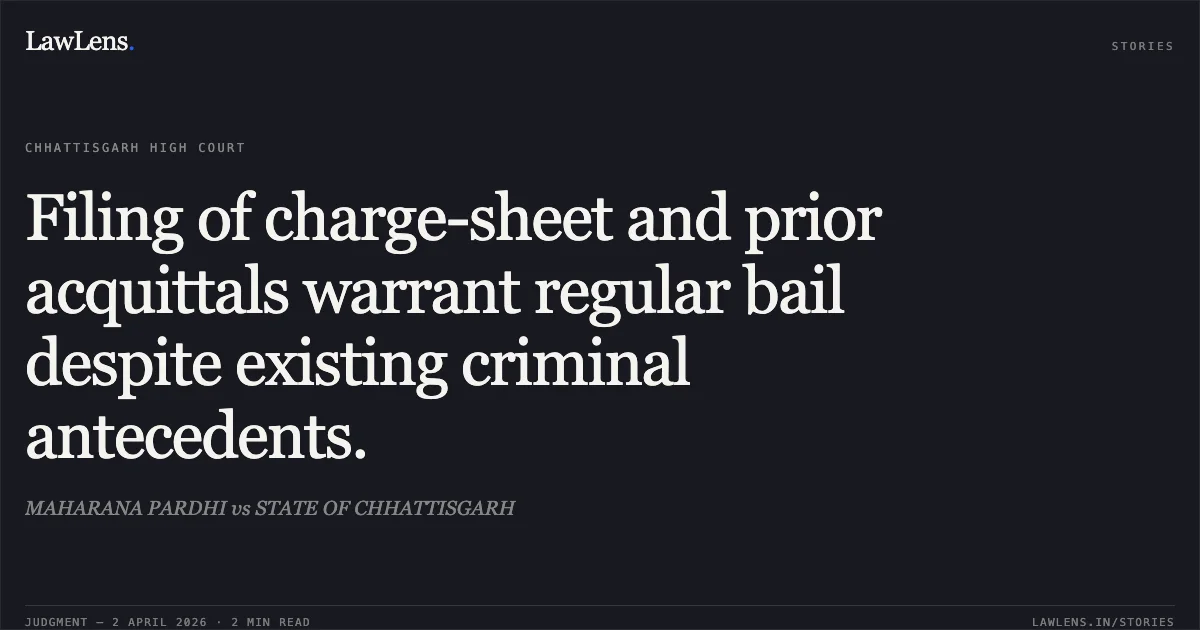
The High Court allowed the bail application and ordered the release of the applicant on a personal bond with two local sureties
The Court held that despite the allegations and criminal history, the filing of the charge-sheet and the period of incarceration justified bail
Source reference: para 6The release is subject to several conditions: the applicant must not seek adjournments when witnesses are present, must attend all court dates personally or through counsel, and must be present for the framing of charges and recording of statements under Section 351 of the BNSS
Source reference: para 7Failure to comply would allow the trial court to treat the default as an abuse of liberty
Source reference: para 7Acts & Sections Cited
12 provisions across 3 statutes referred to in this judgment. Each provision opens on LawLens.
Bharatiya Nagarik Suraksha Sanhita, 20233
Bharatiya Nyaya Sanhita, 20237
Indian Penal Code, 18602
Original Court PDF
MAHARANA PARDHIvsSTATE OF CHHATTISGARH
Click to open original judgment
Original judgment, available to read, download and summarize on LawLens.in