Facts
The Petitioner availed a Cash Credit Facility of Rs. 27.88 lacs from the Respondent-Bank, secured by hypothecation of stock and a mortgage of residential property in Shopian
Source reference: para. 03Due to repayment failure, the accounts were declared Non-Performing Assets (NPA) on October 19, 2022
Source reference: para. 04The Petitioner previously filed WP (C) No. 1804/2024 challenging these notices, where the Court granted an interim stay on coercive action conditioned upon the Petitioner depositing 50% of the outstanding dues—a condition the Petitioner failed to meet
Source reference: para. 05, 26The Petitioner then filed the present Writ Petition seeking to quash an order dated August 12, 2024, passed by the CJM Shopian under Section 14 of the SARFAESI Act, alleging procedural non-compliance and non-consideration of representations
Source reference: para. 01, 06-08Issues
1. Whether the Writ Petition is maintainable given the pendency of a previous petition on the same cause of action and the Petitioner's failure to disclose subsequent legal proceedings
Source reference: para. 12, 242. Whether the Petitioner is entitled to equitable relief under Article 226 despite non-compliance with prior court directions and suppression of material facts regarding proceedings before the Debt Recovery Tribunal (DRT)
Source reference: para. 23, 27Law Applied
Writ jurisdiction under Article 226 is extraordinary, equitable, and discretionary, requiring a party to approach the court with "clean hands"
Source reference: para. 27The rule against concealing vital material to gain advantage (K. Jayaram v. Bangalore Development Authority (2022))
Source reference: para. 27Dismissal of actions for misleading the court (K. D. Sharma v. Steel Authority of India Ltd. (2008))
Source reference: para. 28Prohibition against taking habitual recourse to legal proceedings as an abuse of process (Udyami Evam Khadi Gramodyog Welfare Sanstha v. State of UP (2008))
Source reference: para. 29Statutory compliance requirements under Section 14 and Section 13(8) of the SARFAESI Act and Rules 8 and 9 of the Security Interest (Enforcement) Rules, 2002
Source reference: para. 18-21Reasoning
The Court found that the Petitioner suppressed several vital facts: (i) the existence of a prior pending writ petition [WP (C) No. 1804/2024] on the same cause of action; (ii) the failure to comply with the 50% pre-deposit condition imposed by the Court in the first petition; and (iii) the pendency of recovery proceedings (OA/1503/2024) before the DRT.
Source reference: para. 24, 26, 23The Court observed that the Respondent-Bank had indeed complied with Section 14 requirements by filing the necessary affidavit and providing valuation and publication details, contrary to the Petitioner's wholesale assertions.
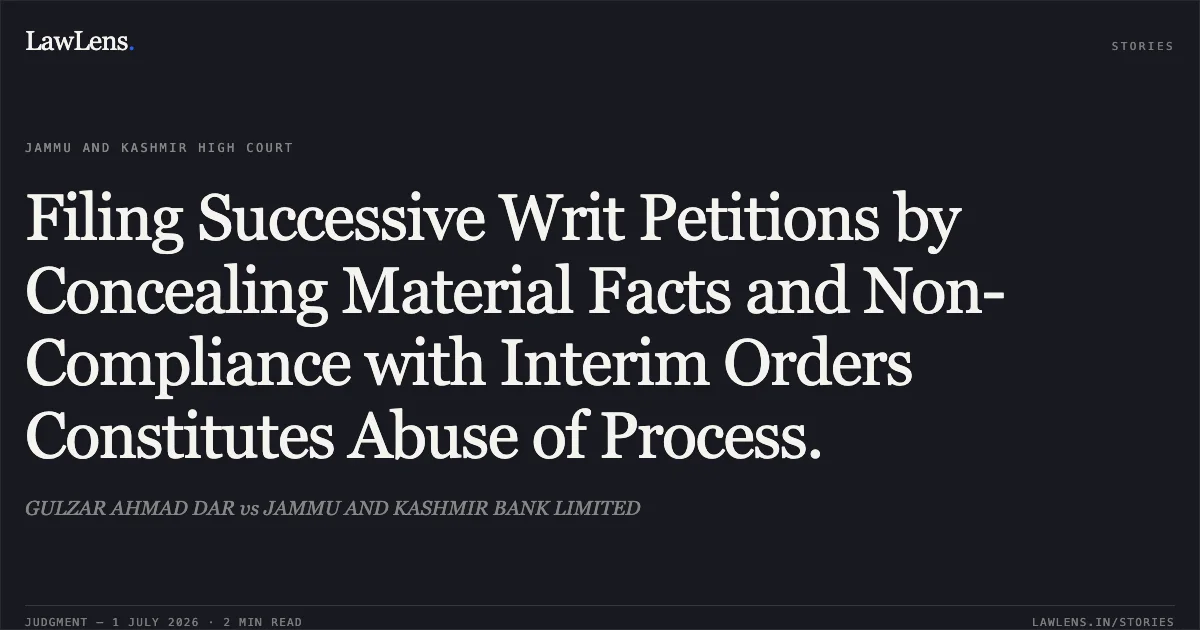
Source reference: para. 20-22The Court reasoned that the Petitioner adopted a "circuitous route" to evade the pre-deposit condition of the first interim order, which constitutes a fraud on the court and an abuse of process.
Source reference: para. 31, 33Holding
The Court dismissed the petition, holding that the Petitioner’s conduct of concealment, misrepresentation, and distortion of facts disqualified him from receiving equitable or discretionary relief.
The Petition was dismissed with costs of Rs. 50,000/- to be deposited in the Litigants Welfare Fund and all interim directions were vacated.
Source reference: para. 34, 35Acts & Sections Cited
2 provisions across 1 statute referred to in this judgment. Each provision opens on LawLens.
Securitisation and Reconstruction of Financial Assets and Enforcement of Security Interest Act, 20022
Original Court PDF
GULZAR AHMAD DARvsJAMMU AND KASHMIR BANK LIMITED
Click to open original judgment
Original judgment, available to read, download and summarize on LawLens.in