Facts
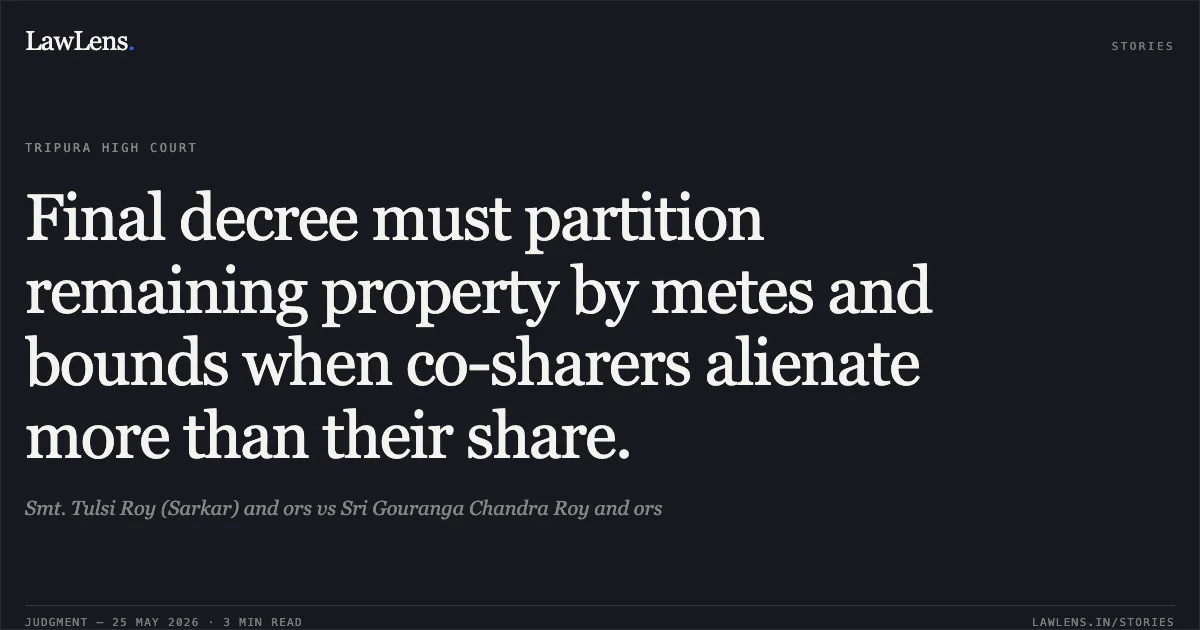
The Respondent No. 1 (plaintiff) filed a partition suit in 1977 [T.S.(P) No. 66 of 1977] seeking an 8-anna (50%) share of 'A' Schedule properties inherited from a common ancestor, Mahesh Roy
Source reference: p. 3A preliminary decree was passed on June 14, 1993, declaring the plaintiff’s 50% share, which was ultimately upheld by the High Court in 2019
Source reference: p. 4-5During final decree proceedings, a Survey Commissioner reported that out of 127 gandas of decretal land, the defendants (appellants) had sold 78 gandas to third parties and 8 gandas were forcibly occupied, leaving only 41 gandas vacant
Source reference: p. 5The Trial Court accepted a second Commissioner's report and directed demarcation of these 41 gandas for the plaintiff
Source reference: p. 6-7The appellants challenged this, claiming the Survey Commissioner failed to account for land previously acquired by the Government for a National Highway
Source reference: p. 6The Lower Appellate Court dismissed the appeal and an amendment application
Source reference: p. 7Issues
1. Whether the final decree proceedings were vitiated by the failure of the Survey Commissioner to account for land acquired by the State Government
Source reference: p. 82. Whether the defendants can raise objections regarding land acquisition at the final decree stage when such facts were noted during the preliminary decree stage
Source reference: p. 8-9Law Applied
The court primarily applied Section 100 of the Code of Civil Procedure regarding the requirements for a Second Appeal
Source reference: p. 2It relied on the principles of partition law as elucidated in Shub Karan Bubna v. Sita Saran Bubna, which establishes that a preliminary decree determines the rights of the parties while the final decree effectuates the actual division by metes and bounds
Source reference: p. 7-8It further adhered to the principle of finality of litigation, holding that findings of fact in a preliminary decree that have attained finality cannot be re-agitated during final decree execution
Source reference: p. 8-9Reasoning
The court reasoned that the appellants' objection regarding land acquisition was factually and legally unsustainable. It noted that the Trial Court, while passing the preliminary decree in 1993, had already recorded (via Exhibit-1) that the State had acquired 2 gandas of land and paid compensation to the predecessors of both parties as early as 1959
Source reference: p. 8Consequently, this acquired land was never part of the 'A' Schedule property brought to suit in 1977
Source reference: p. 9The court found that since the preliminary decree findings—including the extent of the property—had been affirmed up to the High Court in a previous RSA, the defendants were precluded from raising these settled issues to delay the final decree
Source reference: p. 9The court further observed that since the defendants had already sold 78 gandas (exceeding their 50% share of the 127-ganda total), the plaintiff was legally entitled to the remaining 41 vacant gandas
Source reference: p. 7Holding
The High Court dismissed the Second Appeal, holding that there was no merit in the appellants' contentions and no substantial question of law. The court affirmed that the land acquisition issue was settled in 1959 and noted in the 1993 preliminary decree, thus prohibiting its resurrection in the final stage
The direct answer to the issues is that the Survey Commissioner's report was valid and the defendants cannot obstruct the final decree based on settled facts. The orders of the lower courts were upheld, and the final decree for 41 gandas in favor of the plaintiff stands
Source reference: p. 9Acts & Sections Cited
2 provisions across 2 statutes referred to in this judgment. Each provision opens on LawLens.
Code of Civil Procedure, 19081
Tripura Land Revenue and Land Reforms Act, 19601
Original Court PDF
Smt. Tulsi Roy (Sarkar) and orsvsSri Gouranga Chandra Roy and ors
Click to open original judgment
Original judgment, available to read, download and summarize on LawLens.in