Facts
The plaintiff-appellant instituted Title Suit No. 456 of 2015 seeking partition and separate possession of his alleged one-half share in homestead and vacant land measuring approximately 0.0587 hectare at Bhagalpur.
Source reference: para. 3The parties claimed through the branches of the two sons of Narendra Nath Bagchi and were stated to be governed by the Dayabhaga school of Hindu law.
Source reference: para. 4The suit was decreed on admission under Order XII Rule 6 CPC, and a preliminary decree dated 30 April 2019 declared the plaintiff’s one-half share in the Schedule-A property.
Source reference: para. 3A Pleader Commissioner was appointed to divide the property by metes and bounds.
Source reference: para. 3After the plaintiff objected to the first report, the Trial Court directed preparation of a fresh report based on the declared shares and the valuation of the property.
Source reference: para. 3The Commissioner submitted a fresh report dated 6 November 2019, proposing the western portion, including the two-storeyed residential building in the plaintiff’s possession, for the plaintiff and the eastern portion for the defendants.
Source reference: paras. 3, 19The Trial Court rejected the plaintiff’s objections, accepted the report, and passed the final decree dated 2 January 2020 incorporating the Commissioner’s report and map.
Source reference: para. 7In appeal under Section 96 CPC, the plaintiff challenged the report and final decree on the grounds that the constructions had not been properly valued, the three-storeyed building had been wrongly excluded, and adequate access and passage had not been provided.
Source reference: paras. 8–10Issues
1. Whether the Trial Court committed an error in accepting the Survey Knowing Pleader Commissioner’s report dated 6 November 2019 while preparing the final decree?
Source reference: para. 142. Whether the Commissioner’s report substantially complied with the preliminary decree and the Trial Court’s directions concerning division according to the declared shares, valuation, physical features, constructions, and access?
Source reference: paras. 15, 19–233. Whether the plaintiff’s objections warranted setting aside or remitting the matter for preparation of a fresh partition report?
Source reference: paras. 23–27Law Applied
The Court applied Section 96 CPC governing first appeals from decrees, along with Order XX Rule 18(2) CPC, under which a preliminary partition decree is followed by working out the division by metes and bounds.
Source reference: para. 24Order XXVI Rules 13 and 14 CPC require appointment of a Commissioner to effect partition according to the rights declared in the preliminary decree, submission of a report, consideration of objections, and confirmation, variation, or rejection of the report before passing the final decree.
Source reference: para. 24The Court relied on Chandan Mull Indra Kumar & Ors. v. Chiman Lal Girdhar Das Parekh & Anr., 1939 SCC OnLine PC 49 : AIR 1940 PC 3, for the principle that a carefully conducted local investigation should not be disturbed without clearly defined and sufficient grounds.
Source reference: para. 16It also relied on Jugeshwar Singh v. Rijhan Singh, 1937 SCC OnLine Pat 136 : AIR 1938 Patna 104, holding that interference in a first appeal is justified principally where the Trial Court has proceeded on an erroneous question of law or principle, rather than merely to reappreciate factual allotment by the Commissioner.
Source reference: para. 17The Court further followed Trinity Infraventures Ltd. & Ors. v. M.S. Murthy & Ors., 2023 SCC OnLine SC 738, regarding the procedural sequence of preliminary decree, commission, consideration of objections, and final decree.
Source reference: para. 24Reasoning
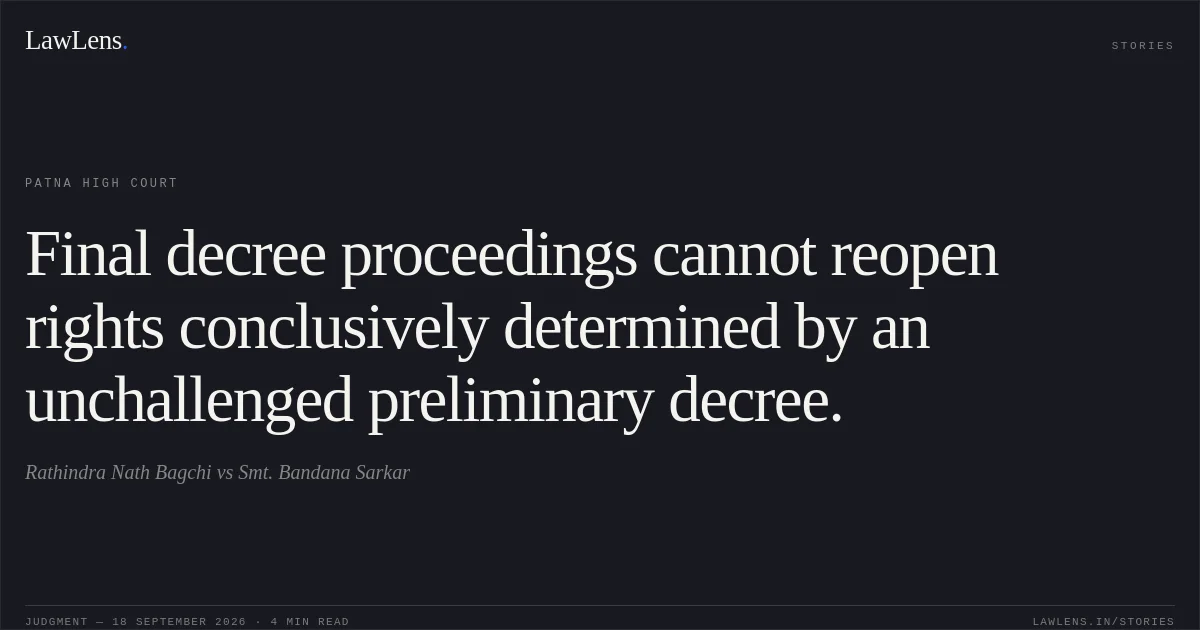
The preliminary decree declaring the parties’ shares had attained finality and could not be reopened during final decree proceedings.
Source reference: para. 15The Court found that the Commissioner had conducted local inspection and measurement in the presence of the parties and their advocates, considered the existing structures, possession, passage, and physical characteristics of the property, and prepared maps showing both the existing position and proposed division.
Source reference: para. 19Although the two-storeyed building had not been separately assigned a monetary value, it was retained in the plaintiff’s existing possession and allotted with the plaintiff’s share; this was not sufficient to invalidate the partition exercise in the circumstances.
Source reference: para. 20The three-storeyed building was treated as a subsequent and illegal construction that had not been included in the pleadings or the preliminary decree.
Source reference: para. 21The plaintiff could not enlarge the subject matter of the partition at the final decree stage without demonstrating that the construction stood on property covered by the preliminary decree.
Source reference: para. 21The objection regarding access also failed because the Commissioner had recorded the southern passage and depicted the division in the map, while the plaintiff produced no material showing that his allotment had become inaccessible.
Source reference: para. 22The Trial Court had afforded the plaintiff an opportunity to object and had considered those objections before accepting the report, thereby substantially complying with Order XXVI Rule 14 CPC.
Source reference: para. 23The absence of affidavit or verification was not treated as independently decisive; more importantly, the plaintiff failed to identify specific prejudice, material irregularity, or violation of the preliminary decree.
Source reference: para. 25In view of the limited scope of appellate interference with a carefully prepared partition report, no legal or procedural error was established.
Source reference: paras. 17, 26–27Holding
The Court answered the principal issue against the plaintiff-appellant and held that the Trial Court committed no error in accepting the Pleader Commissioner’s report dated 6 November 2019.
The final decree dated 2 January 2020, prepared in accordance with that report and map, was upheld.
Source reference: paras. 28–30The appeal was dismissed, interlocutory applications, if any, were disposed of, and there was no order as to costs.
Source reference: paras. 28–30Acts & Sections Cited
2 provisions across 1 statute referred to in this judgment. Each provision opens on LawLens.
Code of Civil Procedure, 19082
Original Court PDF
Rathindra Nath BagchivsSmt. Bandana Sarkar
Click to open original judgment
Original judgment, available to read, download and summarize on LawLens.in