Facts
The Respondent (husband) filed for divorce under Sections 13(1)(i) and 13(1)(ia) of the Hindu Marriage Act, 1955, on grounds of adultery and cruelty
Source reference: p. 2Although the Appellant (wife) was served and initially engaged counsel in 2019, no written statement was filed despite multiple opportunities
Source reference: p. 2On 06.04.2022, the Family Court proceeded ex-parte due to her non-appearance, later granting a divorce decree on 03.08.2022
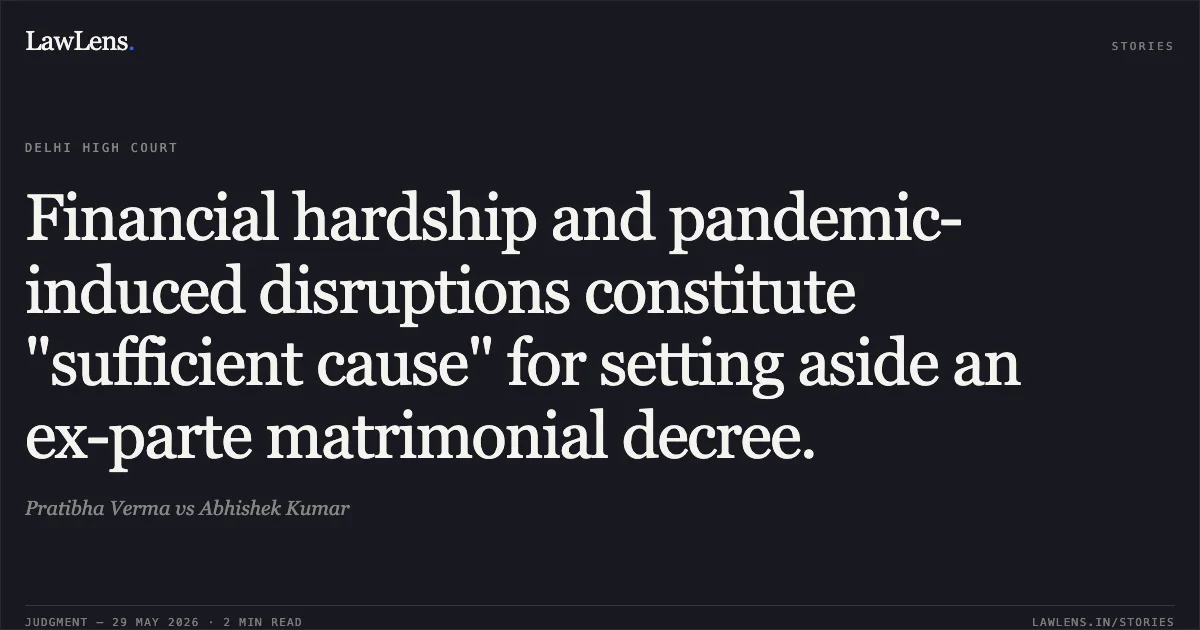
Source reference: p. 2The Appellant filed an application under Order IX Rule 13 of the CPC to set aside the decree, citing financial distress, lack of proper legal assistance, and disruptions caused by the COVID-19 pandemic
Source reference: p. 2-3The Family Court dismissed this application on 11.01.2024, holding that she failed to show "sufficient cause"
Source reference: p. 2Issues
1. Whether the Appellant established "sufficient cause" under Order IX Rule 13 of the CPC to warrant setting aside the ex-parte decree
Source reference: p. 3, para 72. Whether a litigant should be penalized with an ex-parte decree for the negligence of their counsel in matrimonial proceedings
Source reference: p. 5, para 12Law Applied
Order IX Rule 13 of the Code of Civil Procedure, 1908, which allows setting aside ex-parte decrees upon showing "sufficient cause"
Source reference: p. 1, 3Parimal v. Veena @ Bharti (2011), establishing that "sufficient cause" must receive a liberal, justice-oriented construction to ensure cases are decided on merits rather than technicalities
Source reference: p. 4, para 9The Supreme Court's suo motu directions in In Re: Cognizance for extension of Limitation (2022), which excluded the period from 15.03.2020 to 28.02.2022 for limitation purposes due to COVID-19
Source reference: p. 6, para 15Reasoning
The Court reasoned that the Family Court adopted an "unduly technical approach"
Source reference: p. 3, para 6It observed that the Appellant had not abandoned the case but had entrusted it to counsel who failed to perform, noting that a litigant should not be penalized for a lawyer's negligence
Source reference: p. 5, para 11-12The Court emphasized that the "sufficient cause" test was met because the default occurred during the pandemic—a period of "unprecedented disruption" where the Appellant faced financial hardship and displacement
Source reference: p. 6, para 13-14Furthermore, the Court noted that matrimonial disputes carry "serious civil consequences" regarding status and dignity, and as the Respondent had not remarried, restoration would not cause irretrievable prejudice
Source reference: p. 5, 7, para 10, 17Holding
The Court allowed the appeal and set aside the Impugned Order dated 11.01.2024 and the ex-parte divorce decree dated 03.08.2022
The Court held that the Appellant successfully demonstrated "sufficient cause" based on financial distress and pandemic-related hardships. The matter was remanded to the Family Court for fresh adjudication on merits, with a direction for parties to appear on 15.07.2026
Source reference: p. 7, 8, para 18, 20-21Acts & Sections Cited
2 provisions across 2 statutes referred to in this judgment. Each provision opens on LawLens.
Family Courts Act, 19841
Hindu Marriage Act, 19551
Original Court PDF
Pratibha VermavsAbhishek Kumar
Click to open original judgment
Original judgment, available to read, download and summarize on LawLens.in