Facts
The Petitioner was employed as a Sales Clerk with Respondent No. 2 from 14.07.1971
Source reference: p. 2On 12.04.1989, he was served a charge-sheet alleging misappropriation of ₹40,403.64 and a cash shortage detected during internal audits for 1986–1989
Source reference: p. 2Following a domestic inquiry, his services were terminated on 30.06.1989
Source reference: p. 3The Petitioner raised an industrial dispute (I.D. No. 293/1990).
Source reference: no citationOn 02.09.1996, the Industrial Tribunal held the domestic inquiry invalid for violating principles of natural justice but granted the Management liberty to prove misconduct through fresh evidence
Source reference: p. 4-5On 05.07.2002, the Tribunal passed the Impugned Award, upholding the termination after finding the charges of misappropriation proved via the Petitioner’s handwritten admissions and undertakings
Source reference: p. 5The Petitioner challenged this Award under Articles 226 and 227 of the Constitution
Source reference: p. 1Issues
Whether the Industrial Tribunal’s finding that the Petitioner committed misappropriation was perverse or based on no evidence, warranting interference under Article 226
Source reference: para 29Whether the Management’s failure to examine the authors of the internal audit reports or independent witnesses vitiated the proceedings
Source reference: para 17-18, 38Whether the Petitioner’s admissions were involuntary or obtained through coercion and inducement
Source reference: para 35, 43Whether the punishment of termination was shockingly disproportionate to the gravity of the proven misconduct
Source reference: para 49-50Law Applied
principles of supervisory jurisdiction under Article 226, establishing that a High Court cannot act as an appellate body to re-appreciate facts unless the findings are perverse or based on "no evidence," as held in Syed Yakoob v. K.S. Radhakrishnan
Source reference: para 27Indian Overseas Bank v. I.O.B. Staff Canteen Workers' Union
Source reference: para 28Regarding industrial adjudication, the Court noted that strict rules of the Indian Evidence Act do not apply; rather, the "nexus" and "reasonableness" of evidence suffice (State of Haryana v. Rattan Singh)
Source reference: para 39-40For the quantum of punishment, it applied the "loss of confidence" doctrine and the "shocking the conscience" test from Lucknow Kshetriya Gramin Bank v. Rajendra Singh
Source reference: para 53Janatha Bazar v. Secretary, which dictates that sympathy for long service is unwarranted in proven cases of financial misappropriation
Source reference: para 23, 55Reasoning
The Court determined that its jurisdiction is limited to correcting errors of law or manifest perversity, not substituting the Tribunal's factual conclusions
Source reference: para 26-27It found that the Tribunal’s decision was not based on "no evidence" but on substantial documentary material, specifically the Petitioner’s handwritten notings admitting the failure to post amounts in the cash book and his undertakings to deposit the same
Source reference: para 32, 41The Court dismissed the Petitioner’s reliance on Hardwari Lal v. State of U.P., noting that the non-examination of audit authors did not cause prejudice because the Petitioner’s own admissions and subsequent conduct—requesting adjustments from his provident fund—corroborated the reports
Source reference: para 42-43Furthermore, the Court rejected the plea of coercion as "vague," noting that the Petitioner failed to provide material particulars of the alleged threats and had taken contradictory stands throughout the proceedings
Source reference: para 35, 44Holding
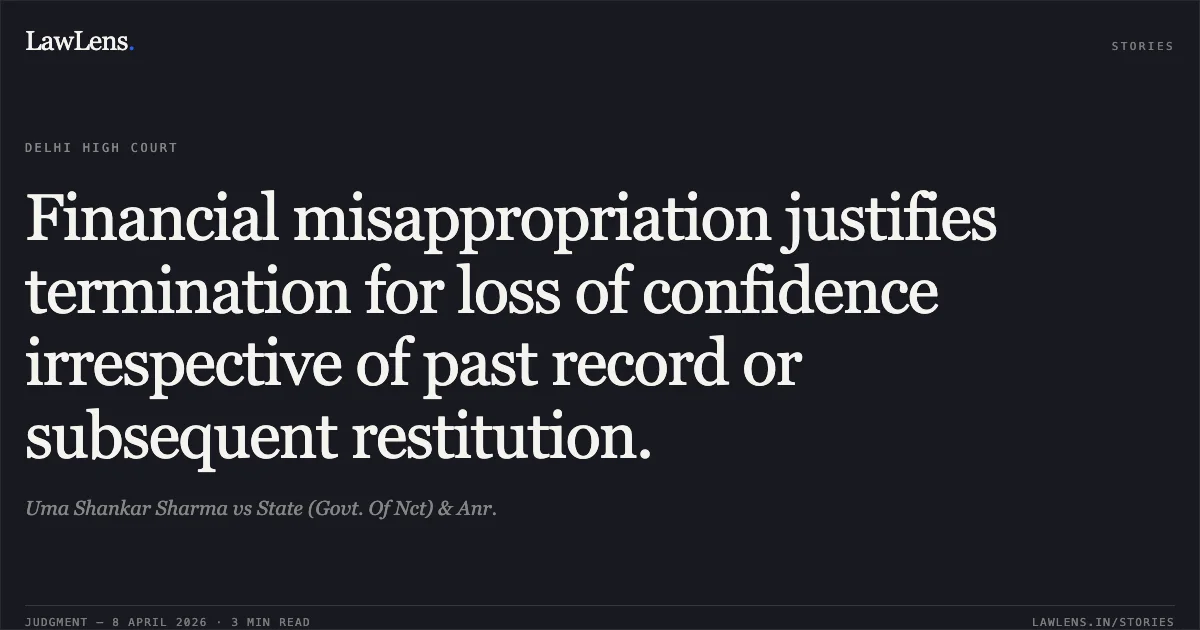
The Court answered the issues against the Petitioner, holding that the charges of continuous financial misappropriation over three years were established
It held that the punishment of termination was not "shockingly disproportionate" given the Petitioner’s fiduciary role and the resulting loss of confidence by the employer
Source reference: para 54-57The High Court found no infirmity or perversity in the Impugned Award dated 05.07.2002
Source reference: para 58Consequently, the Writ Petition was dismissed, and the termination was upheld
Source reference: para 59-60Acts & Sections Cited
2 provisions across 1 statute referred to in this judgment. Linked provisions open on LawLens.
Industrial Disputes Act, 19472
Original Court PDF
Uma Shankar SharmavsState (Govt. Of Nct) & Anr.
Click to open original judgment
Original judgment, available to read, download and summarize on LawLens.in