Facts
The petitioner claimed to be the legatee under a Will allegedly executed by his grandmother, who had been allotted a 1/50th share in a partition suit under the preliminary decree.
Source reference: no citationDuring the final decree proceedings, the petitioner sought recognition of his entitlement to that share on the basis of the Will and led evidence, including the evidence of an attesting witness.
Source reference: no citationThe Final Decree Proceedings Court held that the Will had not been proved in accordance with law and rejected the petitioner’s testamentary claim.
Source reference: para. 1The petitioner challenged that determination under Article 227 of the Constitution, contending that it was merely an interlocutory order and not an appealable decree.
Source reference: paras. 1–2Issues
1. Whether an adjudication by the Final Decree Proceedings Court on the proof of a Will propounded by a legatee constitutes a “decree” under Section 2(2) of the Code of Civil Procedure, 1908, despite being made during final decree proceedings?
Source reference: para. 22. Whether the petitioner’s challenge to the rejection of his testamentary claim was maintainable under Article 227 of the Constitution, or whether he was required to pursue a regular appeal under Section 96 CPC?
Source reference: paras. 14–15, 19–20Law Applied
Section 2(2) CPC defines a “decree” as the formal expression of an adjudication which conclusively determines the rights of the parties regarding all or any of the matters in controversy in the suit; an adjudication need not dispose of the entire suit if it conclusively determines a substantive matter in controversy.
Source reference: para. 3Final decree proceedings are a continuation of the original suit and give effect to the rights declared in the preliminary decree, although every order passed during such proceedings is not necessarily a decree.
Source reference: paras. 5, 8A judicial determination that conclusively affects a party’s substantive entitlement, rather than merely regulating procedure, may constitute a decree in substance regardless of its form or nomenclature.
Source reference: paras. 4, 7, 12Proof of a Will must satisfy Section 63 of the Indian Succession Act, 1925, read with Section 68 of the Indian Evidence Act, 1872.
Source reference: para. 10Since the adjudication was held to be a decree, the appropriate remedy was a regular appeal under Section 96 CPC, and Article 227 could not be invoked as an alternative to that statutory remedy.
Source reference: paras. 14–15, 19–20The time spent before the High Court could be excluded under Section 14 of the Limitation Act, 1963, subject to the conditions specified by the Court.
Source reference: para. 21Reasoning
The Court held that the petitioner’s claim was not collateral or procedural because his entire entitlement to participate in the final decree proceedings depended upon the alleged Will and his succession to the 1/50th share allotted to the testator.
Source reference: para. 5The Final Decree Proceedings Court had permitted the petitioner to propound the Will and had adjudicated, on the evidence led, whether it was duly proved under the applicable statutory requirements.
Source reference: paras. 9–10Its finding that the Will was unproved conclusively extinguished the foundation of the petitioner’s testamentary claim, leaving no further question regarding that claim to be determined in the final decree proceedings.
Source reference: paras. 11, 13, 16Applying the substance-and-effect test under Section 2(2) CPC, the Court concluded that the determination involved a judicial adjudication of a substantive right and therefore had the essential attributes of a decree, notwithstanding that it was not formally drawn up as one.
Source reference: paras. 12, 18Consequently, the petitioner could not use Article 227 supervisory jurisdiction to challenge the merits of that adjudication when a statutory appeal under Section 96 CPC was available.
Source reference: paras. 14, 19–20Holding
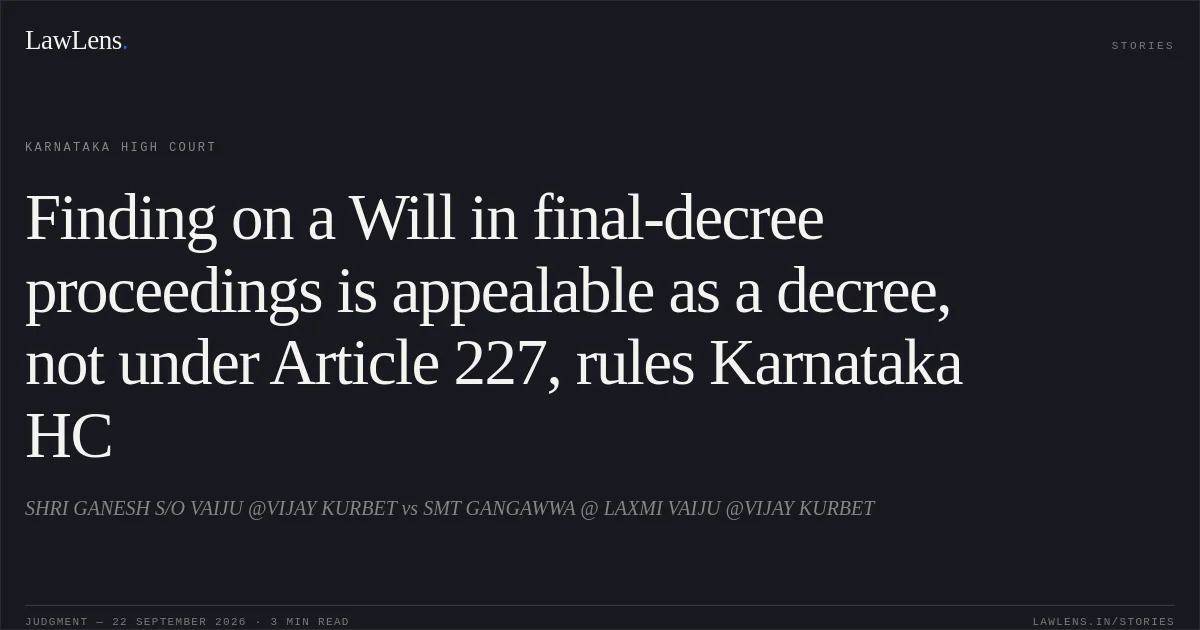
The High Court held that the Final Decree Proceedings Court’s finding that the Will had not been proved constituted a decree in substance and in law under Section 2(2) CPC because it conclusively determined the petitioner’s asserted right as legatee to the 1/50th share.
The writ petition under Article 227 was therefore held to be not maintainable.
Source reference: paras. 18, 20The petition was disposed of with liberty to the petitioner to file a regular appeal under Section 96 CPC.
Source reference: para. 21If filed within four weeks from receipt of the certified copy of the order, the appellate court was directed to consider limitation and exclude the time spent before the High Court under Section 14 of the Limitation Act, 1963.
Source reference: para. 21Acts & Sections Cited
4 provisions across 3 statutes referred to in this judgment. Each provision opens on LawLens.
Code of Civil Procedure, 19082
Indian Succession Act, 19251
Limitation Act, 19631
Original Court PDF
SHRI GANESH S/O VAIJU @VIJAY KURBETvsSMT GANGAWWA @ LAXMI VAIJU @VIJAY KURBET
Click to open original judgment
Original judgment, available to read, download and summarize on LawLens.in