Facts
The appellants, Khalid and Nannu (now deceased), were convicted under Section 302/34 IPC for the murder of Sarafraz @ Pappu.
Source reference: para 1On January 7, 1990, the deceased was allegedly called to Khalid’s barn, where a dispute arose over borrowing a tractor-trolley.
Source reference: para 3The prosecution alleged that Nannu held the deceased while Khalid shot him with a pistol after a shotgun blast was deflected by the informant, hitting Nannu instead.
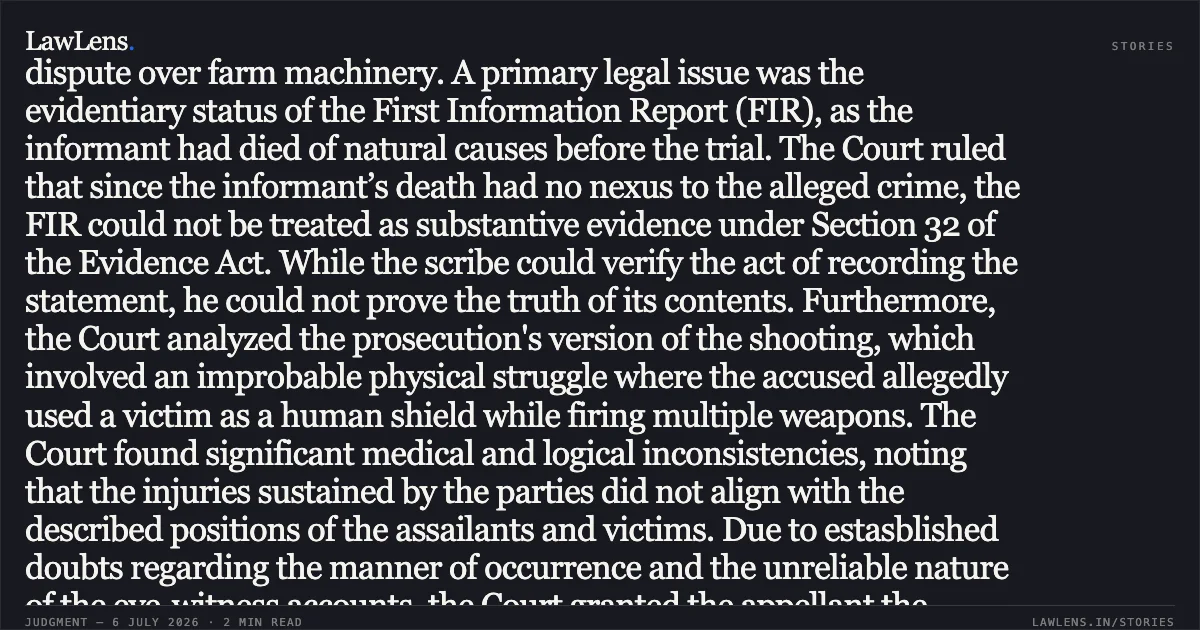
Source reference: para 3/22The informant, Wahiuddin, died before the trial, and the FIR was proved by the scribe, PW-1.
Source reference: para 16/19The appellants contended a cross-version: that the informant’s party were the aggressors who shot Nannu, and Sarafraz was accidentally killed by his own party’s fire while Khalid used him as a human shield.
Source reference: para 24/27Issues
1. Whether the First Information Report (FIR) can be treated as substantive evidence when the informant is dead and the death has no nexus with the reported incident.
Source reference: para 16/172. Whether the prosecution proved the manner of occurrence and the guilt of the appellant beyond a reasonable doubt.
Source reference: para 20/34Law Applied
Section 32(1) of the Indian Evidence Act, 1872, noting that an FIR is not substantive evidence unless it relates to the cause of the informant's death.
Source reference: para 17/18Relying on Pradeep v. State of U.P. (2022) and Lalita v. Vishwanath (2025), the Court held that while a scribe can prove the factum of an FIR, they cannot prove its contents if the informant is dead and Section 32 is inapplicable.
Source reference: para 17/18The fundamental criminal law principle that the prosecution must prove its case beyond a reasonable doubt, as established in Vijayee Singh v. State of U.P.
Source reference: para 34Reasoning
The Court found the prosecution's narrative inherently improbable and noted the "oddity" of the informant, PW-2, and PW-3 following the deceased to the barn without prior hostility.
Source reference: para 23/29The Court observed that if Nannu had held the deceased from behind while a shotgun was fired at close range (even if deflected), it was "almost fantastic" that the pellets hit Nannu's legs without hitting the deceased.
Source reference: para 30/31Scientific evidence showed Nannu sustained pellet injuries, yet the deceased had none on his lower limbs, contradicting the prosecution's claim that they were in physical contact during the fray.
Source reference: para 31The non-proof of FIR contents (due to the informant's death) and the physical impossibility of the alleged assault created a grave cloud of doubt.
Source reference: para 33/35Holding
The Court answered the first issue in the negative, holding that the FIR contents were not proved as the informant's death was natural and unrelated to the crime.
The Court held that the prosecution failed to meet the standard of proof beyond reasonable doubt; the appeal was allowed, the conviction and life sentence were set aside, and Khalid was acquitted.
Source reference: para 36/37/39Appellant No. 2’s appeal had already abated due to his death.
Source reference: para 2Acts & Sections Cited
11 provisions across 3 statutes referred to in this judgment. Each provision opens on LawLens.
Bharatiya Nagarik Suraksha Sanhita, 20231
Code of Criminal Procedure, 19735
Indian Penal Code, 18605
Original Court PDF
Khalid And AnothervsState Of U.P.
Click to open original judgment
Original judgment, available to read, download and summarize on LawLens.in