Facts
Respondent No. 2, the petitioner’s paternal uncle, complained that on 2 May 2024 the petitioner entered a family-owned kalyana mantapa office, demanded rent and, when payment was not made, assaulted him and tore his shirt.
Source reference: para. 2The police registered Crime No. 170/2024 and filed a charge-sheet for offences under Sections 341, 323 and 504 of the IPC; the Magistrate took cognizance and proceedings continued as C.C. No. 22401/2024.
Source reference: paras. 2, 13The petitioner sought to quash the FIR, charge-sheet, cognizance order and subsequent proceedings, relying on the approximately one-hour-and-forty-five-minute interval before registration of the FIR and a pending partition suit between the family members.
Source reference: paras. 1, 5–7The prosecution relied on witness statements, including that of the petitioner’s father, and a wound certificate recording tenderness over the complainant’s shoulder and back.
Source reference: paras. 8–10, 14, 16Issues
1. Whether the complaint and investigation material disclosed an offence by the petitioner and whether the proceedings were liable to be quashed under Section 482 Cr.P.C. on the grounds of delay and the pending civil suit.
Source reference: para. 122. Whether the delay in lodging the complaint and the pre-existing family dispute established that continuation of the criminal proceedings would amount to an abuse of process.
Source reference: paras. 17–23, 31Law Applied
Section 482 of the Code of Criminal Procedure preserves the High Court’s inherent jurisdiction to prevent abuse of process and secure the ends of justice.
Source reference: para. 19At the quashing stage, the Court considers whether the allegations, taken at face value together with the investigation material, disclose an offence; it does not conduct a detailed appreciation of evidence or determine witness credibility as though conducting a trial.
Source reference: para. 19A civil or family dispute, by itself, does not justify quashing where the complaint alleges an independent criminal act; similarly, delay in lodging an FIR is not, by itself, sufficient at this stage to conclude that the alleged incident did not occur.
Source reference: paras. 18, 22–23The petition invoked Section 482 Cr.P.C. (with Section 528 BNSS also identified in the petition heading); no judicial precedents were cited in the order.
Source reference: no citationReasoning
The complaint specified the date, time, place and alleged manner of the assault, while the charge-sheet included the petitioner’s father’s statement supporting the complainant and a wound certificate that was prima facie consistent with physical contact.
Source reference: paras. 13–16, 25The Court held that the FIR-registration interval and the police station’s proximity to the premises could be raised at trial but did not establish at the quashing stage that the incident had not occurred.
Source reference: paras. 17–19The partition suit was instituted by the petitioner, with respondent No. 2 named as a defendant; its pendency showed a family dispute but did not negate the separately alleged assault.
Source reference: paras. 20–24The credibility of the witnesses and the parties’ competing accounts were matters for the trial court.
Source reference: paras. 28–31Holding
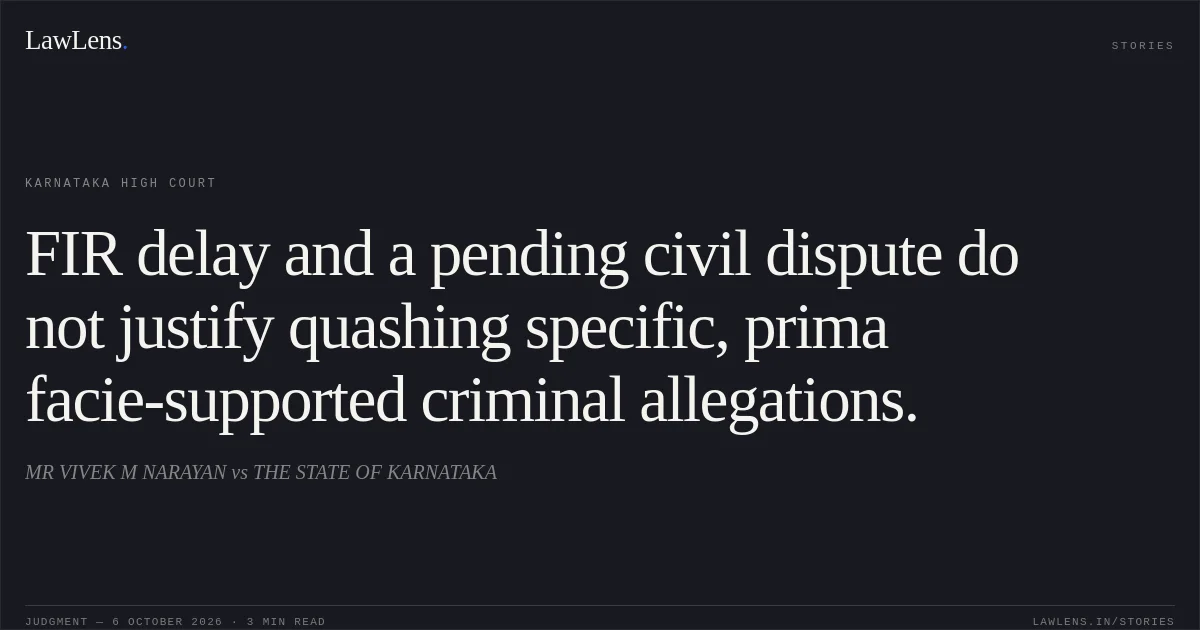
The Court held that the delay and pending partition suit, individually or cumulatively, did not establish abuse of process, and that the allegations and supporting material required the petitioner to face trial.
The criminal petition was dismissed, with liberty to the petitioner to raise all defences before the trial court. The trial court was directed to proceed uninfluenced by the observations made in the quashing order.
Source reference: para. 33Acts & Sections Cited
5 provisions across 3 statutes referred to in this judgment. Each provision opens on LawLens.
Code of Criminal Procedure, 19731
Bharatiya Nagarik Suraksha Sanhita, 20231
Indian Penal Code, 18603
Original Court PDF
MR VIVEK M NARAYANvsTHE STATE OF KARNATAKA
Click to open original judgment
Original judgment, available to read, download and summarize on LawLens.in