Facts
The petitioners, the wife and daughter of the deceased (Vasudev Chandra), sought the quashing of FIR No. 0354/2025 registered under Sections 108 (Abetment of suicide) and 3(5) (Joint liability) of the Bharatiya Nyaya Sanhita (BNS), 2023.
Source reference: para 2-3The deceased committed suicide on the night of December 3–4, 2025.
Source reference: para 3A suicide note ("Nivedan Patra") dated November 29, 2025, and a video were recovered, in which the deceased blamed the petitioners for extortion and property conspiracy.
Source reference: para 3The FIR was lodged 18 days after the incident.
Source reference: para 3The petitioners argued that the FIR was an afterthought, citing a 4-5 day gap between the suicide note and the act, a 10-12 year separation between the spouses, and previous domestic violence complaints filed by the petitioners against the deceased.
Source reference: para 4Issues
1. Whether the FIR should be quashed under Section 528 of the BNSS due to the 18-day delay in registration and the alleged lack of immediate provocation.
Source reference: para 2, 42. Whether the allegations in the FIR and the accompanying suicide note prima facie constitute the offense of abetment of suicide under Section 108 of the BNS.
Source reference: para 6, 8Law Applied
The Court applied Section 108 of the Bharatiya Nyaya Sanhita (BNS), 2023, regarding the abetment of suicide.
Source reference: para 3It exercised its inherent powers under Section 528 of the Bharatiya Nagarik Suraksha Sanhita (BNSS), 2023.
Source reference: para 2The Court relied on the landmark precedent of State of Haryana v. Bhajan Lal (1992), which defines the limited circumstances under which an FIR may be quashed.
Source reference: para 5, 9It further applied the principle from Sushil Sharma v. State of NCT of Delhi (2005), holding that questions of "immediate provocation" and the veracity of allegations are matters of fact to be determined during investigation or trial, not during a pre-trial quashing petition.
Source reference: para 5, 9Reasoning
The Court observed that the FIR was based on specific evidence, including a handwritten suicide note and a video produced by the relatives of the deceased.
Source reference: para 3Although the petitioners argued that the 18-day delay in filing the FIR was fatal, the Court held that delay alone is not a sufficient ground for quashing if the FIR prima facie discloses cognizable offenses.
Source reference: para 5, 8The Court noted that the investigation was in its preliminary stages and no charge sheet had been filed.
Source reference: para 7Furthermore, the petitioners failed to provide the suicide note or video for the Court's perusal, which limited the ability to challenge the prima facie nature of the evidence.
Source reference: para 6The Court reasoned that the merits of the allegations—such as the impact of the long-term separation or the timeline of the suicide note—are evidentiary matters that must be tested during the investigation rather than summarily dismissed at the threshold.
Source reference: para 8Holding
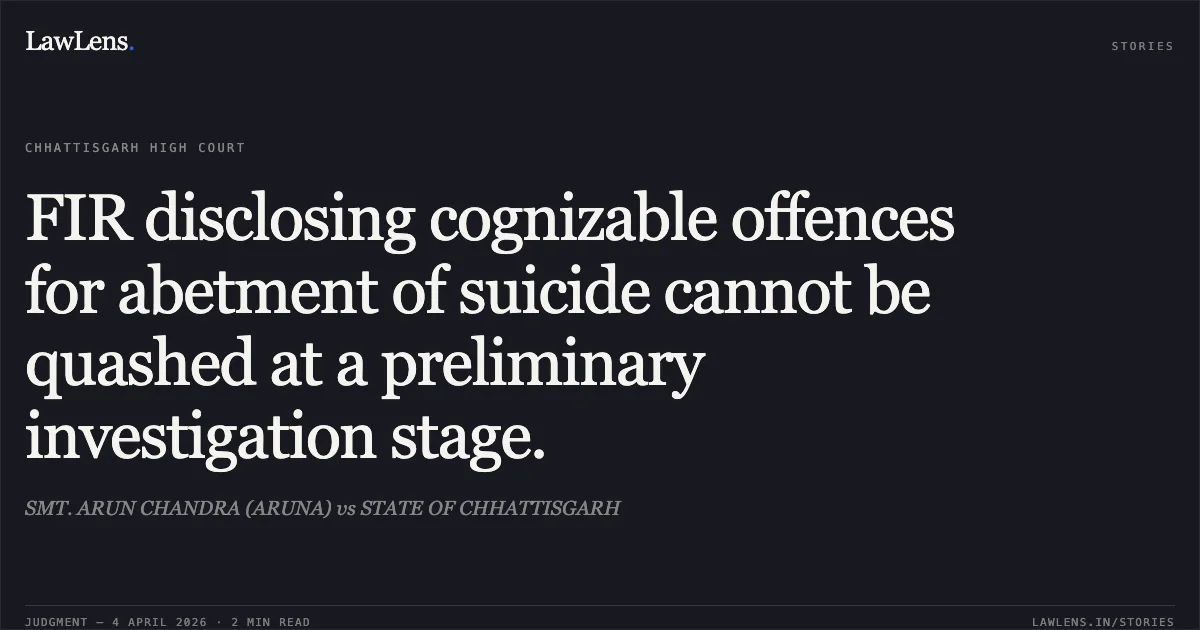
The Court dismissed the petition, holding that no grounds for interference were established at this preliminary stage.
The Court ruled that since the FIR prima facie discloses cognizable offenses under Section 108 of the BNS, the investigation must be allowed to proceed to determine the veracity of the evidence and the specific roles of the petitioners.
Source reference: para 8Relief for quashing the FIR and consequential proceedings was denied.
Source reference: para 10Acts & Sections Cited
3 provisions across 2 statutes referred to in this judgment. Each provision opens on LawLens.
Bharatiya Nyaya Sanhita, 20232
Bharatiya Nagarik Suraksha Sanhita, 20231
Original Court PDF
SMT. ARUN CHANDRA (ARUNA)vsSTATE OF CHHATTISGARH
Click to open original judgment
Original judgment, available to read, download and summarize on LawLens.in