01Facts
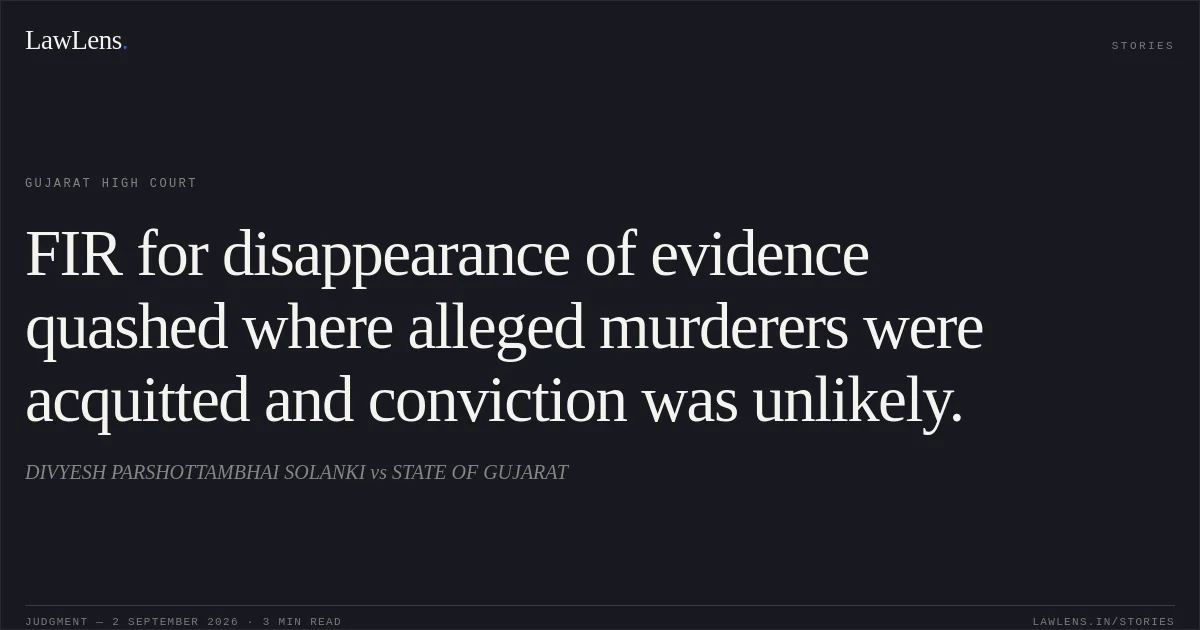
The applicant sought quashing of FIR C.R. No. I-306 of 2013 registered at Sector 7 Police Station, Gandhinagar, for offences under Sections 302, 201 and 114 of the Indian Penal Code, 1860 (“IPC”) and Section 135 of the Gujarat Police Act.
p. 1The prosecution alleged that a young man, who had sustained multiple knife injuries, was brought dead to Civil Hospital, Gandhinagar in an Innova car.
pp. 1–3The applicant was alleged to have accompanied the deceased and to have assisted in destroying evidence by cleaning the vehicle and failing to disclose the commission of the offence.
pp. 1–3The principal accused—Yash @ Lalu Arvindbhai Sarvaiya, Jorubhai Bijalbhai Makvana and Bharatbhai Ganpatlal Sharma—were acquitted by the Second Additional Sessions Judge, Gandhinagar, in Sessions Case No. 58 of 2014 by judgment dated 30 April 2016.
p. 2, 4The FIR against the Innova owner, Hemraj Ramjibhai Padaliya, had also previously been quashed.
pp. 3–402Issues
i.Whether the FIR and consequential criminal proceedings against the applicant, whose alleged role was principally connected with disappearance of evidence and non-disclosure of the offence, should be quashed after the principal accused had been acquitted and the co-accused/vehicle owner’s FIR had been quashed.
pp. 3–5ii.Whether continuation of the prosecution would serve any useful purpose where the alleged eyewitnesses had not supported the prosecution case and the likelihood of conviction was bleak.
pp. 5–603Law Applied
The Court considered the offences alleged under Sections 302, 201 and 114 IPC and Section 135 of the Gujarat Police Act.
p. 1Section 201 IPC concerns causing disappearance of evidence of an offence or giving false information to screen the offender, while Section 114 IPC attributes liability to an abettor present when the offence is committed.
In exercising its inherent jurisdiction to prevent abuse of process and secure the ends of justice, the Court relied on Madhavrao Jivajirao Scindia v. Sambhajirao Chandrojirao Angre, (1988) 1 SCC 692, particularly the principle that where the chance of conviction is bleak and continuation of the prosecution would serve no useful purpose, the proceedings may be quashed.
p. 5Provisions in the judgment · 5 · Linked ones open on LawLens
Indian Penal Code, 1860 Section 302Section 201Section 114
Gujarat Police Act, 1951. Section 135
Code of Criminal Procedure, 1973 Section 174
04Reasoning
The Court noted that the persons alleged to have committed the murder had been acquitted in the Sessions trial, and that the FIR against the Innova owner had already been quashed.
p. 4The applicant’s alleged role was limited to assisting in the disappearance of evidence and not disclosing the crime, rather than participating in the murder itself.
p. 5In addition, the two eyewitnesses, Jayesh Babubhai Patel and Sureshbhai Chagganbhai Hirani, had not supported the prosecution and were declared hostile during trial.
p. 6Applying the principle in Madhavrao Jivajirao Scindia, the Court held that, in these circumstances, the possibility of conviction was remote and requiring the applicant to undergo a trial would amount to a futile exercise and a waste of judicial time and public resources.
pp. 5–605Holding
The Court answered the issues in favour of the applicant.
p. 6It allowed the application and quashed and set aside FIR C.R. No. I-306 of 2013 registered with Sector 7 Police Station, Gandhinagar, along with all consequential proceedings against the applicant.
p. 6The Rule was made absolute to that extent, and direct service was permitted.
p. 6Original Court PDF
DIVYESH PARSHOTTAMBHAI SOLANKIvsSTATE OF GUJARAT
Click to open original judgment
Original judgment, available to read, download and summarize on LawLens.in