Facts
The petitioner was appointed as a Data Entry Operator on collector-rate terms at the District Hospital, Narsinghpur, and joined service on 23 December 2010.
Source reference: p.1He and three other operators processed applications for birth and death certificates under the supervision of the Civil Surgeon, who was stated to be the competent Registrar and whose digital signature and official credentials were used for issuing certificates.
Source reference: p.1Following a complaint concerning a death certificate issued in relation to late Kamal Joshi, an administrative enquiry was conducted.
Source reference: p.1The petitioner was removed from service, and Crime No. 338/2026 was registered at Police Station Kotwali, Narsinghpur, for alleged offences under Sections 318(4), 336(3) and 337 of the Bharatiya Nyaya Sanhita, 2023.
Source reference: p.1The petitioner invoked the High Court’s inherent jurisdiction under Section 528 of the Bharatiya Nagarik Suraksha Sanhita, 2023, seeking quashing of the FIR and consequential proceedings.
Source reference: p.1The State opposed the petition, arguing that the FIR disclosed cognizable offences and that the petitioner’s contentions involved disputed questions of fact unsuitable for determination at the stage of quashing.
Source reference: p.4Issues
Whether the FIR and consequential criminal proceedings disclosed a prima facie case under the alleged provisions of the Bharatiya Nyaya Sanhita against the petitioner so as to warrant their quashing under the High Court’s inherent jurisdiction.
Source reference: p.5Whether the petitioner’s pleas concerning his subordinate role, absence of sanction, lack of dishonest intention, mala fides, selective prosecution and disputed responsibility for processing the certificate could be adjudicated in a quashing petition.
Source reference: pp.2–5Whether the High Court should undertake an appreciation of evidence or adjudication of disputed factual defences at the stage of considering the FIR.
Source reference: p.5Law Applied
The Court applied the inherent jurisdiction of the High Court under Section 528 of the Bharatiya Nagarik Suraksha Sanhita, 2023; the judgment also referred, inconsistently, to proceedings under Section 482 of the Code of Criminal Procedure.
Source reference: pp.1, 5The governing principle applied was that an FIR may be quashed where it does not disclose a cognizable offence, but where its allegations prima facie constitute the essential ingredients of the alleged offences, the Court should not conduct a detailed appreciation of evidence, assess the probable defence, or decide disputed questions of fact at the pre-trial stage.
Source reference: p.5The alleged offences were stated to be under Sections 318(4), 336(3) and 337 of the Bharatiya Nyaya Sanhita; paragraph 5 of the order, however, refers to Section “18(4)” rather than Section 318(4).
Source reference: p.5The petitioner’s reliance on the Registration of Births and Deaths Act, 1969, including the statutory role of the Registrar and the alleged requirement of sanction, was treated as involving factual and legal defences not requiring determination at the FIR-quashing stage.
Source reference: pp.2–4Reasoning
The Court found that the FIR contained specific allegations and attributed a definite role to the petitioner, rather than making vague or omnibus allegations.
Source reference: p.5On that basis, it held that there was prima facie material indicating the essential ingredients of the alleged offences.
Source reference: p.5The petitioner’s assertions that he acted only under the Civil Surgeon’s directions, lacked authority to verify documents, did not personally issue the certificate, had no dishonest intention, and was targeted because of prior enmity were matters requiring examination of evidence and resolution of disputed facts.
Source reference: pp.2–4Similarly, the pleas concerning sanction, the Civil Surgeon’s responsibility, and the alleged discriminatory omission to prosecute other Data Entry Operators could not justify quashing where the FIR, on its face, disclosed cognizable offences.
Source reference: pp.4–5The Court therefore declined to assess the petitioner’s defence or undertake a detailed evidentiary inquiry in the inherent-jurisdiction proceedings.
Source reference: p.5Holding
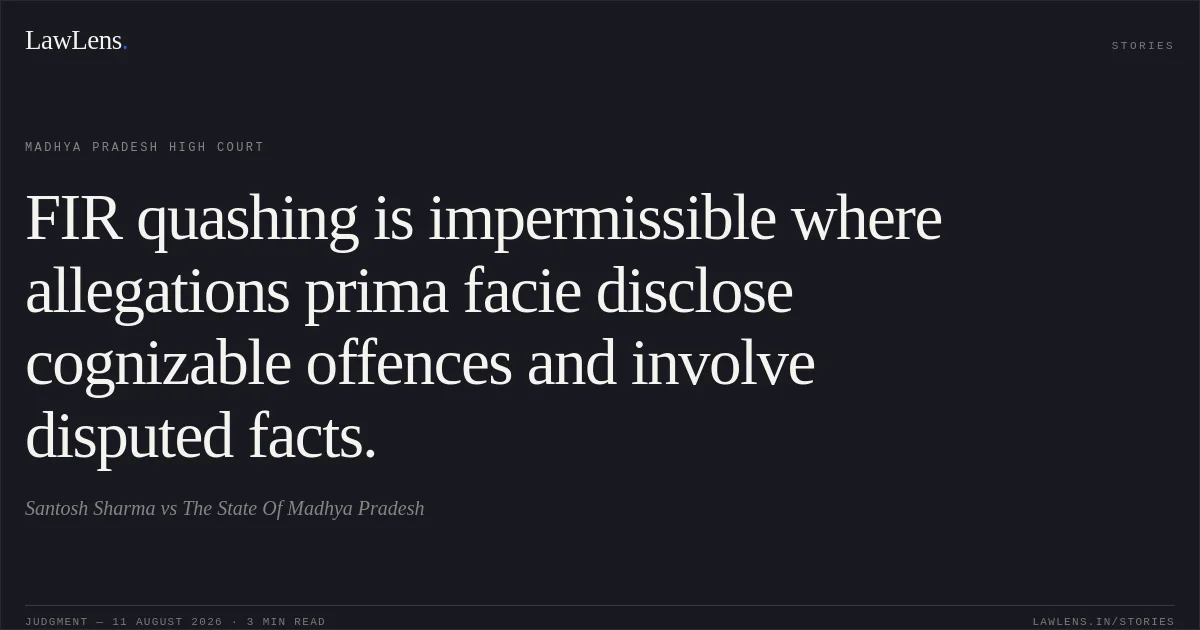
The Court held that the FIR prima facie disclosed the commission of the alleged offences and that the petitioner’s factual and legal defences could be examined only during investigation or trial, not in proceedings seeking quashing of the FIR.
The petition under Section 528 of the BNSS was accordingly dismissed, and no relief was granted to the petitioner.
Source reference: p.6Acts & Sections Cited
6 provisions across 4 statutes referred to in this judgment. Each provision opens on LawLens.
Bharatiya Nagarik Suraksha Sanhita, 20231
Registration of Births and Deaths Act, 19691
Bharatiya Nyaya Sanhita, 20233
Code of Criminal Procedure, 19731
Original Court PDF
Santosh SharmavsThe State Of Madhya Pradesh
Click to open original judgment
Original judgment, available to read, download and summarize on LawLens.in