Facts
The petitioner claimed ownership of the ground floor and basement of property No. E-3, Lajpat Nagar-II, New Delhi, while respondent no. 2, his brother, claimed ownership/co-ownership of the property.
Source reference: para. 4The petitioner alleged that on 19 March 2024, respondent no. 2, in collusion with respondents nos. 3 and 4 and certain unidentified persons, trespassed into the property and attempted to install an electricity meter on the third floor without his consent.
Source reference: para. 4After the police allegedly failed to register an FIR despite a complaint to the Deputy Commissioner of Police, the petitioner filed an application under Section 156(3) Cr.P.C., seeking registration of an FIR for offences under Sections 120B, 503, 506, 166, 295A and 298 IPC.
Source reference: para. 5The police filed an Action Taken Report stating that the police had responded to a quarrel-related DD entry, that the BSES team possessed a valid work order, that no meter was installed, that no unlawful entry occurred, and that the dispute was essentially a civil property dispute between the brothers.
Source reference: para. 6The Judicial Magistrate dismissed the Section 156(3) application on 29 August 2025, holding that the accused were identifiable, the relevant evidence was within the petitioner’s reach, and police investigation was unnecessary.
Source reference: para. 7The Additional Sessions Judge dismissed the petitioner’s revision on 9 March 2026 and affirmed the Magistrate’s order.
Source reference: para. 8Issues
Whether the concurrent orders refusing to direct registration of an FIR under Section 156(3) Cr.P.C. disclosed a manifest illegality, jurisdictional error, or miscarriage of justice warranting interference under Section 528 BNSS/Section 482 Cr.P.C.?
Source reference: paras. 15–18Whether the petitioner’s allegations prima facie disclosed cognizable offences under Sections 120B, 503, 506, 166, 295A and 298 IPC, thereby requiring registration of an FIR?
Source reference: paras. 11, 14, 19Whether the dispute was essentially civil in nature and could appropriately be dealt with without directing police investigation or registration of an FIR?
Source reference: paras. 6–7, 10, 19, 22Whether the cryptic nature of the Revisional Court’s order, and the petitioner’s challenge to the police Action Taken Report, justified remand or interference by the High Court?
Source reference: paras. 16–17, 20–21Law Applied
The Court applied Section 154 Cr.P.C., under which registration of an FIR is mandatory when information discloses a cognizable offence, subject to the limited preliminary-inquiry categories recognised in Lalita Kumari v. Government of Uttar Pradesh, (2014) 2 SCC 1.
Source reference: para. 11Under Sindhu Janak Nagargoje v. State of Maharashtra, the Court reiterated that an FIR ought to be directed where the complaint prima facie discloses a cognizable offence.
Source reference: para. 11Section 156(3) Cr.P.C. confers wide power on the Magistrate to direct registration of an FIR and monitor investigation, although the complainant should ordinarily first approach the police authorities under Sections 154(1), 154(3) and 36 Cr.P.C., as held in Sakiri Vasu v. State of U.P., (2008) 2 SCC 409.
Source reference: para. 12Priyanka Srivastava v. State of U.P., (2015) 6 SCC 287, requires a Section 156(3) application to be supported by an affidavit.
Source reference: para. 13The Court also held that inherent jurisdiction under Section 482 Cr.P.C./Section 528 BNSS remains available despite the bar on a second revision under Section 397(3) Cr.P.C., but may be exercised only sparingly to correct manifest illegality, jurisdictional error or miscarriage of justice, and not merely to substitute another possible view, in accordance with Mohit @ Sonu v. State of U.P., Ganesh Narayan Hegde v. S. Bargarappa and Asghar Khan v. State of U.P.
Source reference: para. 15Judicial orders must contain reasons, as recognised in Kranti Associates (P) Ltd. v. Masood Ahmed Khan and State of U.P. v. Battan, but lack of elaborate reasoning alone does not require interference where the record supports the result.
Source reference: paras. 16–17The Court further relied on Sajal Bose v. State of West Bengal for the principle that unimpeachable contemporaneous material must be given due weight whether it inculpates or exculpates an accused.
Source reference: para. 20Reasoning
The High Court found that the police ATR and the contemporaneous DD entry materially contradicted the petitioner’s allegations.
Source reference: paras. 6, 10, 19They indicated that the police had responded to a quarrel, that the BSES personnel were acting under a valid work order, that no meter was installed, and that neither unlawful entry nor police collusion was established.
Source reference: paras. 6, 10, 19On that material, the alleged ingredients of Sections 120B, 503/506, 166, 295A and 298 IPC were not prima facie made out.
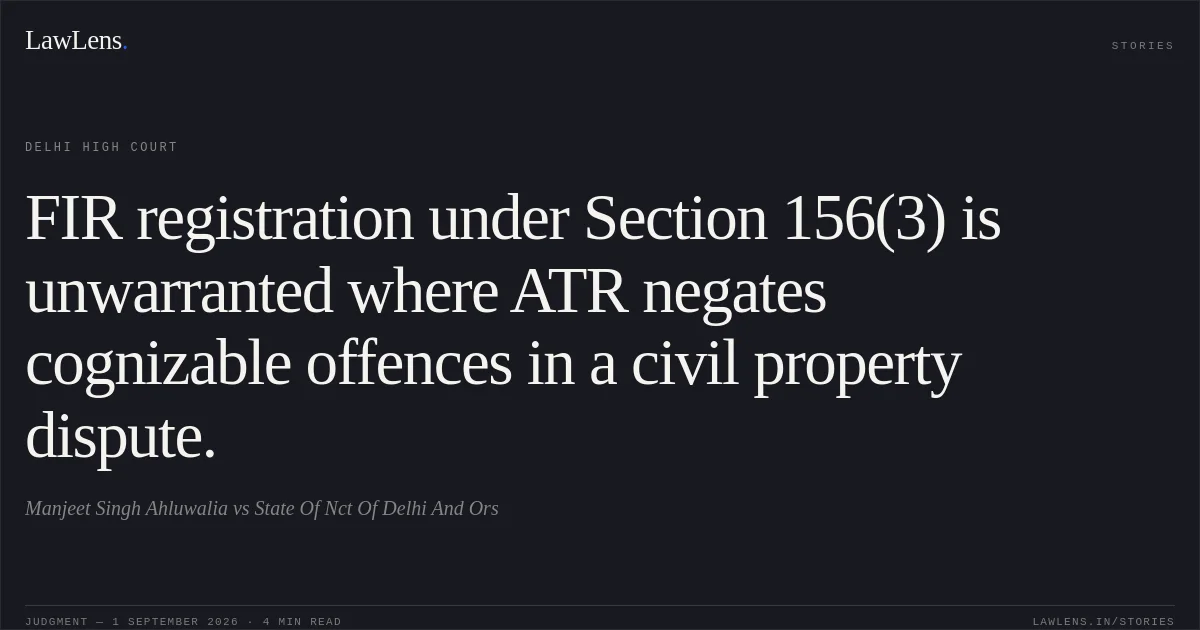
Source reference: para. 19The dispute was predominantly a property dispute between brothers and had already resulted in preventive proceedings under Sections 107/151 Cr.P.C.; it therefore fell within the category of civil-flavoured disputes where immediate registration of an FIR was not warranted.
Source reference: paras. 6, 19The Court also held that the petitioner’s reliance on Sajal Bose was misplaced because that decision supported consideration of unimpeachable contemporaneous material, and the material in the present case operated against, rather than in favour of, the petitioner.
Source reference: para. 20Although the Revisional Court’s order was brief, the High Court held that the record independently supported the concurrent findings, and that remand merely for elaboration of reasons would serve no useful purpose.
Source reference: para. 17Since the matter did not require seizure or investigative steps beyond what could be pursued through a complaint under Section 200 Cr.P.C., no direction for FIR registration was justified.
Source reference: para. 22Holding
The High Court answered the issues against the petitioner.
It held that the allegations, viewed with the ATR and other contemporaneous material, did not prima facie disclose the alleged cognizable offences and that the concurrent refusal to order registration of an FIR did not suffer from manifest illegality, jurisdictional error or miscarriage of justice.
Source reference: paras. 18–21The petition under Section 528 BNSS/Section 482 Cr.P.C. was dismissed, and no direction was issued for registration of an FIR under Section 156(3) Cr.P.C.
Source reference: paras. 22–24Pending applications, if any, were also disposed of.
Source reference: para. 24Acts & Sections Cited
17 provisions across 3 statutes referred to in this judgment. Each provision opens on LawLens.
Bharatiya Nagarik Suraksha Sanhita, 20233
Code of Criminal Procedure, 1973
Indian Penal Code, 18604
Original Court PDF
Manjeet Singh AhluwaliavsState Of Nct Of Delhi And Ors
Click to open original judgment
Original judgment, available to read, download and summarize on LawLens.in