Facts
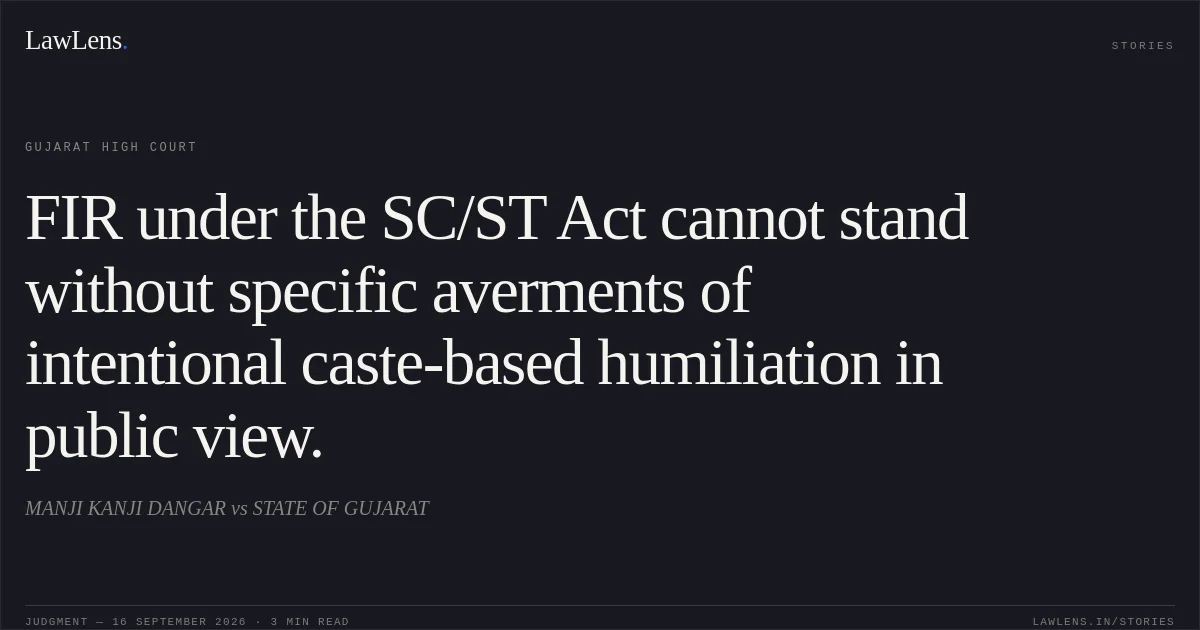
The applicant invoked the Gujarat High Court’s inherent jurisdiction under Section 482 of the Code of Criminal Procedure, 1973, seeking quashing of C.R. No. II-09 of 2015 registered at Paddhar Police Station, Kachchh West, for offences under Sections 504 and 506(2) of the Indian Penal Code, 1860, and Section 3(1)(x) of the Scheduled Castes and the Scheduled Tribes (Prevention of Atrocities) Act, 1989 (“Atrocities Act”).
Source reference: para. 1The dispute arose after a water pipeline was damaged during drainage-line and related excavation work near the complainant’s village. The complainant alleged that the applicant abused him, used caste-based slurs, and threatened to kill him when the complainant objected to the applicant’s conduct at the site.
Source reference: para. 2The applicant denied the incident, alleged political rivalry with the complainant and the contractor, and contended that the FIR was lodged approximately nine hours after the alleged occurrence and was supported only by persons known to the complainant.
Source reference: para. 3–3.1The State opposed quashing on the ground that the FIR disclosed a prima facie case and that the investigation was at an initial stage.
Source reference: para. 4The complainant, although served, did not appear.
Source reference: para. 4.1Issues
Whether the FIR disclosed the essential ingredients of an offence under Section 3(1)(x) of the Atrocities Act, including intentional insult or intimidation with intent to humiliate a member of a Scheduled Caste or Scheduled Tribe in a place within public view?
Source reference: para. 5–5.2Whether the allegations in the FIR constituted criminal intimidation under Section 506(2) of the IPC, particularly whether the alleged threat was intended to cause alarm to the complainant?
Source reference: para. 5.2Whether, in exercise of jurisdiction under Section 482 CrPC, the FIR and consequential proceedings ought to be quashed for absence of the basic ingredients of the alleged offences?
Source reference: para. 5.3–6Law Applied
The Court exercised its inherent jurisdiction under Section 482 CrPC to prevent abuse of the process of law.
Source reference: para. 1The FIR invoked Sections 504 and 506(2) IPC and Section 3(1)(x) of the Atrocities Act.
Source reference: para. 1Relying on Gorige Pentaiah v. State of Andhra Pradesh, (2008) 12 SCC 531, the Court held that an offence under Section 3(1)(x) requires allegations showing, inter alia, that the accused was not a member of a Scheduled Caste or Scheduled Tribe and that the complainant was intentionally insulted or intimidated with the intent to humiliate him in a place within public view; where the basic ingredients are absent from the complaint, the FIR may be quashed.
Source reference: para. 5.1For criminal intimidation, the allegations must disclose a threat intended to cause alarm to the person threatened.
Source reference: para. 5.2Reasoning
Applying the principles in Gorige Pentaiah, the Court found that the FIR did not contain the necessary foundational averments for an offence under Section 3(1)(x) of the Atrocities Act.
Source reference: para. 5.2–5.3The alleged incident was witnessed by persons known to the complainant, and the Court considered that the circumstances did not establish humiliation in a place within public view or the requisite intention to insult or intimidate on the basis of caste.
Source reference: para. 5.2–5.3The Court further held that the FIR did not disclose that the applicant’s alleged threat was intended to cause alarm to the complainant, and therefore no prima facie case under Section 506(2) IPC was made out.
Source reference: para. 5.2In the absence of the essential ingredients of the invoked offences, continuation of the criminal proceedings was held to amount to an abuse of the process of law, notwithstanding the State’s submission that the investigation was at an initial stage.
Source reference: para. 4, 5.3Holding
The Court answered the issues in favour of the applicant and allowed the application under Section 482 CrPC.
C.R. No. II-09 of 2015 registered at Paddhar Police Station, Kachchh West, together with all consequential proceedings, was quashed and set aside.
Source reference: para. 6If the applicant was in custody and was not required in any other offence, he was directed to be released forthwith.
Source reference: para. 6.1The Rule was made absolute to that extent.
Source reference: para. 7Acts & Sections Cited
4 provisions across 3 statutes referred to in this judgment. Each provision opens on LawLens.
Code of Criminal Procedure, 19731
Indian Penal Code, 18602
Scheduled Castes and the Scheduled Tribes (Prevention of Atrocities) Act, 19891
Original Court PDF
MANJI KANJI DANGARvsSTATE OF GUJARAT
Click to open original judgment
Original judgment, available to read, download and summarize on LawLens.in