Facts
The plaintiff, a petrol-pump partnership firm, held a fire insurance policy covering petroleum products at its premises. On 18 October 1982, a fire broke out while petrol was being unloaded from a tanker into the pump’s underground tank, damaging the plaintiff’s stock. The insurer repudiated the claim.
Source reference: pp. 2–3The trial court awarded the plaintiff Rs. 22,736.57 with interest against the insurer and dismissed the suit against the other defendant; on the insurer’s appeal, the first appellate court reversed that decree, finding the loss uncovered because the tanker was not insured. The plaintiff challenged that decision in a second appeal under Section 100 of the Code of Civil Procedure, 1908.
Source reference: pp. 2–3Issues
Whether the first appellate court substantially erred in its interpretation of the fire policy and its finding that the loss was not covered.
Source reference: para. 3, p. 3Whether the appellate court’s treatment of the documentary and oral evidence, and its conclusion on liability under the policy, disclosed an error of law.
Source reference: para. 3, p. 3Whether the plaintiff was entitled to damages from the second defendant despite the risk allegedly being covered by the policy.
Source reference: para. 3, p. 3Law Applied
Section 100 of the Code of Civil Procedure, 1908 permits a second appeal on a substantial question of law.
Source reference: p. 2An insurance policy is construed according to its terms, and a court cannot rewrite the parties’ contract; however, the policy must be read as a whole, with due regard to its stated coverage and purpose. The judgment identifies no external precedent. It treats the absence of the word “only” before the listed containers as material to whether those containers exhaustively limited the cover.
Source reference: paras. 7.1–7.2, p. 6; para. 13.1, p. 9Reasoning
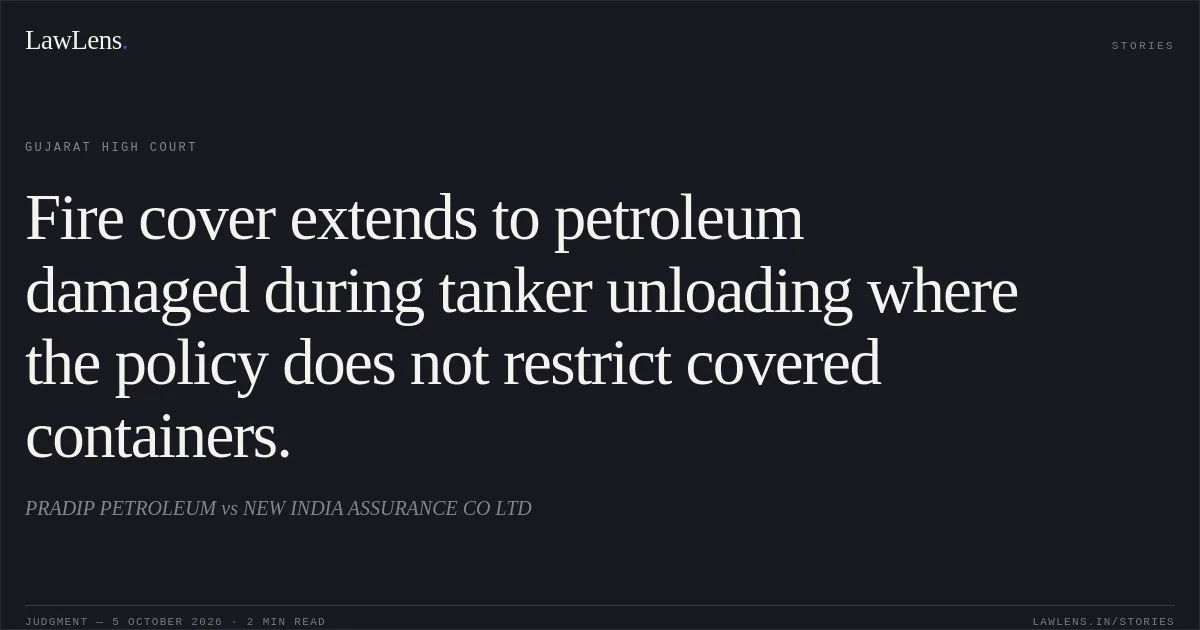
The policy covered specified petroleum products at the insured petrol pump, including products in underground tanks. The High Court held that the first appellate court wrongly treated the absence of insurance on the tanker as determinative, although the claim concerned damage to the insured petroleum stock during unloading at the insured premises.
Source reference: paras. 11–12, pp. 7–8; paras. 12.1–14, pp. 8–10The policy did not state that the products had to be in the listed containers only for cover to apply; the court considered the tanker’s storage tank another container and found that the appellate court had misread the policy and failed to account for its object and purpose. It therefore found the appellate court’s conclusion perverse and legally unsustainable.
Source reference: paras. 12.1–14, pp. 8–10Holding
The High Court answered the substantial questions in the plaintiff’s favour to the extent of the insurance claim, set aside the first appellate court’s judgment, and restored the trial court’s decree.
In view of the plaintiff’s election to accept a lump sum, it directed the insurer to pay Rs. 50,000 inclusive of interest within six weeks, failing which the plaintiff could recover the amount by execution.
Source reference: paras. 17–18, pp. 11–12The second appeal was partly allowed; there was no order as to costs, and the suit’s dismissal against the second defendant remained undisturbed.
Source reference: paras. 17–18, pp. 11–12Acts & Sections Cited
1 provisions across 1 statute referred to in this judgment. Each provision opens on LawLens.
Code of Civil Procedure, 19081
Original Court PDF
PRADIP PETROLEUMvsNEW INDIA ASSURANCE CO LTD
Click to open original judgment
Original judgment, available to read, download and summarize on LawLens.in