Facts
The dispute concerns the estate of late Thankam, who died on August 27, 2011
Source reference: p. 2The Respondent-defendants claimed that Thankam executed a registered Will in 1999 bequeathing her property to them.
Source reference: p. 2The Appellant-plaintiff, unaware of the Will, filed a partition suit
Source reference: p. 2The Trial Court (Principal Sub Court, Thrissur) held the Will unproven under Section 63 of the Indian Succession Act (ISA) because the attesting witness (DW2) failed to prove due execution and the testator was illiterate with no evidence that the Will was read over to her
Source reference: para. 18-20On appeal, the High Court of Kerala reversed this in a brief judgment, terming the Trial Court’s reasoning "extraneous," dismissing the suit, and directing the Trial Judge to undergo training
Source reference: para. 3.1Issues
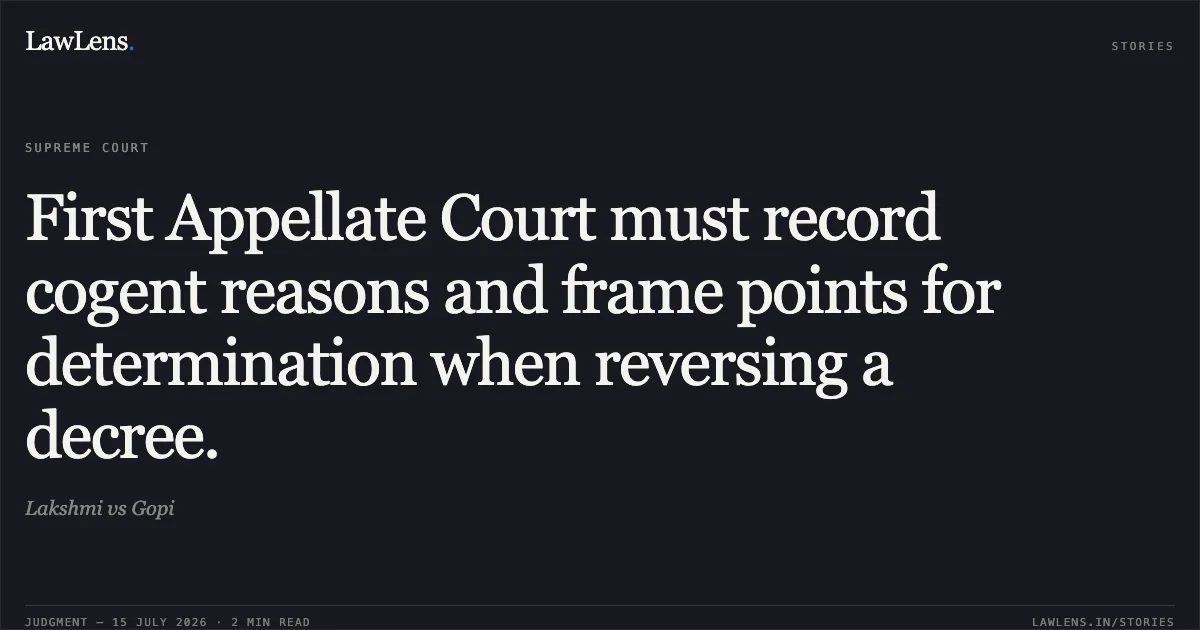
1. Whether the High Court, as the first appellate court, followed the mandatory requirements of Order 41 Rule 31 of the CPC in reversing the Trial Court’s decree
Source reference: para. 4/62. Whether the disparaging remarks and directions for judicial training against the Trial Judge were justified and consistent with the principles of judicial restraint
Source reference: para. 4/12Law Applied
The court applied Section 96 and Order 41 Rule 31 of the CPC, 1908, which stipulate that a first appellate court must state points for determination, the decision, and the reasons thereof
Source reference: p. 8-9It relied on Santosh Hazari v. Purushottam Tiwari regarding the duty of the first appellate court to apply its mind and provide reasons, especially in cases of reversal
Source reference: para. 6/9For the proof of Wills, the court applied Sections 67 and 68 of the Evidence Act, 1872, and Sections 59 and 63 of the ISA, 1925
Source reference: p. 19-20Regarding judicial remarks, it applied the "cardinal importance" test from State of U.P. v. Mohd. Naim, requiring sobriety, moderation, and necessity before making adverse comments against lower judicial officers
Source reference: para. 12Reasoning
The Supreme Court observed that the High Court’s judgment was cryptic, spanning only two paragraphs, and failed to frame points for determination or provide a reasoned rebuttal to the Trial Court’s findings
Source reference: para. 3.1/8The Bench emphasized that "reasons are the lifeblood of law" and the High Court, being the final court of facts, had a duty to re-appreciate the evidence independently
Source reference: para. 7/11The High Court erred by brushing aside the Trial Court's concerns regarding the testator's illiteracy and the attesting witness's testimony without discussing the statutory requirements for proving a Will under the ISA
Source reference: para. 10-11Furthermore, the Supreme Court found the direction to send the Trial Judge for training to be a disproportionate "heavy-handed baton" that compromised judicial independence, violating the principles of restraint established in Mohd. Naim and Shikha Trading Co.
Source reference: para. 11-12Holding
The court held that a cryptic reversal without independent reasoning or framing points for determination is unsustainable in law
The Supreme Court allowed the appeal, setting aside the High Court’s judgment and the disparaging remarks against the Trial Judge; The first appeal (RFA No. 298 of 2019) is restored to the High Court of Kerala for fresh consideration on merits, leaving all contentions open
Source reference: para. 13Acts & Sections Cited
3 provisions across 2 statutes referred to in this judgment. Each provision opens on LawLens.
Code of Civil Procedure, 19082
Code of Criminal Procedure, 19731
Original Court PDF
LakshmivsGopi
Click to open original judgment
Original judgment, available to read, download and summarize on LawLens.in


