Facts
The applicants (Applicant No. 1, second wife, and Applicant No. 2, son from the second marriage) sought to quash an order dated 11.04.2022 which rejected Applicant No. 2’s claim for compassionate appointment following the death of railway employee Devendra Kumar Singh on 23.11.2019.
Source reference: p. 2Applicant No. 1 claimed that the deceased married her in 1992 with departmental permission after his first wife (Respondent No. 5) began living separately in 1991.
Source reference: p. 2The deceased had nominated the applicants in official records.
Source reference: p. 2-3However, Respondent No. 5 (the first/legally wedded wife) also sought compassionate appointment for her daughter, Nayanika Singh.
Source reference: p. 4Relying on Railway Board circulars, the department prioritized the first wife's claim and subsequently appointed Nayanika Singh on 20.10.2022.
Source reference: p. 5, 9Issues
1. Whether the child of a second wife is entitled to priority in compassionate appointment over the child of the first (legally wedded) wife.
Source reference: p. 82. Whether the inclusion of the second wife's name in official records and family declarations confers the status of a "legally wedded wife" under Hindu Personal Law.
Source reference: p. 93. Whether the O.A. is maintainable without impleading the beneficiary of the impugned action (the appointed daughter).
Source reference: p. 10Law Applied
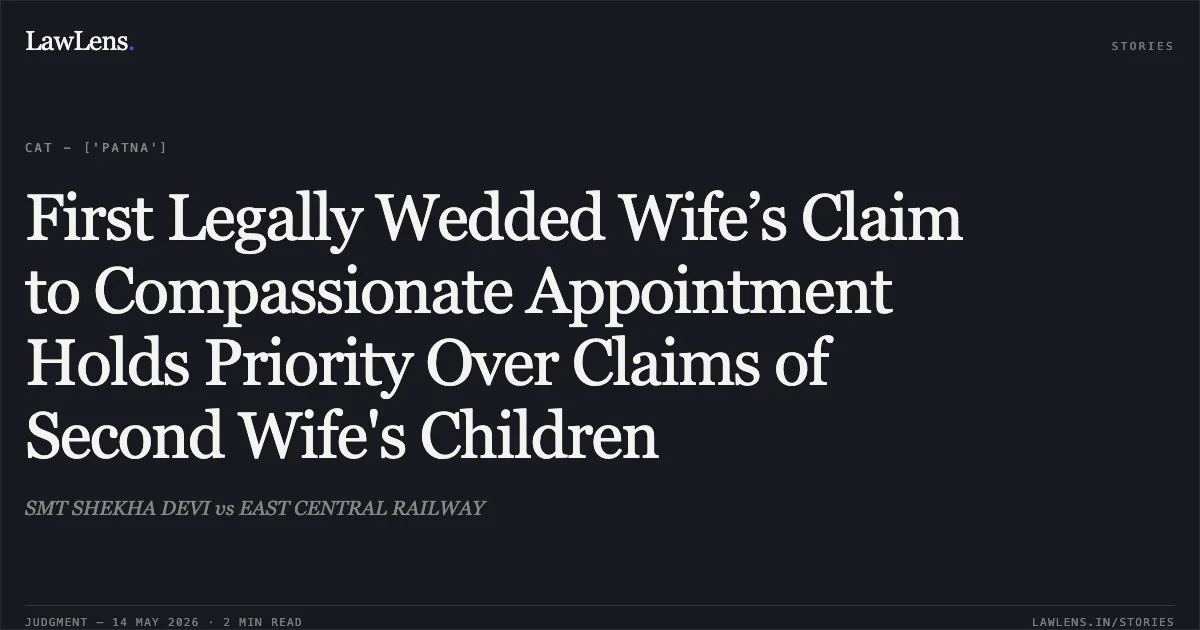
The court applied RBE No. 218/2019, which modifies earlier circulars to allow children of a second wife to be considered for compassionate appointment but mandates that the legally wedded first wife’s claim for herself or her children takes priority over competing claims from the second wife’s family.
Source reference: p. 7-8The court further applied Section 5(1) of the Hindu Marriage Act, 1955, which prohibits bigamy and renders a second marriage void if the first spouse is living and not legally divorced.
Source reference: p. 8-9It also referenced Rule 75(6) of the CCS (Pension) Rules, 1972 regarding eligibility for benefits.
Source reference: p. 9Reasoning
The Tribunal reasoned that while the Supreme Court in Union of India v. V.R. Tripathi (dismissing SLP(C) No. 32004/2016) protected the rights of children from second marriages, the administrative policy (RBE No. 218/2019) explicitly gives priority to the "legally wedded" first wife and her offspring.
Source reference: p. 7-8The Tribunal found that neither the separation since 1991 nor the recording of the second wife's name in railway documents (Pass/Medical Card) conferred legal status upon the second marriage, as no decree of divorce existed to dissolve the first marriage under the Hindu Marriage Act.
Source reference: p. 9Since Respondent No. 5 (the first wife) actively opted for her daughter’s appointment, the department correctly applied the seniority of claim established by the RBE.
Source reference: p. 9Finally, the Tribunal noted a procedural defect: the applicants failed to implead Nayanika Singh, who had already been appointed and would be adversely affected by any order.
Source reference: p. 10Holding
The Tribunal answered that the first wife’s claim holds legal priority and the second wife lacks legal status despite official nominations.
The Tribunal held the O.A. was "devoid of merit" and "barred by the principle of non-joinder of necessary party." The O.A. was dismissed, and the impugned order dated 11.04.2022 was upheld.
Source reference: p. 10Acts & Sections Cited
1 provisions across 1 statute referred to in this judgment. Each provision opens on LawLens.
Hindu Marriage Act, 19551
Original Court PDF
SMT SHEKHA DEVIvsEAST CENTRAL RAILWAY
Click to open original judgment
Original judgment, available to read, download and summarize on LawLens.in