Facts
On February 21, 2021, the complainant’s family was at Marhi Mata Temple for a picnic. A scuffle broke out with 7–8 individuals (the appellants) following an objection to their abusive language
Source reference: para 5During the assault involving wooden sticks and an iron cooking implement (Kevcha), Karan Ratre died and others were injured
Source reference: para 5The Trial Court (Second Additional Sessions Judge, Bilaspur) convicted the six appellants under Sections 147, 148, and 302/149 of the IPC, sentencing them to life imprisonment
Source reference: para 3The appellants challenged the conviction on the grounds of misidentification and lack of forensic evidence
Source reference: para 11Issues
1. Whether the death of the deceased, Karan Ratre, was homicidal in nature
Source reference: para 142. Whether the prosecution proved beyond reasonable doubt that the appellants were the actual assailants
Source reference: para 16Law Applied
The court applied Section 302 of the IPC (Punishment for Murder) read with Section 149 (Every member of unlawful assembly guilty of offence committed in prosecution of common object)
Source reference: para 3It also considered Section 147 (Punishment for Rioting) and Section 148 (Rioting, armed with deadly weapon)
Source reference: para 3Procedurally, the court relied on the evidentiary value of Test Identification Parades (TIP) and the standard of "proof beyond reasonable doubt" required for conviction in criminal jurisprudence
Source reference: para 23It finally mandated compliance with Section 437-A CrPC (now Section 481 BNSS) regarding bail bonds pending potential higher court appeals
Source reference: para 26Reasoning
The court affirmed the homicidal nature of the death based on the post-mortem report (Exhibit P/1) showing internal brain hemorrhage
Source reference: para 15Notably, the complainant and two injured eyewitnesses (PW-6 and PW-7) turned hostile and failed to identify the accused in court
Source reference: para 20While PW-5 (Rekha Samundre) identified the appellants in court, she was not part of the TIP, and her first-time identification in court without previously knowing the accused was deemed unreliable
Source reference: para 11, 21, 23Furthermore, there was no specific attribution of overt acts to individual appellants
Source reference: para 21The recovery of weapons was deemed inconsequential as there was no FSL report confirming the presence of human blood, and no doctor's query report linked the weapons to the specific injuries sustained
Source reference: para 22, 23Holding
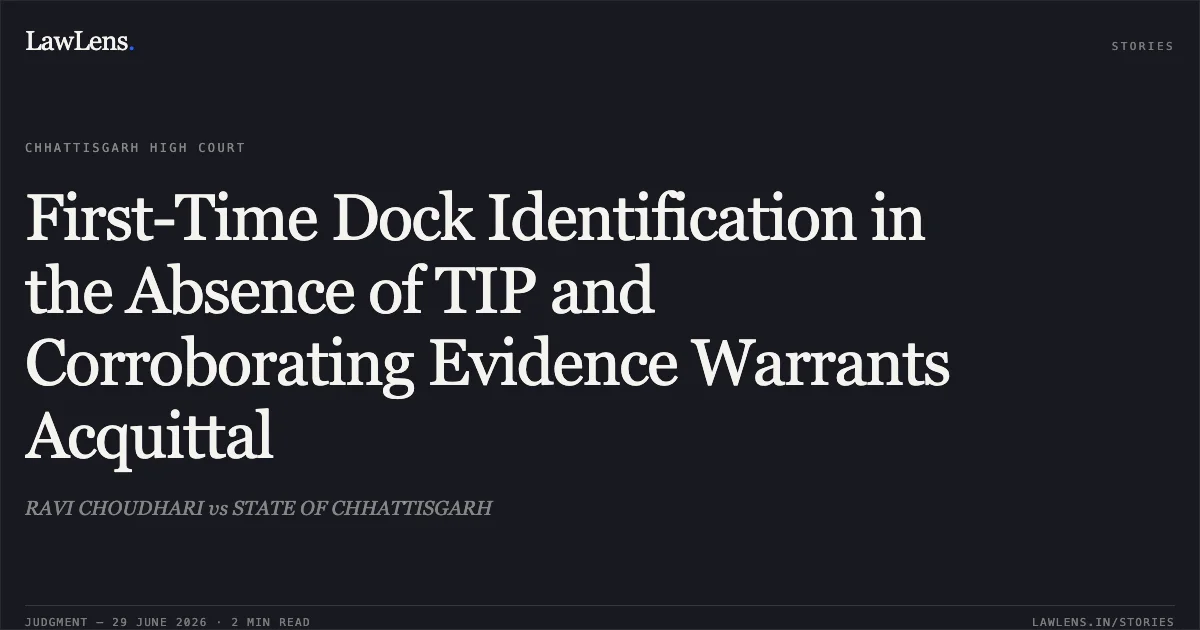
The High Court held that the prosecution failed to establish the guilt of the appellants beyond reasonable doubt
The Court answered the first issue in the affirmative (homicidal death) but the second issue in the negative (identity not proven)
Source reference: para 15, 24Consequently, the High Court set aside the judgment dated September 29, 2025, acquitted all appellants of the charges, and ordered their immediate release. The appellants were directed to furnish personal bonds under Section 437-A CrPC to remain effective for six months in case of a further appeal to the Supreme Court
Source reference: para 24-26Acts & Sections Cited
9 provisions across 3 statutes referred to in this judgment. Each provision opens on LawLens.
Bharatiya Nagarik Suraksha Sanhita, 20231
Code of Criminal Procedure, 19732
Indian Penal Code, 18606
Original Court PDF
RAVI CHOUDHARIvsSTATE OF CHHATTISGARH
Click to open original judgment
Original judgment, available to read, download and summarize on LawLens.in