Facts
The petitioner, original plaintiff in Regular Civil Suit No. 15 of 2001, challenged the dismissal of that suit dated 29 November 2014 by filing Regular Civil Appeal No. 77 of 2014.
Source reference: paras. 4.1–4.2; pp. 5–6During the pendency of the appeal, the original respondent-defendant died. His advocate informed the appellate court of the death through a pursis dated 23 March 2021, which was seen by the petitioner’s advocate and recorded by the court.
Source reference: para. 4.2; p. 5The pursis did not contain the death certificate or the names and addresses of the deceased respondent’s legal heirs.
Source reference: para. 4.3; p. 6The petitioner filed applications on 7 January 2026 seeking to bring the legal heirs on record, set aside the abatement, and condone approximately five years’ delay.
Source reference: para. 5; p. 6The Principal District Judge, Jamnagar rejected the applications below Exhibits 1, 9, 10 and 11 on 16 April 2026, holding that the petitioner had not provided a reasonable explanation for the delay and had acted carelessly.
Source reference: para. 8; p. 8The petitioner invoked Article 227 of the Constitution seeking quashing of that order and restoration of the appeal.
Source reference: para. 2; p. 2Issues
Whether the pursis dated 23 March 2021, informing the appellate court of the respondent’s death in the presence of and with the knowledge of the petitioner’s advocate, constituted sufficient compliance with Order XXII Rule 10A of the CPC, despite the absence of the death certificate and particulars of the legal heirs?
Source reference: paras. 9–9.3; pp. 8–10Whether the petitioner had shown sufficient cause for condoning the five-year delay in seeking substitution of the deceased respondent’s legal heirs and setting aside the abatement?
Source reference: paras. 5–8, 13; pp. 6–8, 20Whether the appellate court’s refusal to condone the delay and its rejection of the substitution applications disclosed perversity, illegality or material irregularity warranting interference under Article 227 of the Constitution?
Source reference: paras. 14–15; pp. 20–21Law Applied
The Court applied Order XXII Rule 10A of the Code of Civil Procedure, which requires a pleader who learns of a party’s death to inform the court, upon which the court is ordinarily required to notify the opposite party.
Source reference: paras. 9.1–9.2; p. 9The Court held that the rule does not require the deceased party’s advocate to file the death certificate or furnish the names and addresses of the legal heirs; where the death is communicated in the presence of the opposite party’s advocate and recorded by the court, there is substantial compliance.
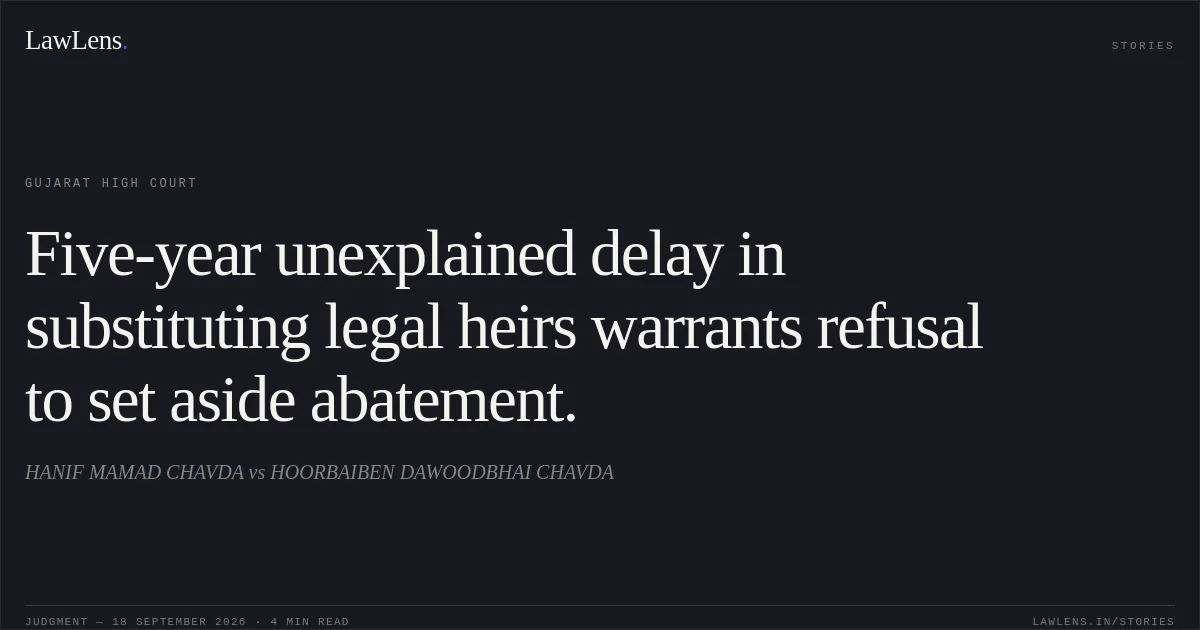
Source reference: paras. 9.2–9.7; pp. 9–13Under Sections 3 and 5 of the Limitation Act, 1963, limitation must be enforced, while delay may be condoned only upon sufficient cause; such discretion is judicial and cannot be exercised mechanically in cases of gross negligence or want of due diligence.
Source reference: paras. 10–12; pp. 14–20The Court relied on Om Prakash Gupta v. Satish Chandra, 2025 (0) AIR (SC) 1201, concerning the scope of Order XXII Rule 10A; Lanka Venkateswarlu v. State of A.P., (2011) 4 SCC 363, cautioning against condoning unjustified delay; Pathapati Subba Reddy v. Special Deputy Collector (LA), 2024 INSC 286, summarising the principles governing “sufficient cause”; and Shivamma v. Karnataka Housing Board, 2025 INSC 1104, emphasising bona fides, diligence and the relevance of the length of delay.
Source reference: paras. 9.5, 10–12; pp. 11–20The supervisory jurisdiction under Article 227 does not permit interference merely because another view is possible; intervention requires patent illegality, perversity or material irregularity.
Source reference: para. 14; p. 20Reasoning
The High Court held that the petitioner’s advocate had actual knowledge of the respondent’s death because the respondent’s advocate’s pursis was seen by him and recorded by the appellate court on 23 March 2021.
Source reference: paras. 4.2, 9.7; pp. 5, 13The absence of the death certificate and particulars of the legal heirs did not negate compliance with Order XXII Rule 10A, particularly because that provision only imposes a duty to communicate the fact of death.
Source reference: paras. 9.2–9.7; pp. 9–13Since the petitioner and the deceased respondent were next-door neighbours, the petitioner could reasonably have obtained the death and heirship particulars without waiting for five years.
Source reference: paras. 4.3, 9.3; pp. 6, 10The applications filed only on 7 January 2026 contained no satisfactory explanation for the prolonged inaction and also included an inaccurate statement suggesting that the petitioner was an institution and had learned of the death only through returned summons.
Source reference: para. 6; p. 7Applying the principles that liberal construction cannot override limitation, and that gross negligence and want of diligence may justify refusal even where condonation is discretionary, the Court found no sufficient cause for the delay.
Source reference: paras. 10–13; pp. 14–20The appellate court’s decision was therefore neither perverse nor legally defective so as to warrant interference under Article 227.
Source reference: paras. 8, 14; pp. 8, 20Holding
The Court held that Order XXII Rule 10A had been substantially complied with because the respondent’s death was clearly communicated to, and recorded in the presence of, the petitioner’s advocate.
The petitioner failed to establish sufficient cause for the five-year delay in bringing the legal heirs on record and setting aside the abatement.
Source reference: paras. 10–13; pp. 14–20Finding no illegality, irregularity or perversity in the appellate court’s order dated 16 April 2026, the High Court dismissed the petition under Article 227, confirmed the impugned order, and made no order as to costs.
Source reference: paras. 14–15; p. 21Acts & Sections Cited
3 provisions across 1 statute referred to in this judgment. Each provision opens on LawLens.
Limitation Act, 19633
Original Court PDF
HANIF MAMAD CHAVDAvsHOORBAIBEN DAWOODBHAI CHAVDA
Click to open original judgment
Original judgment, available to read, download and summarize on LawLens.in