Facts
The applicant, a 75-year-old retired Assistant Director of the Andaman and Nicobar Administration, retired from service on March 31, 2009
Source reference: para. 2(a)Between December 2020 and January 2021, while in Chennai, he underwent specialized cardiac treatment (angiography and other procedures) at Madras Medical Mission Hospital, incurring expenses of ₹4,24,573/-
Source reference: para. 2(b)-(c)In June 2024, he underwent eye surgery (Phaco Emulsification) in Kerala, costing ₹46,170/-
Source reference: para. 2(e)The respondent authorities, via a Speaking Order dated August 7, 2024, rejected his claim for medical reimbursement
Source reference: para. 2(d)The rejection was based on the grounds that the applicant received a Fixed Medical Allowance (FMA) with his pension, had not opted for the Central Government Health Scheme (CGHS), and had failed to utilize the cashless treatment facility under the Pradhan Mantri Jan Arogya Yojana (PMJAY)
Source reference: para. 2(d), 10The applicant challenged this rejection seeking full reimbursement with interest
Source reference: para. 1Issues
1. Whether a pensioner receiving Fixed Medical Allowance (FMA) is precluded from claiming reimbursement for specialized or emergency medical treatment for serious ailments
Source reference: para. 7, 122. Whether the non-option for CGHS or failure to use specific empanelled hospitals under PMJAY justifies the rejection of a medical reimbursement claim for life-threatening or specialized conditions
Source reference: para. 10, 12Law Applied
The court applied the principles governing medical reimbursement for Central Government pensioners as established in Union of India v. V.A. Abraham (WPCT No. 213 of 2004), which was upheld by the Supreme Court
Source reference: para. 4, 6It relied on the Ministry of Health and Family Welfare’s O.M. dated June 5, 1998, regarding the extension of CS(MA) Rules to pensioners in non-CGHS areas
Source reference: para. 7The court further cited Shiv Kant Jha v. Union of India and Union of India v. Shri Amson (WPCT No. 9 of 2026), establishing that FMA is intended only for routine medical expenses and does not constitute a waiver of the right to reimbursement for extraordinary or specialized treatment
Source reference: para. 8, 12Reasoning
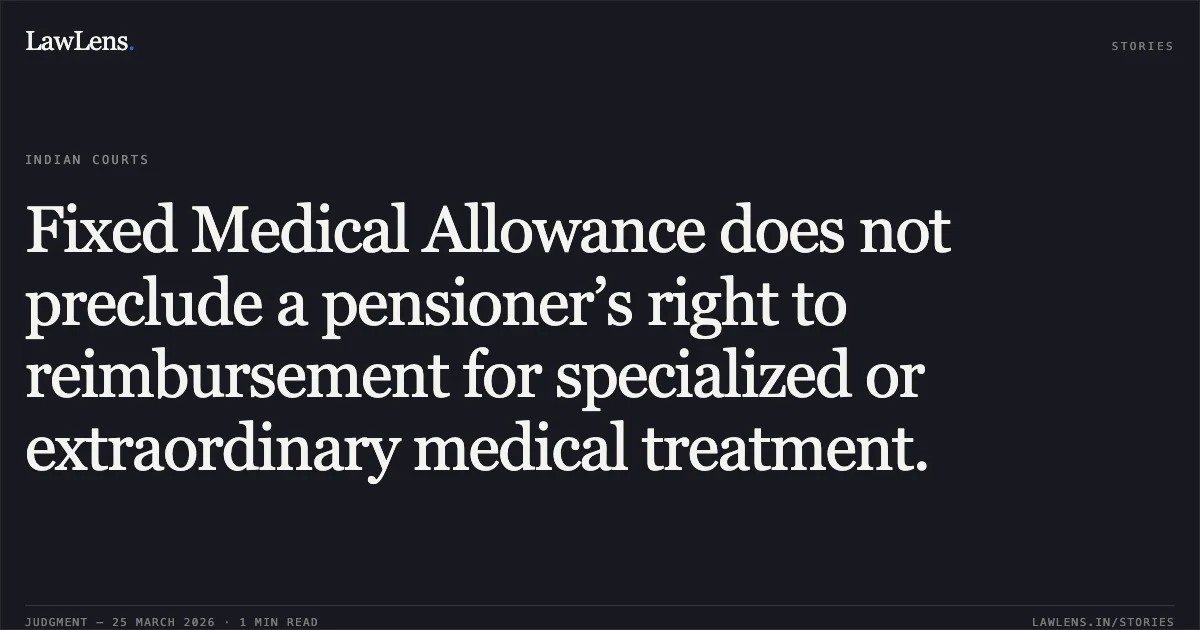
The Tribunal found that the respondents' reliance on the applicant's receipt of FMA and his non-enrollment in CGHS was legally untenable for specialized treatments
Source reference: para. 10, 12The court reasoned that FMA is a nominal sum meant for minor outpatient expenses and cannot be equated with a comprehensive medical cover for life-threatening diseases
Source reference: para. 8, 12Citing Union of India v. V.A. Abraham, the Tribunal noted that because adequate medical facilities for such serious ailments were unavailable in the Andaman and Nicobar Islands, the applicant was compelled to seek treatment on the mainland
Source reference: para. 6, 9, 11The court emphasized that a "right to health" is a fundamental consideration, and technicalities regarding which scheme was opted for cannot be used to place "unreasonable restrictions" on a pensioner’s right to reimbursement for necessary surgeries
Source reference: para. 8, 12Holding
The Tribunal quashed the impugned rejection order dated August 7, 2024
It held that the applicant is entitled to medical reimbursement regardless of his FMA status or non-option for CGHS
Source reference: para. 12The respondents were directed to reimburse the medical expenses incurred for heart and eye treatments as per his submitted claims, provided they are verified as correct under the rules, within three months of receiving the order
Source reference: para. 13The O.A. was disposed of with no order as to costs
Source reference: para. 13Acts & Sections Cited
1 provisions across 1 statute referred to in this judgment. Each provision opens on LawLens.
Administrative Tribunals Act, 19851
Original Court PDF
V P BabuvsA & N ADMINISTRATION
Click to open original judgment
Original judgment, available to read, download and summarize on LawLens.in


