Facts
Dipti Palit died intestate on 29 November 2015, leaving certain debts and securities.
Source reference: para. 3The appellant, claiming to be the sole heir as the son of the deceased’s brother, applied under Section 372 of the Indian Succession Act, 1925, for a succession certificate, asserting entitlement under Section 15(1)(d) of the Hindu Succession Act, 1956.
Source reference: para. 3The respondents, claiming to be the deceased’s nephew and sister-in-law, opposed the application and filed a counter-claim seeking the certificate in their favour.
Source reference: para. 4The District Judge, Cachar, Silchar, found that the assets were the deceased’s self-acquired properties and granted the succession certificate to the respondents under Section 15(1)(b) of the Hindu Succession Act.
Source reference: para. 6The appellant challenged that decision under Section 384 of the Indian Succession Act, 1925.
Source reference: para. 2Issues
Whether the debts and securities of the intestate female Hindu, being her self-acquired property, devolved under Section 15(1) of the Hindu Succession Act, 1956, and whether the respondents had preference over the appellant?
Source reference: paras. 6–8, 10–12Whether the exception under Section 15(2)(a) of the Hindu Succession Act applied on the basis that the property had been inherited from the deceased’s father or mother?
Source reference: paras. 7–12Whether the succession certificate granted by the trial court to the respondents required interference in appeal under Section 384 of the Indian Succession Act, 1925?
Source reference: paras. 2, 13–14Law Applied
The Court applied Sections 372 and 384 of the Indian Succession Act, 1925, concerning applications for and appeals against succession certificates.
Source reference: paras. 2–3Under Section 15(1) of the Hindu Succession Act, 1956, the property of a female Hindu dying intestate devolves in the statutory order: first upon her sons, daughters and husband; secondly upon the heirs of her husband; thirdly upon her mother and father; fourthly upon the heirs of her father; and lastly upon the heirs of her mother.
Source reference: para. 10The entries are preferential, so heirs in an earlier category exclude heirs in subsequent categories.
Source reference: para. 11Section 15(2)(a) creates an exception for property inherited by the female Hindu from her father or mother, which, in the absence of her children, devolves upon the heirs of the father; however, the exception depends upon proof of the source of inheritance.
Source reference: paras. 10–11Reasoning
The Court accepted the trial court’s finding that the debts and securities were the deceased’s self-acquired properties and that there was no evidence showing that they had been inherited from her paternal side.
Source reference: para. 12Consequently, Section 15(2)(a) was inapplicable, and succession was governed by the general order under Section 15(1).
Source reference: paras. 10–12The appellant, being the son of the deceased’s brother, was treated as falling within Section 15(1)(d), whereas the respondents were held to fall within the preferential category of the heirs of the husband under Section 15(1)(b).
Source reference: para. 12Since the earlier category excludes the subsequent category, the respondents were preferred over the appellant in respect of the self-acquired property.
Source reference: paras. 11–12The High Court therefore found no legal infirmity in the trial court’s judgment warranting appellate interference.
Source reference: para. 13Holding
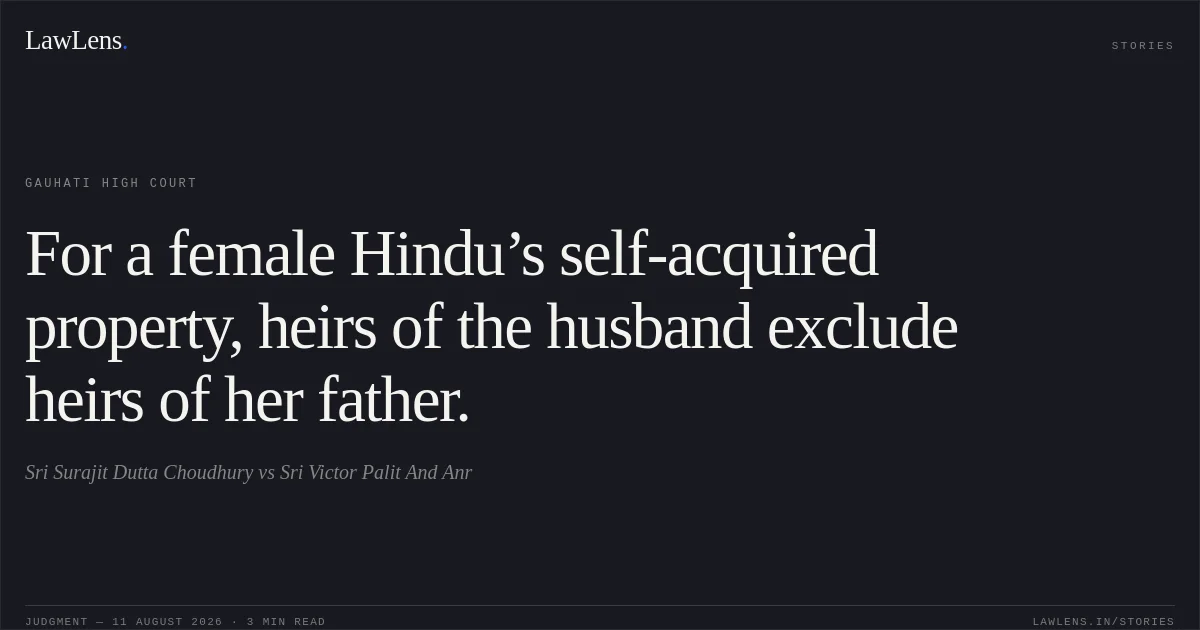
The High Court held that the deceased’s self-acquired debts and securities devolved under Section 15(1) of the Hindu Succession Act, 1956, and that the respondents, as heirs within the preferential category under Section 15(1)(b), excluded the appellant, who fell under Section 15(1)(d).
Section 15(2)(a) did not apply because there was no evidence that the property had been inherited from the deceased’s father or mother.
Source reference: para. 12The appeal under Section 384 of the Indian Succession Act was dismissed with costs, and the trial court records were directed to be returned along with a copy of the judgment.
Source reference: paras. 14–15Acts & Sections Cited
5 provisions across 2 statutes referred to in this judgment. Each provision opens on LawLens.
Indian Succession Act, 19253
Hindu Succession Act, 19562
Original Court PDF
Sri Surajit Dutta ChoudhuryvsSri Victor Palit And Anr
Click to open original judgment
Original judgment, available to read, download and summarize on LawLens.in