Facts
The deceased, Ghana Mary, died when the car in which she and the claimant were travelling was struck by a train at an unmanned railway crossing.
Source reference: paras. 2.1–2.3; pp. 2–3The Tribunal found the car driver negligent and awarded ₹57,52,136 in compensation.
Source reference: paras. 2.1–2.3; pp. 2–3The Insurance Company’s appeal under Section 173 of the Motor Vehicles Act, 1988, did not challenge the findings on negligence or liability; it challenged only the deduction applied for the deceased’s personal and living expenses.
Source reference: paras. 3.1–3.2; p. 3The deceased was married, and there was one claimant/dependent.
Source reference: para. 8.8; p. 7Issues
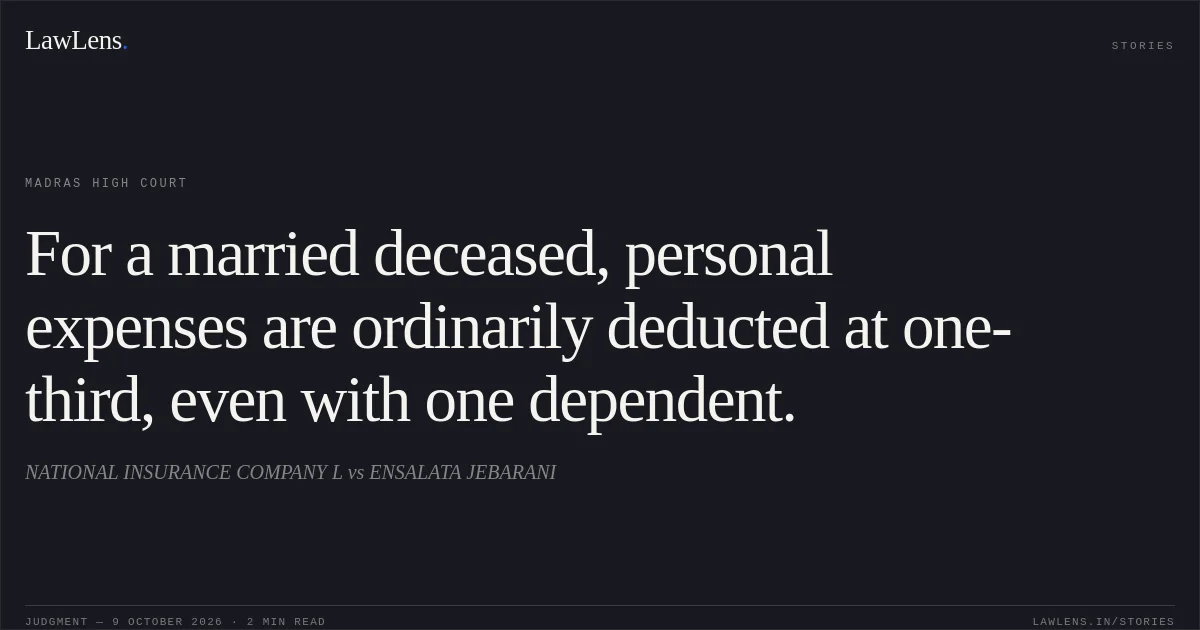
Whether, for a married deceased with only one claimant/dependent, the deduction towards personal and living expenses should be one-half or one-third of the income.
Source reference: para. 6.1; p. 5Law Applied
Under Sarla Verma (Smt.) v. Delhi Transport Corporation, as approved in National Insurance Co. Ltd. v. Pranay Sethi, the ordinary deduction for a married deceased is one-third towards personal and living expenses; the deduction is not converted to one-half merely because there is only one claimant.
Source reference: para. 8.2; p. 5A one-half deduction ordinarily applies in the case of a bachelor.
Source reference: paras. 8.4–8.5; pp. 6–7The Supreme Court’s decision in Ved Kanwar & Ors. v. Babulal & Ors., SLP (C) Nos. 5776–5777 of 2023, reiterated that a one-third deduction is the minimum ordinary deduction where the deceased was married, even if other claimants are not dependants.
Source reference: paras. 8.4–8.5; pp. 6–7Reasoning
The Court rejected the Insurance Company’s argument that the deduction depended solely on the number of dependants.
Source reference: paras. 8.1–8.8; pp. 5–7It treated the deceased’s marital status—not the fact that only one claimant had approached the Tribunal—as decisive under the applicable principles.
Source reference: paras. 8.1–8.8; pp. 5–7Since the deceased was married, the Tribunal correctly deducted one-third of her income.
Source reference: paras. 8.1–8.8; pp. 5–7The Insurance Company identified no basis to interfere with that calculation, and its other challenges to negligence and liability were not before the Court.
Source reference: paras. 8.1–8.8; pp. 5–7Holding
The Court held that the one-third deduction was appropriate and dismissed the appeal, confirming the Tribunal’s award of ₹57,52,136.
The Insurance Company was directed to deposit the award, with interest as ordered by the Tribunal and credit for any amount already deposited, within six weeks of receiving the judgment; the claimant may withdraw the amount in accordance with the Tribunal’s apportionment.
Source reference: paras. 9.1–9.4; p. 8No order as to costs.
Source reference: paras. 9.1–9.4; p. 8Acts & Sections Cited
1 provisions across 1 statute referred to in this judgment. Each provision opens on LawLens.
Motor Vehicles Act, 19881
Original Court PDF
NATIONAL INSURANCE COMPANY LvsENSALATA JEBARANI
Click to open original judgment
Original judgment, available to read, download and summarize on LawLens.in