Facts
On 22 June 2013, GRP police received secret information that two passengers travelling in the Samta Express were carrying ganja. The police intercepted the appellant in a general carriage and recovered a suspected ganja-like substance from his office bag.
Source reference: para. 2, pp. 2–3After completing the search, seizure, weighing, homogenisation, sampling, and documentation proceedings, the seized substance was found to weigh 4.500 kilograms; samples were sent to the State Forensic Science Laboratory, Raipur, and the material was deposited in the malkhana.
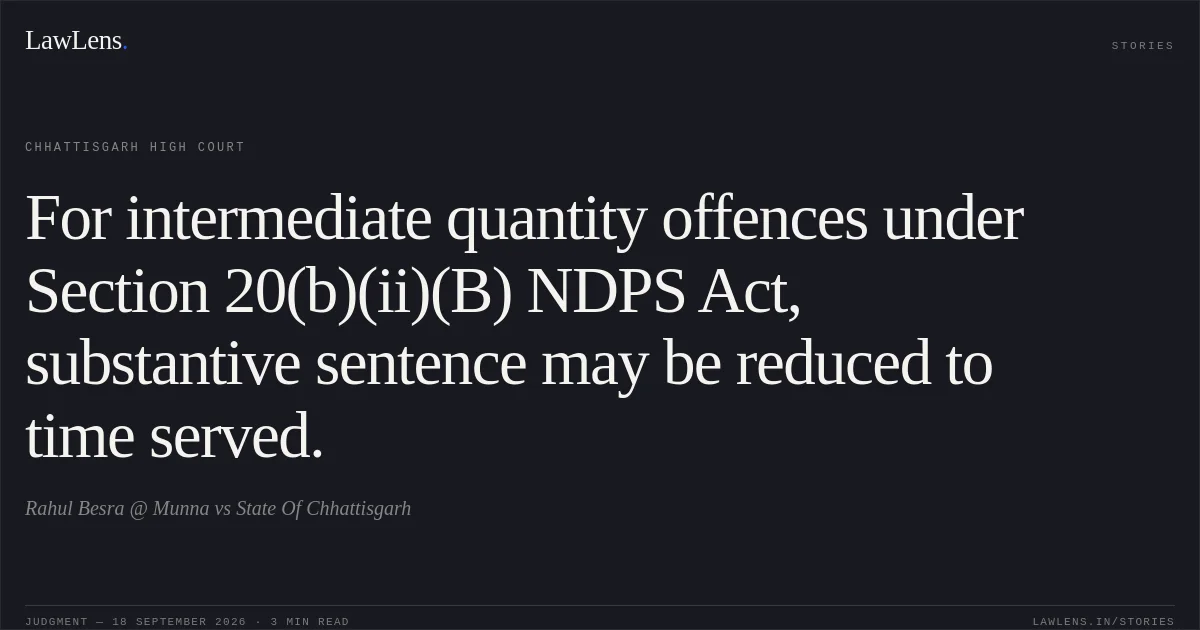
Source reference: para. 2, pp. 2–3The appellant was prosecuted under Section 20(b)(ii)(B) of the Narcotic Drugs and Psychotropic Substances Act, 1985 (“NDPS Act”). The Special Judge, Rajnandgaon, convicted him and sentenced him to five years’ rigorous imprisonment, a fine of ₹20,000, and, in default, one year’s additional rigorous imprisonment.
Source reference: para. 1, p. 1In appeal under Section 374(2) of the Code of Criminal Procedure, the appellant did not challenge his conviction and confined the challenge to the quantum of sentence, asserting that he had undergone more than six months’ incarceration, that the offence was of 2013, that the recovered quantity was intermediate, and that he had deposited the fine.
Source reference: para. 5, pp. 4–5Issues
1. Whether the conviction of the appellant under Section 20(b)(ii)(B) of the NDPS Act was sustainable on the evidence of recovery, seizure, weighing, and forensic examination.
Source reference: paras. 8–9, pp. 4–52. Whether, having regard to the quantity recovered, the period already undergone, the absence of a statutory minimum sentence, the lapse of time, and the appellant’s antecedents, the substantive sentence should be reduced to the period already undergone.
Source reference: paras. 10–15, pp. 5–9Law Applied
The Court applied Section 20(b)(ii)(B) of the NDPS Act concerning possession of cannabis in an intermediate quantity and Section 374(2) CrPC governing appeals against conviction.
Source reference: no citationIt relied on the sentencing principle of proportionality, under which punishment must correspond to the gravity and manner of the offence while also considering the offender’s circumstances, antecedents, prospects of reform, and the lapse of time.
Source reference: para. 10, pp. 5–7Drawing on Raj Bala v. State of Haryana, (2016) 1 SCC 463, Gopal Singh v. State of Uttarakhand, (2013) 7 SCC 545, and Shailesh Jasvantbhai v. State of Gujarat, (2006) 2 SCC 359, the Court held that sentencing discretion must be rational rather than based on sympathy or arbitrary leniency, and must balance societal interests with proportionate punishment.
Source reference: para. 10, pp. 5–7The Court also relied on Mohammad Giasuddin v. State of Andhra Pradesh, (1977) 3 SCC 287, for the principle that sentencing must be individualised by considering aggravating and mitigating circumstances, the offender’s background, and prospects of rehabilitation.
Source reference: para. 11, p. 7Reasoning
The Court found that the testimony of the investigating officer and seizure witnesses established the appellant’s interception and possession of the contraband, while the weighing evidence and forensic report corroborated the quantity and nature of the seized substance.
Source reference: para. 8, pp. 4–5It found no material contradiction or infirmity sufficient to undermine the trial court’s finding of guilt and therefore affirmed the conviction.
Source reference: para. 9, p. 5On sentence, the Court considered that the recovered 4.500 kilograms constituted an intermediate quantity, the offence had been committed in 2013, the appellant had already undergone more than six months’ imprisonment, no previous criminal antecedents were shown, and Section 20(b)(ii)(B) did not prescribe a minimum term of imprisonment.
Source reference: para. 13, p. 8Balancing the seriousness of narcotics offences and their societal impact against these mitigating circumstances, the Court held that the original five-year substantive sentence was excessive in the circumstances and warranted modification.
Source reference: paras. 14–15, pp. 8–9Holding
The appeal was partly allowed. The appellant’s conviction under Section 20(b)(ii)(B) of the NDPS Act was affirmed, but the substantive sentence was reduced to the period of imprisonment already undergone.
The fine of ₹20,000 was maintained. If unpaid, the appellant was directed to deposit it within one month, failing which he would undergo two months’ additional rigorous imprisonment.
Source reference: paras. 16–17, p. 9His bail bond was directed to remain operative for the applicable statutory period, and the trial court record was ordered to be returned for compliance.
Source reference: paras. 16–17, p. 9Acts & Sections Cited
5 provisions across 2 statutes referred to in this judgment. Each provision opens on LawLens.
Code of Criminal Procedure, 19734
Narcotic Drugs and Psychotropic Substances Act, 19851
Original Court PDF
Rahul Besra @ MunnavsState Of Chhattisgarh
Click to open original judgment
Original judgment, available to read, download and summarize on LawLens.in