Facts
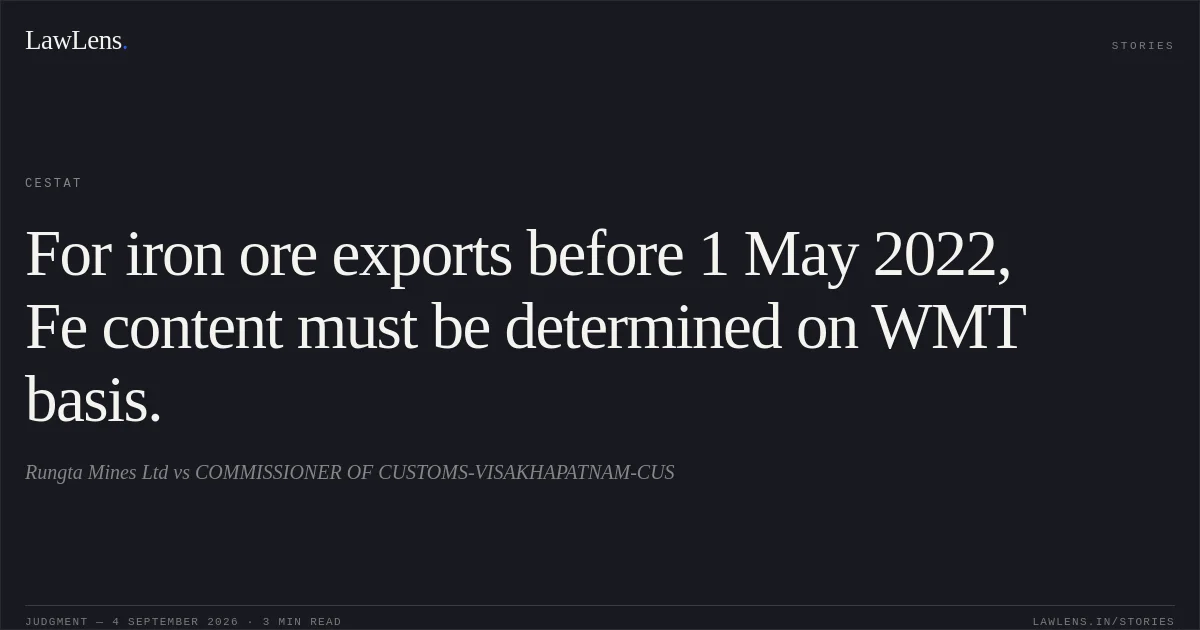
The appellant exported iron ore fines under shipping bills filed before 1 May 2022.
Source reference: para. 2A dispute arose regarding the method for determining the iron (Fe) content for classification and levy of export duty—whether it should be calculated on a Wet Metric Ton (WMT) basis, accounting for moisture, or on a Dry Metric Ton (DMT) basis.
Source reference: para. 2The Commissioner (Appeals) rejected the appellant’s claim, inter alia, on the grounds that the assessments had been accepted without protest and that the appellant was seeking to introduce additional material at the appellate stage.
Source reference: paras. 4–5, 10The three appeals were heard together because they involved common questions of law and fact.
Source reference: para. 1Issues
Whether the Fe content of iron ore fines exported under shipping bills filed before 1 May 2022 was required to be determined on a WMT basis or a DMT basis for classification and levy of export duty?
Source reference: paras. 2, 7–9, 13Whether the appellant was barred from raising the legal issue at the appellate stage because the assessments had been accepted without protest and the claim allegedly involved additional evidence?
Source reference: paras. 4, 10–12Law Applied
The Tribunal applied the principle laid down by the Supreme Court in Union of India v. Gangadhar Narsingdas Aggarwal, 1997 (89) E.L.T. 19 (S.C.), that the Fe content of iron ore exported in moist condition must be determined with reference to the condition of the goods at the time of export, and that a dry-basis percentage cannot be directly applied to goods exported in moist condition.
Source reference: para. 7It relied on Board Circular No. 4/2012-Cus. dated 17 February 2012, which clarified that Fe content for export-duty purposes was to be determined on a WMT basis by taking moisture and other impurities into account.
Source reference: para. 7The Tribunal also considered the supplementary note inserted in Chapter 26 of the First Schedule to the Customs Tariff Act, 1975, with effect from 1 May 2022, expressly requiring Fe content under Heading 2601 to be calculated on a DMT basis; this supported the conclusion that the earlier regime was WMT-based.
Source reference: para. 8Further, under Jute Corporation of India Ltd. v. Commissioner of Income Tax, 1991 (51) E.L.T. 176 (S.C.), and Eternit Everest Ltd. v. Commissioner of Central Excise and Customs, Bhopal, 2010 (254) E.L.T. 507 (Tri.-Del.), an appellate authority may entertain an additional legal ground necessary to determine the correct tax liability, and a question of law may be raised at the appellate stage.
Source reference: para. 11The Tribunal also held that there can be no estoppel against the statute.
Source reference: para. 12Reasoning
The Tribunal found that the applicable law for the relevant pre-1 May 2022 exports required the Fe content to be assessed in the condition in which the iron ore was actually exported—namely, in moist form.
Source reference: paras. 7–9, 13Consequently, the Fe percentage had to be determined on a WMT basis, taking the moisture recorded in the relevant test reports into account.
Source reference: paras. 7–9, 13The subsequent statutory insertion expressly prescribing the DMT method from 1 May 2022 reinforced, rather than displaced, the conclusion that the earlier legal position was WMT-based.
Source reference: para. 8The Tribunal further held that the appellant’s contention was a legal challenge based on test reports and material already forming part of the assessment record, not an attempt to introduce an entirely new factual case.
Source reference: paras. 10–12Therefore, Rule 5 of the Customs (Appeals) Rules, 1982 did not justify rejection of the claim.
Source reference: paras. 10–12Acceptance of the assessments without protest could not validate an assessment contrary to the tariff, binding precedent, or the Board’s circular.
Source reference: paras. 10–12Holding
The Tribunal held that, for the shipping bills filed before 1 May 2022, the Fe content of the exported iron ore fines was required to be determined on a WMT basis, including the moisture percentage reflected in the relevant test reports.
The impugned Order-in-Appeal was set aside.
Source reference: para. 14The jurisdictional assessing authority was directed to re-determine the Fe content on a WMT basis, carry out consequential reclassification and reassessment, and grant consequential relief, including refund if otherwise admissible in law.
Source reference: para. 14All three appeals were allowed by way of remand.
Source reference: para. 15Original Court PDF
Rungta Mines LtdvsCOMMISSIONER OF CUSTOMS-VISAKHAPATNAM-CUS
Click to open original judgment
Original judgment, available to read, download and summarize on LawLens.in