Facts
Steel Authority of India Ltd. (“SAIL”) operates a warehouse/stockyard at Durgapur where loading, unloading and storage of steel products are performed through contractual labour. The warehouse was registered as a “shop” under the West Bengal Shops and Establishments Act, 1963.
Source reference: para. 8SAIL had awarded the relevant work to a contractor under tenders stipulating payment of minimum wages notified by the West Bengal Government, and the workers were paid State-notified minimum wages.
Source reference: paras. 9, 28(i)–(iv)The respondent trade union claimed the difference between the Central and State minimum-wage rates for 45 workers for the period October 2022 to December 2025, together with compensation, contending that warehouse work constituted a scheduled employment under Central Government Notification No. S.O. 192(E) dated 19 January 2017.
Source reference: paras. 12, 18–26The Regional Labour Commissioner (Central), Asansol, held that SAIL was a Government of India undertaking, that the Central Government was the appropriate government, and directed payment of the differential wages with compensation.
Source reference: paras. 2, 14SAIL challenged that order under Article 226, contending that it was a company incorporated under the Companies Act and not a corporation established by a Central Act, and that the State minimum-wage rates applied.
Source reference: paras. 13, 15–17Issues
Whether the Central Government or the State Government was the “appropriate government” for determining minimum wages in respect of the scheduled employment at SAIL’s Durgapur warehouse under Section 2(b) of the Minimum Wages Act, 1948?
Source reference: paras. 2, 28(vi), 32–35Whether SAIL’s status as a Central Public Sector Undertaking, with the Central Government holding 65% of its equity, was sufficient to attract Central Government minimum-wage rates?
Source reference: paras. 2, 14–16Whether the Regional Labour Commissioner’s order dated 25 March 2026 directing payment of the differential wages and compensation was legally sustainable?
Source reference: paras. 14–17, 35–37Law Applied
The Court applied Section 2(b) of the Minimum Wages Act, 1948, under which the Central Government is the appropriate government for scheduled employment carried on by or under the authority of the Central Government, or in a mine, oilfield, major port, railway administration, or corporation established by a Central Act; in other cases, the State Government is the appropriate government.
Source reference: para. 28(vi)Section 3 places the responsibility for fixing minimum wages upon the appropriate government.
Source reference: para. 2Relying on Steel Authority of India Ltd. v. National Union Waterfront Workers, (2001) 7 SCC 1, the Court held that a Central Government company is not equated with the Central Government merely because it is an instrumentality or agency of the State; the relevant industry must be carried on by or under the authority of the Central Government, and that authority must be established on the facts.
Source reference: paras. 3–4The Court also relied on Nashik Workers Union v. Hindustan Aeronautics Ltd., (2016) 6 SCC 224, which reaffirmed that government ownership and control alone do not determine the appropriate government and that the principles in the SAIL decision remain applicable.
Source reference: para. 5Reasoning
SAIL was incorporated under the Companies Act and was not established by a specific Central enactment.
Source reference: para. 28(v)The mere fact that the Central Government held 65% of its equity and that SAIL was a Maharatna public-sector undertaking did not establish that the Durgapur warehouse activity was carried on by or under the authority of the Central Government within the meaning of Section 2(b) of the Minimum Wages Act.
Source reference: paras. 2–4, 13–16The work was performed by contract labour supplied by a contractor at a warehouse situated in West Bengal, pursuant to contracts that expressly contemplated payment of State-notified minimum wages.
Source reference: paras. 8–9, 28(i)–(iv), 29–32Applying the principles in SAIL v. National Union Waterfront Workers and Nashik Workers Union, the Court held that SAIL’s status as a Central Government undertaking could not, by itself, convert the State establishment into one governed by Central minimum-wage rates.
Source reference: paras. 30–35The Regional Labour Commissioner had therefore applied the incorrect legal test and had no sufficient basis for directing payment of the Central-State wage differential and compensation.
Source reference: paras. 14–17, 35Holding
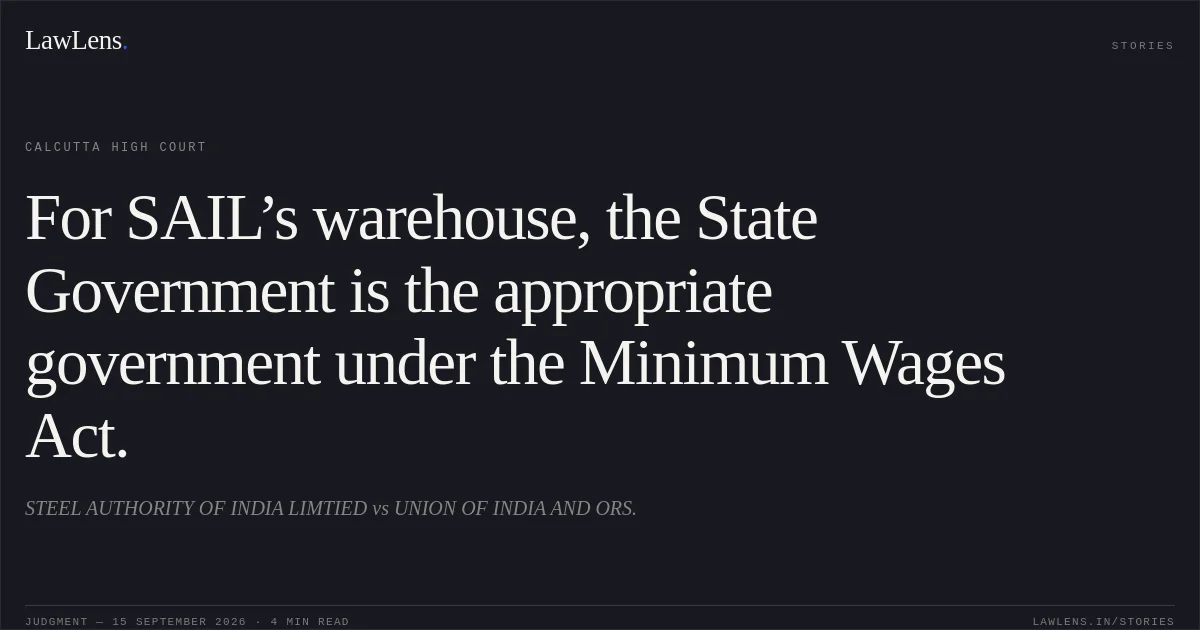
The Court answered the issues in favour of SAIL and held that the State Government was the appropriate government for the Durgapur warehouse establishment.
Central Government ownership and control of SAIL, without proof that the relevant employment was carried on by or under the authority of the Central Government or by a corporation established by a Central Act, was insufficient to attract Central minimum-wage rates.
Source reference: paras. 30–35WPA 8853 of 2026 was allowed, and the Regional Labour Commissioner’s order dated 25 March 2026 directing payment of differential wages and compensation was set aside.
Source reference: paras. 36–37Connected applications were disposed of and any interim order was vacated.
Source reference: paras. 38–39Acts & Sections Cited
4 provisions across 3 statutes referred to in this judgment. Linked provisions open on LawLens.
Minimum Wages Act, 19482
Code on Wages, 20191
West Bengal Shops & Establishments Act, 19631
Original Court PDF
STEEL AUTHORITY OF INDIA LIMTIEDvsUNION OF INDIA AND ORS.
Click to open original judgment
Original judgment, available to read, download and summarize on LawLens.in