Facts
The Petitioner, a registered small-scale industrial unit owned by a Kashmiri Pandit, was allotted Shed No. 5 at Bagh-i-Ali Mardan Khan Industrial Area, Srinagar, in 1978
Source reference: [para. 2]Following the mass migration of 1989, the proprietor fled to Jammu for safety, effectively abandoning the unit
Source reference: [para. 3-4]In 1991, the shed suffered fire damage
Source reference: [para. 5]While the Petitioner was in migration, the State re-allotted Shed No. 5 to Respondent No. 6 in 1996
Source reference: [para. 19]The Petitioner successfully challenged this in OWP No. 488/1996, where the Court directed the State to either provide a similar shed or return Shed No. 5
Source reference: [para. 6]In purported compliance, the State offered two sheds at Rangreth but imposed high premiums and rent significantly higher than the original allotment
Source reference: [para. 7-8]After various contempt proceedings and modifications, the State issued Order No. IDC/B/2004/73 on 06.04.2004, cancelling the Rangreth allotment due to the Petitioner's alleged failure to complete formalities
Source reference: [para. 12]The Petitioner filed the present writ seeking to quash the cancellation and recover possession of Shed No. 5
Source reference: [para. 13]Issues
1. Whether the State's cancellation of the alternative industrial shed allotment was legally sustainable given the Petitioner’s status as a forced migrant.
Source reference: [para. 12-13]2. Whether the State fulfilled its obligation to protect and preserve the leasehold property of a displaced person during a period of civil unrest.
Source reference: [para. 21-22]Law Applied
The Court applied the principles of Natural Justice, specifically the requirement of fair hearing and reasonableness in administrative action
Source reference: [para. 23]It relied on the doctrine of the State’s fiduciary duty to act as a "protector" rather than a "predator" regarding the properties of citizens displaced by forced migration
Source reference: [para. 21-22]The Court emphasized that administrative actions must be equitable and account for extraordinary circumstances, such as internal displacement due to security threats
Source reference: [para. 23]Reasoning
The Court observed that the State exploited the Petitioner’s forced absence by re-allotting his original shed to a third party, describing the State's conduct as "predatory"
Source reference: [para. 21-22]It reasoned that because the migration was a matter of life and limb, the State had a solemn obligation to protect the Petitioner’s leasehold interest rather than treating the absence as a voluntary abandonment
Source reference: [para. 21, 23]The Court found that the subsequent offer of alternative sheds at Rangreth was a "mirage" and "eyewash" because the State attempted to treat the Petitioner as a new allottee by demanding premiums and exorbitant rent, rather than restoring him to his original position
Source reference: [para. 9-10, 21]Furthermore, the Court held that cancelling the allotment while contempt proceedings were pending and while the security situation prevented the Petitioner’s return was a violation of natural justice and an unfair exercise of administrative power
Source reference: [para. 23-24]Holding
The High Court disposed of the writ petition in favor of the Petitioner.
It held that the Petitioner was subjected to inequitable treatment and that justice must be restored by adjusting equities
Source reference: [para. 22]The Court directed the official respondents to: (i) carry forward the allotment of two sheds at Rangreth if vacant, or provide new ones; (ii) waive any requirement for premium payments; and (iii) charge rent at the prevalent rate only prospectively from the date of actual possession, without insisting on past arrears
Source reference: [para. 24]The impugned cancellation order was effectively set aside through these directions
Source reference: [para. 25-26]Original Court PDF
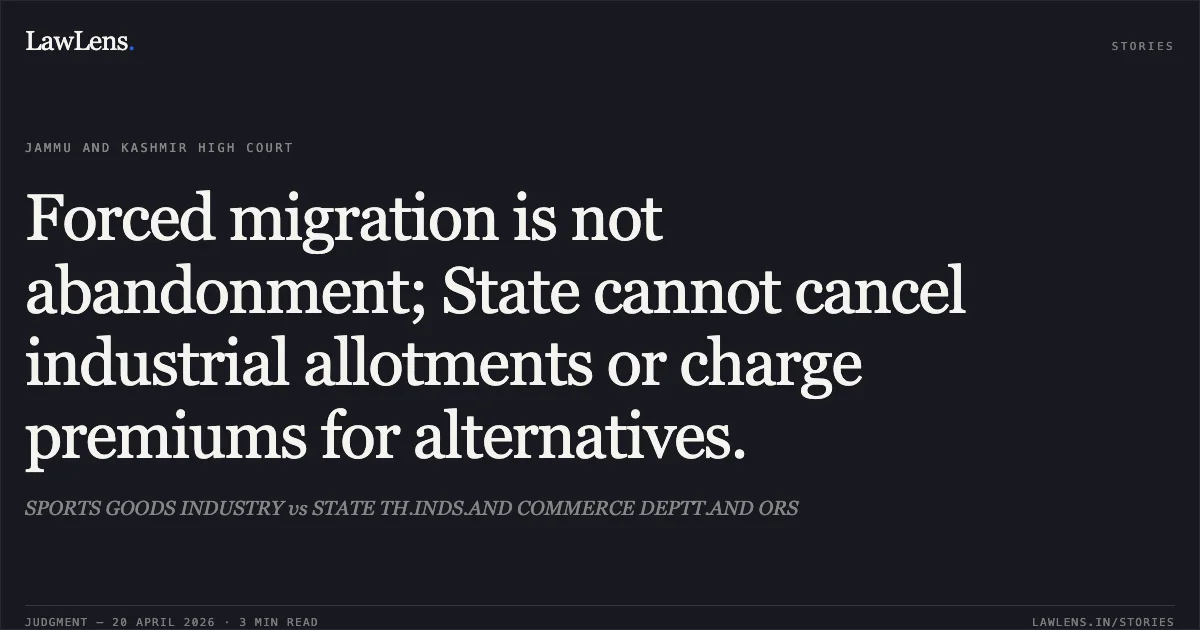
SPORTS GOODS INDUSTRYvsSTATE TH.INDS.AND COMMERCE DEPTT.AND ORS
Click to open original judgment
Original judgment, available to read, download and summarize on LawLens.in