Facts
The Respondent initiated arbitral proceedings against the Petitioners before a three-member Tribunal in Sweden (SCC Arbitration V2020/199) seeking damages of USD 25.2 million based on a Shareholders Agreement
Source reference: para 2, 57, 68The Petitioners resisted the claims, primarily contending that no valid arbitration agreement existed
Source reference: para 5, 58The Tribunal accepted this contention, concluding it lacked jurisdiction as no valid agreement had come into existence
Source reference: para 2, 87, 90However, acting under Sections 37 and 42 of the Swedish Arbitration Act, the Tribunal rendered a "cost-only" award, directing the Respondent to pay the Petitioners approximately Rs. 10.51 Crores in legal and arbitration costs
Source reference: para 2, 21-22, 60The Petitioners sought to execute this foreign award in India under Part II, Chapter I of the Arbitration and Conciliation Act, 1996 ("the Act")
Source reference: para 2The Respondent objected, citing the non-production of the original agreement at the time of filing and the unenforceability of an award predicated on a finding of "no agreement"
Source reference: para 4, 13Issues
1. Whether the non-production of the original arbitration agreement at the time of filing the execution petition, as required by Section 47(1)(b), renders the petition non-maintainable?
Source reference: para 4, 692. Whether an arbitral award for costs, rendered by a Tribunal that found no valid arbitration agreement existed, qualifies as a "foreign award" under Section 44 of the Act?
Source reference: para 6, 813. Whether such an award is enforceable under Section 48 of the Act, particularly concerning the fundamental policy of Indian law and the capability of the subject matter to be settled by arbitration?
Source reference: para 16, 80, 82Law Applied
The court primarily applied Section 44 of the Act, which defines a "foreign award" as one made in pursuance of an "agreement in writing" for arbitration
Source reference: para 48, 52It relied on Section 47 regarding the evidence required for enforcement, interpreting the word "shall" as "may" (directory) based on PEC Limited v. Austbulk Shipping SDN BHD (2019) 11 SCC 620
Source reference: para 28, 71The court also applied Section 48, which specifies grounds for refusal of enforcement, including the invalidity of the agreement [S. 48(1)(a)], the subject matter not being capable of settlement by arbitration [S. 48(2)(a)], and conflict with the public policy of India [S. 48(2)(b)]
Source reference: para 50-51, 80Precedents like Gemini Bay Transcription Pvt. Ltd. v. Integrated Sales Service Ltd. (2022) 1 SCC 753 and Pasl Wind Solutions (P) Ltd. v. GE Power Conversion (India) (P) Ltd. (2021) 7 SCC 1 were cited to establish the essential ingredients of a foreign award
Source reference: para 52, 55, 81Reasoning
The court first resolved the procedural objection under Section 47, holding that the subsequent production of the agreement was sufficient compliance, as the requirement to file it "at the time of application" is directory and not a ground for dismissal if the document's legitimacy is undisputed
Source reference: para 70-71On the merits of enforceability, the court noted that the Petitioners themselves had successfully argued in Sweden that no arbitration agreement existed
Source reference: para 74, 85The court held that under Section 44(a), a "foreign award" must arise from an "agreement in writing"
Source reference: para 73, 81Since the Tribunal explicitly found that no such agreement existed, the resulting award failed to meet the statutory definition of a "foreign award" under Indian law
Source reference: para 81Furthermore, under Section 48(2)(a), the court determined that Indian law does not recognize "agreement-less" arbitration; thus, the dispute was not "capable of settlement by arbitration" in India
Source reference: para 80, 82Lastly, the court noted that the Petitioners were estopped from seeking enforcement because they had previously pleaded before the Tribunal that such a cost award would be unenforceable in India for lack of a signed agreement
Source reference: para 13, 76-77Holding
The High Court dismissed the Execution Petition
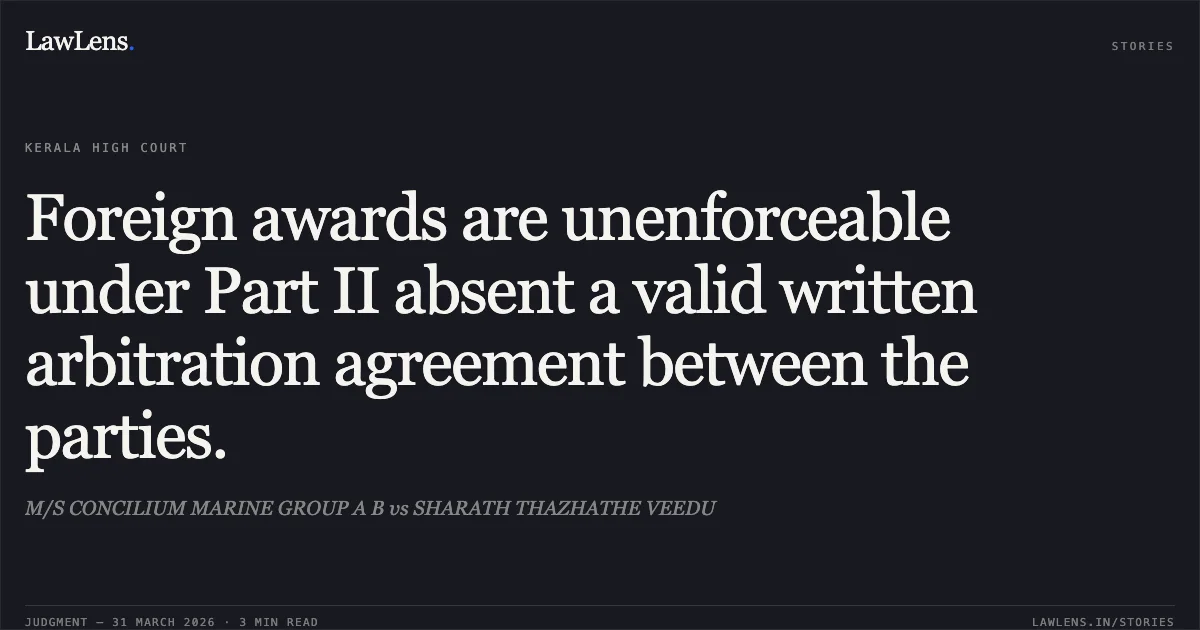
It held that an award rendered by a foreign tribunal which simultaneously finds that no valid arbitration agreement exists cannot be enforced in India under Part II of the Act
Source reference: para 81, 94Such an award does not satisfy the definition of a "foreign award" under Section 44 and its enforcement is prohibited under Section 48(1)(a) (invalid agreement), Section 48(2)(a) (non-arbitrable subject matter), and Section 48(2)(b) (conflict with the public policy of India)
Source reference: para 81-82, 94-95The court concluded that a valid, written arbitration agreement is a non-negotiable jurisdictional baseline for enforcement in India
Source reference: para 80Acts & Sections Cited
11 provisions across 2 statutes referred to in this judgment. Each provision opens on LawLens.
Arbitration and Conciliation Act, 1996
Code of Civil Procedure, 19082
Original Court PDF
M/S CONCILIUM MARINE GROUP A BvsSHARATH THAZHATHE VEEDU
Click to open original judgment
Original judgment, available to read, download and summarize on LawLens.in