Facts
The Department filed three appeals against common orders of the Commissioner (Appeals), who had rejected demands for differential customs duty against Premier Plastic Industries in respect of three consignments.
Source reference: para. 1The importer had declared the goods as “Urea Houseware—Trays and Bowls” and classified them under CTH 68159990. On examination of one consignment, Customs found 19 excess cartons and goods bearing the undeclared “DOLPHIN” brand. CRCL testing showed that the kitchenware was primarily composed of urea-formaldehyde resin with inorganic filler.
Source reference: paras. 2–2.2Statements of the importer’s proprietor and his father were recorded under Section 108 of the Customs Act, 1962. The importer accepted the test report and deposited ₹3 lakh towards differential duty.
Source reference: para. 2.3During investigation, the Department obtained documents through an overseas enquiry conducted via the Hong Kong/Chinese Customs authorities. These documents indicated that the exporter had declared substantially higher values before Chinese Customs than those declared by the importer before Indian Customs, allegedly resulting in undervaluation of approximately 65–68%.
Source reference: paras. 2.4, 7.3The Department issued show-cause notices proposing differential customs duty of ₹20,08,933, ₹32,85,849 and ₹18,26,677.37, respectively. The original adjudicating authorities confirmed the demands, but the Commissioner (Appeals) set them aside, principally holding that the documents received from Hong Kong Customs were inadmissible or insufficiently authenticated.
Source reference: para. 2.5Issues
1. Whether the documents received through the overseas enquiry from the Hong Kong/Chinese Customs authorities were admissible and entitled to the statutory presumption under Section 139 of the Customs Act, 1962?
Source reference: paras. 7–7.42. Whether the importer had misdeclared the description, quantity, brand and classification of the goods?
Source reference: paras. 2.1–2.3, 9.13. Whether rejection of the declared transaction value under Rule 12 of the Customs Valuation Rules, 2007, and subsequent redetermination of value under Rules 4 to 9 were legally sustainable?
Source reference: paras. 10–10.14. Whether penalty equal to the duty determined was mandatory under Section 114A of the Customs Act, 1962?
Source reference: paras. 10.2–10.3Law Applied
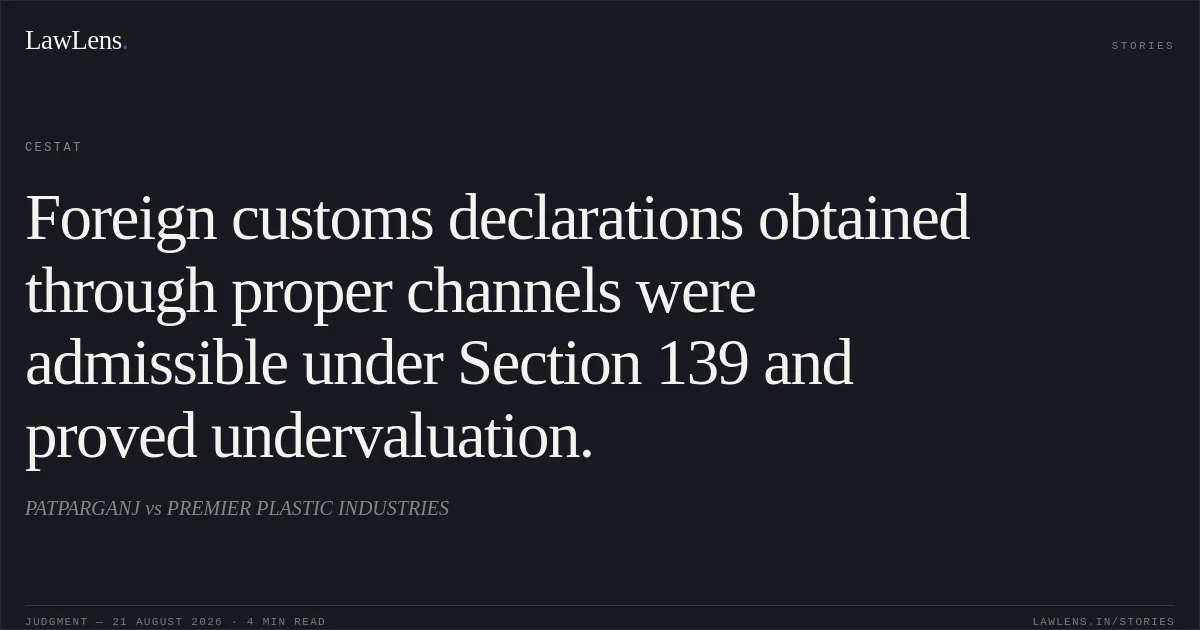
Section 139(ii) of the Customs Act, 1962 provides a presumption regarding documents received from outside India during investigation of an offence under the Act, subject to proof to the contrary; the Tribunal held that such documents may be admitted even when copies are relied upon.
Source reference: paras. 7.1–7.4Section 108 statements recorded by Customs officers are admissible substantive evidence when voluntary, since Customs officers are not police officers; the Tribunal relied on Surjit Singh Chhabra v. Union of India, 1997 (89) E.L.T. 646, and the principles referred to in Ramesh Chandra Mehta, Illias, K.I. Pavunny and related decisions.
Source reference: para. 9.1Under Rule 12 of the Customs Valuation Rules, 2007, the declared transaction value may be rejected where there is reasonable doubt regarding its truth or accuracy; the value must thereafter be determined sequentially under Rules 4 to 9, subject to the applicable statutory flexibility.
Source reference: paras. 10–10.1Section 114A of the Customs Act mandates a penalty equal to the duty where short-levy or non-levy results from collusion, wilful misstatement or suppression of facts.
Source reference: paras. 10.2–10.3The Tribunal also distinguished Eicher Tractors Ltd. v. Commissioner, 2000 (122) E.L.T. 321 (S.C.), Commissioner of Customs v. South India Television (P) Ltd., 2007 (214) E.L.T. 3 (S.C.), and Collector v. East Punjab Traders, 1997 (89) E.L.T. 11 (S.C.), while relying on Orson Electronics, Décor Rubber Industries and Martwin Electronics concerning reliance on foreign customs documents.
Source reference: paras. 4.2, 7.5Reasoning
The Tribunal found that the overseas documents had been obtained through a formal enquiry and transmitted through proper official channels, with authenticated English translations and a covering communication from the competent authorities.
Source reference: paras. 7.3–7.4Accordingly, the objections that the documents were copies, unsigned, in a foreign language or not separately attested under the Diplomatic and Consular Officers (Oaths and Fees) Act, 1948, were rejected. Section 139 was held applicable, and the importer produced no contrary evidence beyond oral denial.
Source reference: paras. 7.2–8.1The physical examination, CRCL report, undeclared excess quantity and brand, foreign export declarations, and the importer’s Section 108 statements collectively corroborated the Department’s case of misdeclaration and undervaluation.
Source reference: paras. 2.1–2.3, 9.1–9.2The Tribunal held that these circumstances furnished sufficient grounds to reject the declared transaction value under Rule 12. It further held that the redetermined value was based on the value of identical goods imported from the same exporter and that the valuation methodology substantially followed the sequential scheme under Rules 4 to 9.
Source reference: paras. 10–10.1Since the undervaluation resulted from wilful misstatement or suppression, the equal penalty imposed under Section 114A was also sustained.
Source reference: paras. 10.2–10.3Holding
The Tribunal answered all issues in favour of the Department. It held that the documents obtained from the Chinese Customs authorities were admissible and covered by the presumption under Section 139 of the Customs Act; that the importer had misdeclared and undervalued the goods; and that rejection and redetermination of the transaction value, together with the Section 114A penalty, were legally sustainable.
The orders of the Commissioner (Appeals) were set aside, and all three departmental appeals were allowed.
Source reference: para. 11Acts & Sections Cited
6 provisions across 2 statutes referred to in this judgment. Each provision opens on LawLens.
Customs Act,19625
Diplomatic and Consular Officers (Oaths and Fees) Act, 19481
Original Court PDF
PATPARGANJvsPREMIER PLASTIC INDUSTRIES
Click to open original judgment
Original judgment, available to read, download and summarize on LawLens.in