Facts
The respondent-accused, a Nigerian national, was arrested on 16 March 2023 in connection with Crime No. 37 of 2023 registered by the Directorate of Revenue Intelligence under Sections 8(c), 21(c), 23(c), 27A, 28 and 29 of the Narcotic Drugs and Psychotropic Substances Act, 1985 (“NDPS Act”).
Source reference: pp.3–7, paras.2–3.2The prosecution alleged that approximately 4.935 kg, treated by the Court as about 5 kg, of heroin recovered from a co-accused was intended to be delivered to him and that he coordinated the trafficking through Indian intermediaries and an alleged associate, “Helen”.
Source reference: pp.3–7, paras.2–3.2The investigation culminated in a chargesheet filed on 6 September 2023.
Source reference: p.7, para.3.2The Special Court rejected his bail application, noting the commercial quantity, his alleged role as a mastermind, his previous conviction in an NDPS case, and his alleged involvement in an international drug-trafficking syndicate.
Source reference: p.7, para.3.2The Bombay High Court nevertheless granted regular bail on 5 May 2025, principally observing that there was no recovery from him, that the prosecution relied on statements and WhatsApp chats, and that he had undergone more than two years of custody.
Source reference: pp.7–9, para.4The Supreme Court stayed the bail order and directed steps for the accused’s arrest. He could not be traced and was found to have absconded.
Source reference: pp.9–12, paras.5.1–5.3The surety produced for him was also discovered to be fictitious: the address, employment, bank account, PAN and Aadhaar details were non-existent or forged.
Source reference: pp.9–12, paras.5.1–5.3; pp.59–62, paras.19–20.3Issues
Whether the High Court correctly granted bail to the accused in an NDPS case involving commercial quantity without recording the satisfaction mandated by the twin conditions in Section 37(1)(b)(ii) of the NDPS Act.
Source reference: pp.35–40, paras.11.3–11.3.7; pp.49–52, paras.14–16Whether the accused’s prolonged incarceration and the alleged absence of recovery from him could, by themselves, justify bail notwithstanding the statutory restrictions under Section 37 of the NDPS Act and the possibility of enhanced punishment under Section 31A.
Source reference: pp.49–54, paras.14–16Whether the accused’s subsequent abscondence after the Supreme Court stayed the bail order justified cancellation of bail.
Source reference: pp.54–55, para.17Whether the Supreme Court could issue directions under Article 142 to regulate the verification of sureties and the grant of bail to foreign nationals accused in NDPS cases involving commercial quantities.
Source reference: pp.103–114, paras.26–27What safeguards should govern bail granted to such foreign nationals, particularly concerning passports, FRRO registration, sureties, address verification, financial disclosures and institutional accountability.
Source reference: pp.114–136, paras.28–29Law Applied
The Court applied Section 37(1)(b)(ii) of the NDPS Act, which requires, after hearing the Public Prosecutor, reasonable grounds for believing that the accused is not guilty and is unlikely to commit an offence while on bail; these conditions are cumulative and additional to ordinary bail considerations.
Source reference: pp.35–40, para.11.3Section 35 creates a statutory presumption regarding culpable mental state, while Section 31A makes the possibility of enhanced punishment, including death in specified circumstances, relevant where a person previously convicted of a qualifying NDPS offence is subsequently involved in an offence concerning the prescribed commercial quantity.
Source reference: pp.35–36, para.11.3; pp.50–52, para.15The Court relied on Narcotics Control Bureau v. Mohit Aggarwal, holding that “reasonable grounds” under Section 37 require credible and plausible grounds for believing that the accused is not guilty and is unlikely to commit another offence, although the court need not conduct a meticulous examination of evidence at the bail stage.
Source reference: pp.37–38, para.11.3.2It also considered Mohd. Muslim v. State (NCT of Delhi), which permits a broad and prima facie assessment and recognises that Article 21 may operate against indefinite pre-trial incarceration, but read that principle harmoniously with Section 37.
Source reference: pp.38–41, paras.11.3.3–11.3.7Under Article 21, foreign nationals are entitled to protection of life and personal liberty, although the State may regulate their presence and movement; bail conditions imposed on them must remain reasonable, proportionate and capable of compliance.
Source reference: pp.45–48, para.13.5Under Article 142, the Supreme Court may issue interim directions to fill a legal or administrative vacuum and do complete justice, but cannot supplant or disregard substantive statutory law.
Source reference: pp.103–114, paras.26–27Reasoning
The Court held that the High Court had failed to apply Section 37 of the NDPS Act.
Source reference: pp.49–50, para.14Merely noting that no contraband was recovered from the accused and relying on Tofan Singh did not establish reasonable grounds for believing that he was not guilty, nor did the High Court examine whether he was unlikely to commit another offence while on bail.
Source reference: pp.49–50, para.14The High Court also failed to consider the prosecution material concerning the WhatsApp communications, the alleged coordination of the consignment, the accused’s prior NDPS conviction, and his alleged involvement in a similar offence while previously on bail.
Source reference: pp.6–7, paras.3.1–3.2; pp.49–50, para.14Although Article 21 is relevant to prolonged incarceration, the Court observed that the present case involved approximately 5 kg of heroin, a commercial quantity, and that Section 31A made the possibility of capital punishment legally relevant; consequently, the statutory protection under Section 436A of the CrPC and Section 479 of the BNSS did not apply in the same manner.
Source reference: pp.50–54, paras.15–16In any event, the accused absconded after the Supreme Court stayed the bail order, demonstrating violation of the bail conditions and converting the matter into one of cancellation of bail.
Source reference: p.54, para.17The discovery that the surety was fictitious exposed a systemic failure: the very mechanism intended to secure the accused’s attendance had become ineffective.
Source reference: no citationExercising Article 142, the Court therefore prescribed safeguards for foreign nationals accused in commercial-quantity NDPS cases, while preserving judicial discretion in exceptional situations and respecting Article 21.
Source reference: pp.114–136, paras.28–29Holding
The Supreme Court cancelled the bail granted by the Bombay High Court because the accused absconded after the bail order was stayed and thereby violated the conditions of bail.
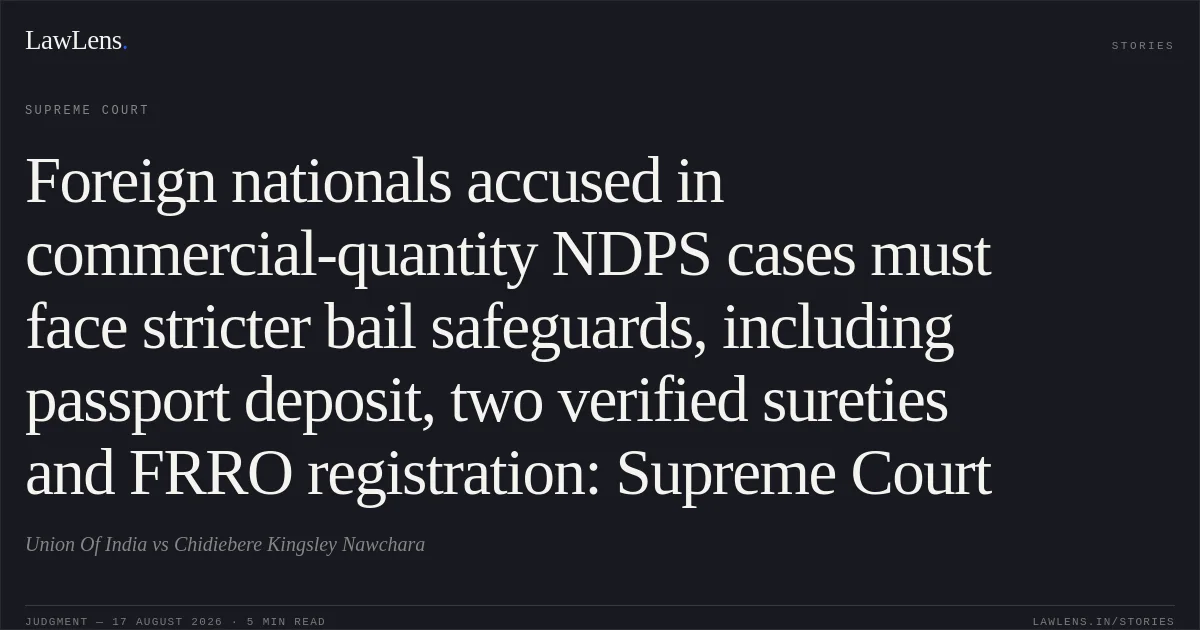
It further held that, in cases involving a foreign national accused of an NDPS offence involving commercial quantity: the passport must be deposited with the jurisdictional court and foreign travel may be restricted; the accused must register with the FRRO within one week of release; two genuine sureties of like amount are ordinarily mandatory, subject to relaxation by a reasoned judicial order where securing two sureties is genuinely difficult; sureties and the accused’s Indian address must be physically verified before release, ordinarily within three days; the accused must disclose sources of income and funds in India; the investigating officer must inform the relevant embassy or consulate; a centralised database of accused persons and sureties must be created; officials involved in verifying subsequently discovered fake sureties must face departmental inquiry; a lien or charge may be created over property furnished by the surety; High Courts should develop digital verification portals; and Form 47A, containing enhanced disclosures and undertakings, should be inserted after Form 47 of the BNSS.
Source reference: pp.132–136, para.29The appeal was disposed of in these terms.
Source reference: p.141, para.33Acts & Sections Cited
84 provisions across 7 statutes referred to in this judgment. Each provision opens on LawLens.
Narcotic Drugs and Psychotropic Substances Act, 1985
Code of Criminal Procedure, 1973
Bharatiya Nagarik Suraksha Sanhita, 2023
Indian Penal Code, 18602
Prevention of Money-Laundering Act, 20024
Passports Act, 19671
Original Court PDF
Union Of IndiavsChidiebere Kingsley Nawchara
Click to open original judgment
Original judgment, available to read, download and summarize on LawLens.in