Facts
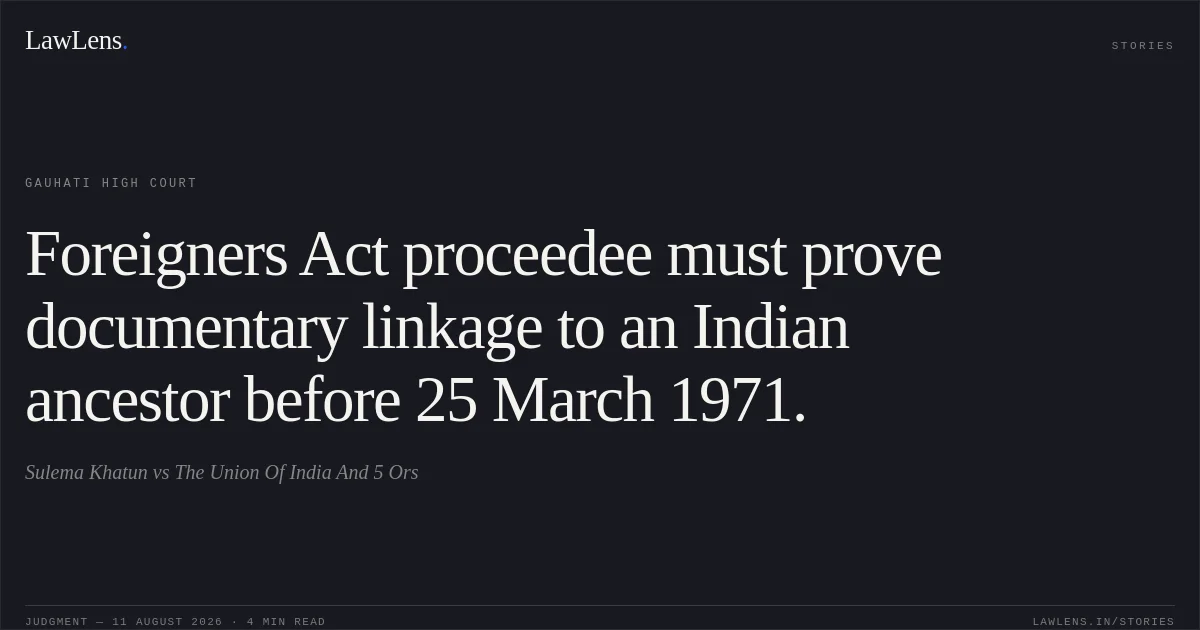
The petitioner challenged the opinion dated 11 March 2019 of the Foreigners Tribunal–I, Tezpur, Sonitpur, in F.T. Case No. 8 of 2018, arising from Police Enquiry No. 263/2017, whereby she was declared a foreigner who had entered India from Bangladesh on or after 25 March 1971.
Source reference: para. 2She claimed to be an Indian citizen by birth, born at Barguri village, Sonitpur, and asserted that her parents, Intaz Ali and Manikjan, were Indian citizens whose names appeared in the 1966 and 1971 electoral rolls.
Source reference: para. 4She relied on electoral rolls of 1966, 1971, 1997 and 2013, a registered sale deed executed by her projected father in 1982, and the oral evidence of herself, her projected brother, an Election Office official and a Sub-Registrar’s Office employee.
Source reference: paras. 5–13The Tribunal rejected her claim and answered the reference against her.
Source reference: no citationBefore the High Court, the petitioner contended that the Tribunal had overlooked and misappreciated material evidence.
Source reference: paras. 15–16The respondents argued that she had failed to establish documentary linkage with her projected parents or any Indian ancestor prior to 25 March 1971 and that the Tribunal’s factual findings did not warrant interference in certiorari jurisdiction.
Source reference: para. 18Issues
Whether the petitioner discharged the burden under Section 9 of the Foreigners Act, 1946, by proving that she was not a foreigner and by establishing her linkage with Indian-citizen parents or ancestors prior to 25 March 1971?
Source reference: paras. 21–22, 40Whether the electoral rolls, sale deed and oral testimony adduced by the petitioner constituted sufficient and reliable documentary linkage evidence?
Source reference: paras. 23–36Whether the Foreigners Tribunal’s opinion suffered from perversity or legal error warranting interference by the High Court under Article 226 of the Constitution?
Source reference: paras. 15–16, 39–40Law Applied
The Court applied Section 9 of the Foreigners Act, 1946, under which the burden lies on the proceedee to establish that he or she is not a foreigner; that burden is discharged on the standard of preponderance of probabilities.
Source reference: paras. 21–22In proceedings under the Foreigners Act and the Foreigners (Tribunals) Order, 1964, documentary evidence establishing the proceedee’s linkage with an Indian-citizen ancestor prior to 25 March 1971 is essential, and oral testimony alone is insufficient, as held in Nur Begum v. Union of India, Asia Khatoon v. Union of India, Haidar Ali v. Union of India, Abdul Khalique v. Union of India, and Karim Ali @ Abdul Karim v. Union of India.
Source reference: paras. 31–38The Court distinguished Dolgobinda Paricha v. Nimai Charan Misra, observing that evidence concerning relationship under Section 50 of the Evidence Act may be corroborative but cannot, by itself, replace documentary linkage in a citizenship proceeding.
Source reference: paras. 32–34It further applied the limited scope of certiorari jurisdiction under Article 226: a writ court ordinarily examines the decision-making process and does not reappreciate factual findings absent perversity or jurisdictional error, as recognised in Khalek @ Raphik Ali v. Union of India.
Source reference: para. 39Reasoning
Although the 1966 and 1971 electoral rolls indicated that Intaz Ali and Manikjan were present as voters in Barguri, the Court held that those documents did not establish that the petitioner was their daughter.
Source reference: paras. 23–25Their evidentiary value was also weakened by defects concerning certification, missing particulars and the carbon-copy nature of the 1971 roll.
Source reference: para. 23The 1982 sale deed demonstrated the presence of a person named Intaz Ali in India but did not establish the petitioner’s relationship with that person.
Source reference: para. 25The 1997 and 2013 electoral rolls showed the names of the projected parents and brothers, but the petitioner’s name did not appear in any electoral roll alongside either parent or brother.
Source reference: paras. 26–30Her explanation that she had married Sultan Ahmed and moved to her matrimonial home was unsupported by documentary evidence of the marriage or residence.
Source reference: paras. 28–30Consequently, the oral evidence of the petitioner and her projected brother could not cure the absence of documentary linkage, and the Court found no perversity or legal infirmity in the Tribunal’s reasoning warranting certiorari intervention.
Source reference: paras. 33–40Holding
The High Court held that the petitioner failed to discharge the burden under Section 9 of the Foreigners Act, 1946, because she did not produce reliable documentary evidence linking herself to Intaz Ali and Manikjan or to any Indian-citizen ancestor prior to 25 March 1971.
The opinion dated 11 March 2019 of the Foreigners Tribunal–I, Tezpur, declaring her a foreigner, was upheld and confirmed.
Source reference: para. 41The writ petition was dismissed, the interim order dated 2 September 2019 was vacated, and the original Tribunal Case Record was directed to be returned.
Source reference: paras. 42–43Acts & Sections Cited
2 provisions across 2 statutes referred to in this judgment. Linked provisions open on LawLens.
Foreigners Act, 19461
Indian Evidence Act, 18721
Original Court PDF
Sulema KhatunvsThe Union Of India And 5 Ors
Click to open original judgment
Original judgment, available to read, download and summarize on LawLens.in