Facts
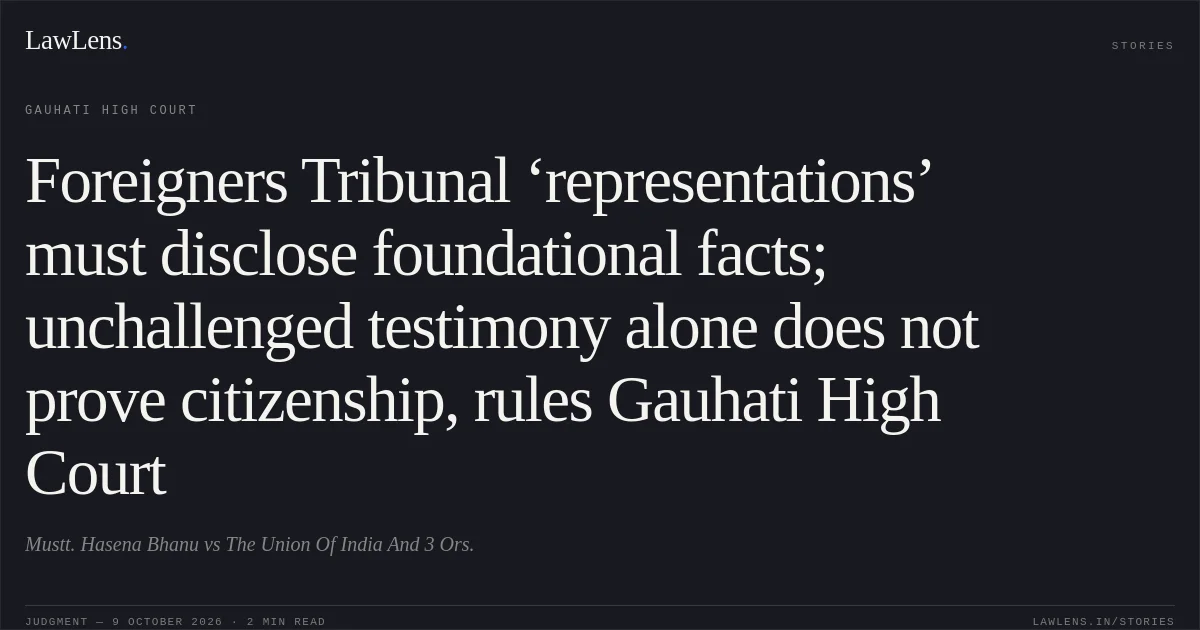
The petitioner challenged a Foreigners Tribunal opinion dated 19 May 2017 declaring her a foreigner who entered India after 25 March 1971.
Source reference: p. 3, para. 2She relied on electoral rolls from 1966 and 1970 listing her projected father and grandfather, later electoral rolls listing her, a Gaon Panchayat linkage certificate, and evidence from herself and a witness said to be her uncle.
Source reference: pp. 3–5, paras. 4–6The Tribunal found that she had not established her link to her projected father and grandfather.
Source reference: p. 5, para. 9The High Court considered her challenges concerning the required contents of her representation, the significance of the father’s name in the reference or summons, and the effect of the absence of cross-examination.
Source reference: pp. 8–9, para. 16Issues
1. Whether a proceedee’s “representation” before a Foreigners Tribunal must disclose the foundational facts relevant to the citizenship claim, as a written statement would.
Source reference: pp. 8–15, paras. 16(I), 212. Whether mention of a person’s name as the proceedee’s father in the summons or accompanying complaint establishes parentage or prevents the Tribunal from declaring the proceedee a foreigner.
Source reference: pp. 8–9, para. 16(II); pp. 15–16, paras. 22–253. Whether the absence of cross-examination or Tribunal queries requires the proceedee’s and her witnesses’ affidavit evidence to be presumed truthful.
Source reference: pp. 8–9, para. 16(III); pp. 16–21, paras. 26–374. Whether the Tribunal’s opinion warranted interference.
Source reference: pp. 8–9, para. 16(IV); p. 21, para. 38Law Applied
Section 9 of the Foreigners Act, 1946 places on the person concerned the burden of proving that they are not a foreigner.
Source reference: p. 11, para. 21(f)–(g)Paragraph 3 of the Foreigners (Tribunals) Order, 1964, and the corresponding paragraph 17 of the Immigration and Foreigners Order, 2005, use the term “representation”; the Court held that this terminology does not dispense with the requirement to plead and prove foundational facts.
Source reference: pp. 14–15, para. 21(m)–(o)Relying on Sarbananda Sonowal v. Union of India, (2005) 5 SCC 665, the Court stated that facts ordinarily within a claimant’s personal knowledge—including date and place of birth and parental details—must be provided so the State can verify or rebut them.
Source reference: p. 13, para. 21(k)A name in a summons does not itself prove parentage.
Source reference: pp. 15–16, paras. 23–25Oral evidence, or a document’s admission as an exhibit without objection, does not by itself establish citizenship or make an otherwise inadmissible document admissible; the claim must be supported by relevant, admissible documentary evidence.
Source reference: pp. 16–19, paras. 26–32; Rukia Begum v. Union of India, (2018) 5 GLR 438Reasoning
The Court found that the petitioner’s written statement did not set out essential family and birth details, and that her electoral-roll documents did not establish a documentary link between her and the projected father and grandfather.
Source reference: p. 9–10, para. 18; pp. 17–19, paras. 28–29The linkage certificate and oral testimony were insufficient to supply that missing proof; the Court also considered the PAN card a post-reference document that did not establish the claimed lineage.
Source reference: pp. 17–19, paras. 28–29It rejected the argument that the father’s name in the summons established parentage, and held that the witnesses’ evidence could not be presumed truthful merely because it was not cross-examined.
Source reference: pp. 15–16, paras. 23–25; pp. 18–21, paras. 30–37The petitioner therefore failed to discharge the burden under Section 9.
Source reference: p. 19, para. 32Holding
The Court answered the issues against the petitioner and held that the Tribunal’s opinion disclosed no ground for interference.
It dismissed the writ petition, revoked the interim bail order, and directed that the consequences of the Tribunal’s declaration follow.
Source reference: p. 21, paras. 39–40Acts & Sections Cited
2 provisions across 1 statute referred to in this judgment. Each provision opens on LawLens.
Bharatiya Sakshya Adhiniyam, 20232
Original Court PDF
Mustt. Hasena BhanuvsThe Union Of India And 3 Ors.
Click to open original judgment
Original judgment, available to read, download and summarize on LawLens.in