Facts
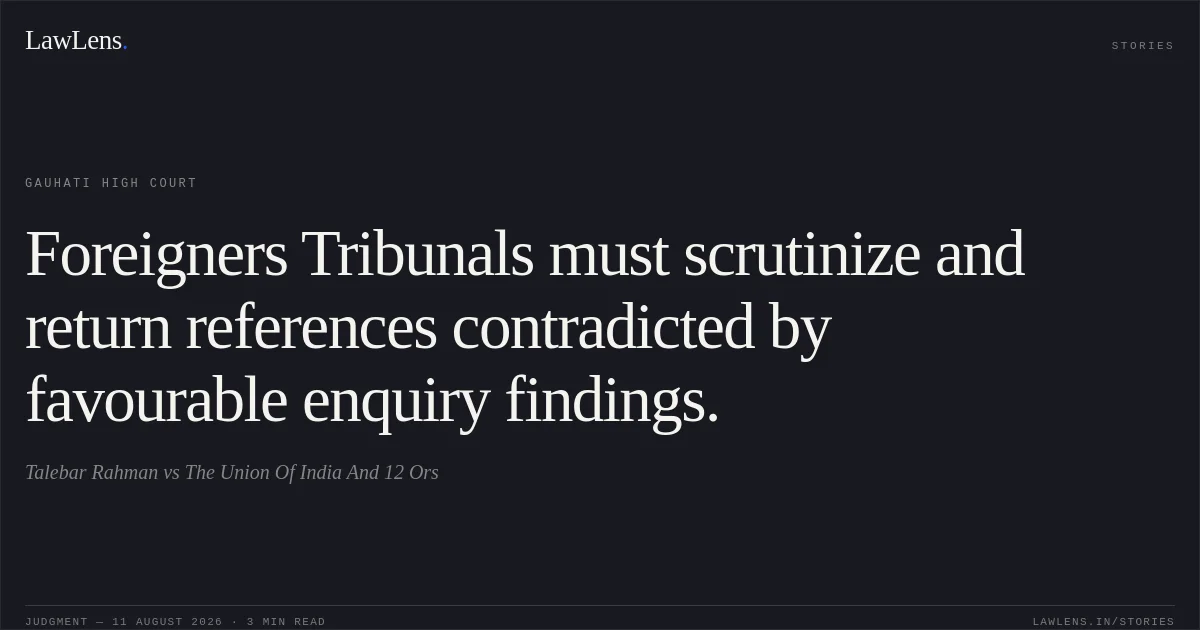
The petitioner challenged the judgment dated 11.01.2019 of Foreigners Tribunal No. 3, Kamrup (M), Guwahati, in FT Case No. 76/2017, whereby he was declared a foreigner who had entered India from the specified territory on or after 25.03.1971.
Source reference: p.4, para. 2The Enquiry Officer’s report dated 23.02.2017 stated that, on a prima facie enquiry and based on the local police report, the petitioner was “not IM”.
Source reference: p.4, paras. 3–4The DCP (Border), Guwahati, had examined and endorsed the Enquiry Officer’s report, but the matter was nevertheless referred to the Foreigners Tribunal.
Source reference: p.5, para. 6The petitioner contended that, in view of the favourable enquiry report and its acceptance by the DCP (Border), no valid reference could have been made. The respondents argued that the petitioner had failed to establish citizenship through acceptable documents and relied, inter alia, upon the limited evidentiary value of the NRC relied upon by him.
Source reference: p.5, para. 7Issues
1. Whether the Foreigners Tribunal could validly adjudicate the reference when the Enquiry Officer had reported that the petitioner was not an illegal migrant and the DCP (Border) had endorsed that report.
Source reference: pp. 4–5, paras. 3–6, 11–122. Whether the Tribunal’s declaration of the petitioner as a post-1971 foreigner was sustainable when the validity of the underlying reference had not first been examined.
Source reference: pp. 6–9, paras. 10–133. Whether the matter should be remanded to the Tribunal for determination of the validity of the reference and, if valid, for a fresh adjudication.
Source reference: p. 9, para. 13Law Applied
Clause 2 of the Foreigners (Tribunals) Order, 1964 authorises the competent referral authority, including the Superintendent of Police (Border), to refer the question of whether a person is a foreigner to the Foreigners Tribunal for its opinion; the investigating officer’s report is ordinarily indicative and does not finally determine citizenship, as recognised in Aziz Miya v. Union of India & Ors., 2023 (4) GLT 246.
Source reference: pp. 5–6, para. 8However, under State v. Moslem Mondal, 2013 (1) GLT 809, a reference cannot be mechanical and the referral authority must apply its mind to the materials collected during investigation.
Source reference: pp. 6–7, para. 10Following Monowara Khatun v. Union of India & Ors., WP(C)/2674/2016, decided on 12.01.2018, where the Enquiry Officer found that the person was not a foreigner and the SP (Border) accepted that conclusion, the Tribunal ought to return the reference rather than proceed on a contrary or defective reference.
Source reference: pp. 6–8, paras. 10–12Reasoning
The Court found the present case materially similar to Monowara Khatun. The Enquiry Officer had expressly concluded that the petitioner was not an illegal migrant, and the DCP (Border) had endorsed that conclusion after examining the records.
Source reference: p. 5, para. 6; p. 8, para. 11Although the matter was thereafter referred to the Tribunal, the reference was inconsistent with the conclusions of the investigating and referring authorities. Applying the requirement of a non-mechanical reference under Moslem Mondal and the approach adopted in Monowara Khatun, the Court held that the Tribunal should first have examined whether a valid reference existed and, if not, returned the matter to the referral authority.
Source reference: pp. 8–9, paras. 11–12The Court distinguished the concern in Aziz Miya by noting that the issue was not merely the non-conclusive nature of an Enquiry Officer’s report, but the effect of the report after its acceptance or endorsement by the competent referral authority.
Source reference: pp. 8–9, paras. 11–12Since the impugned opinion was set aside on this procedural ground, the Court did not examine the merits of the petitioner’s citizenship documents or the Tribunal’s factual findings.
Source reference: p. 9, para. 13Holding
The writ petition was allowed to the extent that the Tribunal’s order dated 11.01.2019 was set aside, without adjudicating the merits of the petitioner’s citizenship claim.
The matter was remanded to the Foreigners Tribunal, which was directed first to determine whether a valid reference had been made. If the reference was valid, the Tribunal was to rehear the case and pass a fresh opinion in accordance with law; if invalid, it was to pass an appropriate order in light of the High Court’s observations.
Source reference: p. 9, para. 13The petitioner was directed to appear before the Tribunal within 30 days from receipt of the certified copy of the judgment, and the original Tribunal records were ordered to be returned.
Source reference: pp. 9–10, paras. 14–15Original Court PDF
Talebar RahmanvsThe Union Of India And 12 Ors
Click to open original judgment
Original judgment, available to read, download and summarize on LawLens.in