Facts
The Plaintiffs instituted a commercial suit seeking specific performance of a Collaboration Agreement dated 01.11.2022, permanent injunction and consequential reliefs in respect of property bearing No. 10/51, Punjabi Bagh (West), New Delhi, measuring approximately 550 square yards.
Source reference: p.2, paras. 4–6Under the alleged Agreement, the Plaintiffs were to demolish and reconstruct the property, pay the Defendant ₹5 crore, and receive ownership of the basement, ground floor and third floor with terrace rights, while the Defendant would retain the first and second floors; ₹12 lakh was allegedly paid at execution.
Source reference: p.2, para. 6Upon the Defendant’s alleged failure to hand over possession and apprehension of creation of third-party rights, the Plaintiffs instituted the suit after pre-institution mediation ended in a Non-Starter Report.
Source reference: p.3, paras. 7–8On 17.05.2023, the Court directed the parties to maintain status quo regarding the title and possession of the suit property.
Source reference: p.3, para. 8The Defendant subsequently denied executing the Collaboration Agreement and related documents, alleged forgery and fabrication, and sought vacation of the interim order under Order XXXIX Rule 4 CPC.
Source reference: pp.4–5, paras. 10, 12–14During the proceedings, the disputed documents and signatures were examined by the CFSL. Its report dated 04.09.2025 stated that the questioned signatures differed from the Defendant’s admitted and specimen signatures in fundamental writing characteristics beyond natural variation.
Source reference: p.5, para. 11Issues
1. Whether the Defendant had established sufficient grounds under Order XXXIX Rule 4 CPC for vacation or variation of the ex parte ad interim status quo order dated 17.05.2023.
Source reference: p.9, para. 182. Whether the CFSL report constituted a material subsequent development warranting reconsideration of the interim protection.
Source reference: pp.6–7, paras. 12–143. Whether, despite the CFSL report, the suit property required interim protection to prevent third-party rights and possible frustration of the suit.
Source reference: pp.8–9, paras. 15–16Law Applied
The Court applied Order XXXIX Rule 4 CPC, which empowers the Court to discharge, vary or set aside an injunction, particularly where the injunction was obtained through suppression or misrepresentation, there has been a material change in circumstances, or its continuation would cause manifest injustice.
Source reference: p.9, para. 19It held that this jurisdiction should not ordinarily become a mini-trial on disputed questions of fact, and that an interim injunction is ordinarily not vacated merely because the Defendant disputes the Plaintiff’s claim.
Source reference: p.9, para. 19The Court also relied on Ramrameshwari Devi v. Nirmala Devi, (2011) 8 SCC 249, which cautions against granting or indefinitely continuing ex parte injunctions and emphasises restitution and protection against abuse of the process through false averments or forged documents.
Source reference: pp.10–11, para. 21The Court further applied Section 52 of the Transfer of Property Act, 1882, embodying the doctrine of lis pendens, under which transfers during litigation remain subject to the outcome of the suit.
Source reference: p.12, para. 22Reasoning
The Court found that the CFSL report materially undermined the documentary foundation on which the original status quo order had been granted, as it recorded fundamental differences between the questioned and admitted/specimen signatures.
Source reference: pp.5, 9–12, paras. 11, 20–22Although the report was not treated as finally determining the genuineness of the documents, its contents made it inappropriate to allow the Plaintiffs to continue enjoying the original interim protection in its existing form solely on the basis of the disputed Agreement and related documents.
Source reference: p.12, para. 22At the same time, complete vacation of protection could enable the Defendant to alienate the property, create third-party rights and potentially render the specific-performance suit infructuous, causing irreparable prejudice if the Plaintiffs ultimately succeeded.
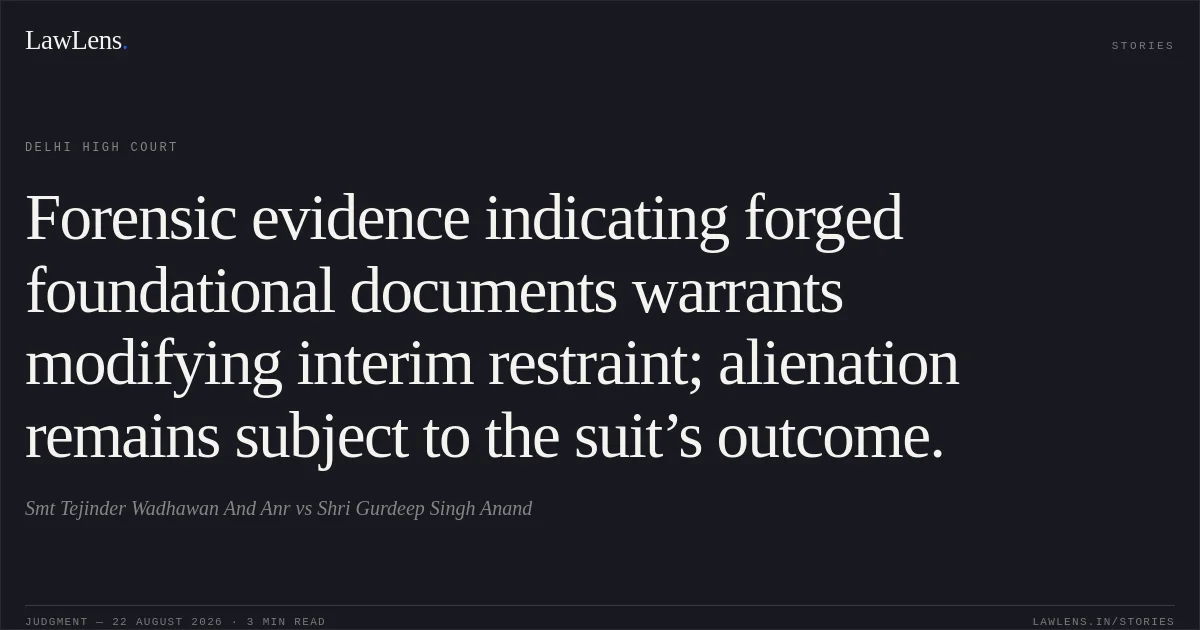
Source reference: p.12, para. 22The Court therefore balanced the effect of the CFSL report against the need to preserve the subject matter of the litigation, modifying rather than completely vacating the interim order.
Source reference: p.12, paras. 22–24Holding
The Court partly accepted the Defendant’s application under Order XXXIX Rule 4 CPC and modified the order dated 17.05.2023.
The original status quo direction was replaced to the extent that Section 52 of the Transfer of Property Act, 1882, would apply, making any sale of the suit property subject to the outcome of the suit.
Source reference: p.12, paras. 22–23The Defendant was additionally directed to obtain the Court’s permission before proceeding with any sale of any portion of the suit property.
Source reference: p.12, paras. 22–23The Court expressly clarified that it had made no final observations on the merits of the parties’ claims.
Source reference: p.12, para. 24The Defendant’s Order VII Rule 11 application was disposed of as not pressed, with liberty to raise those contentions at an appropriate stage.
Source reference: p.1, paras. 1–3The suit was listed for framing of issues on 05.11.2026.
Source reference: p.12, para. 25Acts & Sections Cited
4 provisions across 4 statutes referred to in this judgment. Linked provisions open on LawLens.
Commercial Courts Act, 20151
Code of Civil Procedure, 19081
Indian Evidence Act, 18721
Transfer of Property Act, 18821
Original Court PDF
Smt Tejinder Wadhawan And AnrvsShri Gurdeep Singh Anand
Click to open original judgment
Original judgment, available to read, download and summarize on LawLens.in