Facts
The respondent authority issued a tender notification on 12.03.2024 for the e-auction of various plots
Source reference: para. 1The petitioner deposited the Earnest Money Deposit (EMD) of ₹22,92,024/- and the tender fee
Source reference: para. 3However, the petitioner failed to submit a "sealed bid" by the deadline of 14.06.2024, allegedly due to a technical glitch
Source reference: para. 2, 4As a result, the petitioner was barred from the auction held on 19.06.2024, where the plot was successfully sold to another bidder
Source reference: para. 5-6The respondent authority forfeited the petitioner’s EMD, citing tender clauses that mandated forfeiture for failure to submit a sealed bid
Source reference: para. 7, 10The petitioner challenged this forfeiture as unjust enrichment
Source reference: para. 9Issues
1. Whether the respondent authority can proceed to forfeit the petitioner’s Earnest Money Deposit solely on the ground that he had not made a sealed bid, despite having paid the tender fee and EMD.
Source reference: para. 12Law Applied
Interpretation of Clause 3(a) and Clause L of the tender, which stipulated EMD forfeiture for failure to submit a sealed bid
Source reference: para. 13, 15General Condition Clause 22.2, which mandated the refund of EMD to all other participants once the bid of a "Preferred Bidder" is accepted
Source reference: para. 18Section 74 of the Indian Contract Act, 1872, regarding liquidated damages, establishing that forfeiture is a pre-estimate of loss and is not permissible in the absence of actual financial damage
Source reference: para. 30-31Distinction of the precedents of Pooja Ceratech Pvt. Ltd. v. ONGC and NHAI v. Ganga Enterprises; reliance on the principle against unjust enrichment as discussed in the Madras High Court decision in Rubina v. Authorized Officer
Source reference: para. 39, 40, 44-45Reasoning
The Court reasoned that the primary objective of an EMD is to ensure the auction is not stalled or disrupted to the financial prejudice of the authority
Source reference: para. 23Since the auction was concluded successfully and the plot was sold to a higher bidder, the authority achieved its objective and suffered no financial loss
Source reference: para. 22, 32The Court found that Clause 22.2 (mandating refund upon acceptance of a preferred bid) overrides the forfeiture clauses when the sale is finalized
Source reference: para. 26-27The Court held that by paying the EMD and tender fee based on a fixed reserve price, a participant is "deemed" to have made a bid at least equal to that reserve price; therefore, the claim that no bid was made is technically incorrect
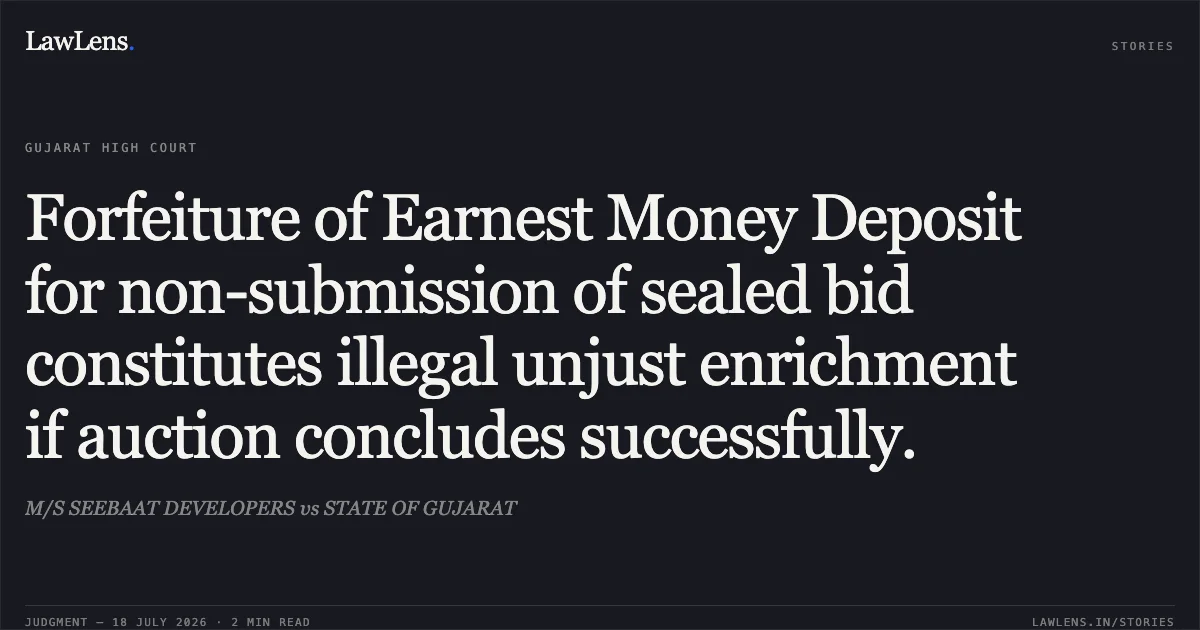
Source reference: para. 34, 37Forfeiting the EMD in a successful auction would constitute unjust enrichment and an unethical act by an instrumentality of the State
Source reference: para. 28, 33Holding
The Court answered the issue in the negative, holding that the respondent authority cannot forfeit the EMD when the auction process was successfully completed and no financial loss was incurred
The Court quashed the forfeiture of ₹29,92,040/- and directed the respondent authority to refund the EMD amount to the petitioner within four weeks
Source reference: para. 48-49The Writ Petition was allowed
Source reference: para. 49Acts & Sections Cited
1 provisions across 1 statute referred to in this judgment. Each provision opens on LawLens.
Indian Contract Act, 18721
Original Court PDF
M/S SEEBAAT DEVELOPERSvsSTATE OF GUJARAT
Click to open original judgment
Original judgment, available to read, download and summarize on LawLens.in


