Facts
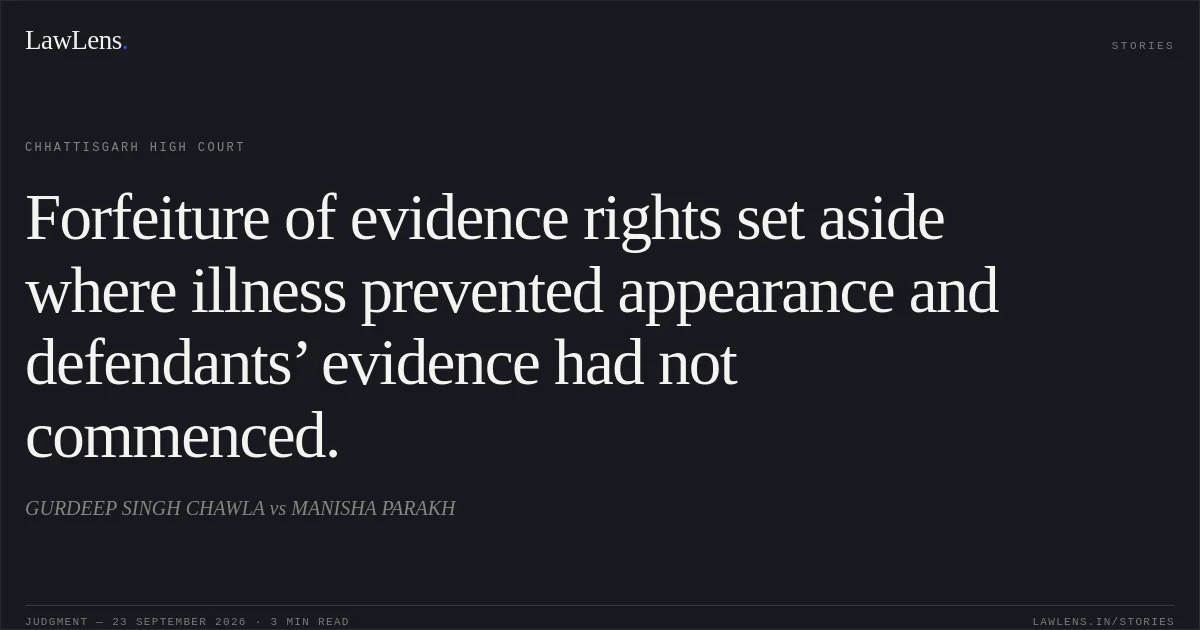
The petitioners were plaintiffs in Civil Suit No. 76-A/2020, seeking declaration of title and permanent injunction concerning ancestral property.
Source reference: para. 1After issues were framed, the matter was fixed for the plaintiffs’ evidence on 12 February 2026.
Source reference: para. 1Petitioner No. 1, who was representing and conducting the case on behalf of the other plaintiffs, could not appear on several dates due to illness.
Source reference: para. 2He subsequently fractured his left leg on 12 June 2026 and was advised bed rest.
Source reference: para. 2On 10 August 2026, the petitioners sought an adjournment under Order XVII Rule 1 of the Code of Civil Procedure, 1908 (“CPC”), but the Trial Court rejected the application and forfeited the plaintiffs’ right to lead evidence.
Source reference: para. 4The petitioners challenged that order under Article 227 of the Constitution, contending that denial of an opportunity to lead evidence would prejudice their adjudication of property rights and that the defendants’ evidence had not yet commenced.
Source reference: paras. 1–2Issues
Whether the Trial Court was justified in rejecting the petitioners’ application for adjournment under Order XVII Rule 1 CPC and forfeiting their right to lead evidence despite the pleaded illness and subsequent fracture of Petitioner No. 1?
Source reference: paras. 1–2, 4–5Whether, in the circumstances of the case, the petitioners should be granted one further opportunity to examine themselves and their witnesses, subject to payment of costs?
Source reference: paras. 6–8Law Applied
The Court applied Article 227 of the Constitution of India, which empowers the High Court to exercise supervisory jurisdiction over subordinate courts to ensure that proceedings are conducted within the bounds of law and substantial justice.
Source reference: para. 5It also considered Order XVII Rule 1 CPC, which governs the grant of adjournments.
Source reference: para. 5The governing principle applied was that although parties are not entitled to repeated or unnecessary adjournments, a genuine and sufficiently explained inability to appear may justify granting a limited opportunity, particularly where the refusal would substantially prejudice adjudication on the merits.
Source reference: paras. 5–8The Court further imposed costs and directed that no unnecessary adjournment be granted thereafter.
Source reference: paras. 5–8Reasoning
The High Court acknowledged that the plaintiffs had already received opportunities to lead evidence.
Source reference: paras. 4–6However, it found that the reasons placed before the Trial Court were not attributable to negligence: Petitioner No. 1 had suffered illness on several dates and had thereafter fractured his left leg, requiring treatment and bed rest.
Source reference: paras. 4–6Since he was conducting the matter on behalf of the other plaintiffs, his absence materially affected their ability to present evidence.
Source reference: paras. 5–6The Court also considered that the defendants’ evidence had not yet commenced and that the plaintiffs had sought only one further opportunity.
Source reference: paras. 5–6In these circumstances, forfeiting the plaintiffs’ right to lead evidence was considered disproportionate and likely to prejudice determination of the property dispute on its merits.
Source reference: paras. 5–6The Court therefore exercised its supervisory jurisdiction to restore the opportunity, while balancing procedural discipline by directing payment of costs and prohibiting unnecessary adjournments.
Source reference: paras. 7–8Holding
The High Court allowed the writ petition and set aside the Trial Court’s order dated 10 August 2026, by which the petitioners’ application under Order XVII Rule 1 CPC had been rejected and their right to lead evidence had been forfeited.
The Trial Court was directed to permit the plaintiffs to examine themselves and their witnesses, subject to payment of ₹5,000 as costs to the defendants.
Source reference: para. 8The Trial Court was further directed to fix a date for the plaintiffs’ evidence, not grant unnecessary adjournments, and preserve the defendants’ right to cross-examine the plaintiffs and their witnesses.
Source reference: para. 8Original Court PDF
GURDEEP SINGH CHAWLAvsMANISHA PARAKH
Click to open original judgment
Original judgment, available to read, download and summarize on LawLens.in