Facts
The Private Respondent (Respondent No. 3), a Chief Manager at Union Bank of India, was dismissed from service on 22.01.2019 following a disciplinary enquiry regarding loan irregularities at the Agra branch.
Source reference: para. 3, 11The Respondent No. 3 applied for gratuity in December 2021.
Source reference: para. 3Nearly four years after his dismissal, on 21.11.2022, the Bank issued a notice to forfeit his gratuity, alleging a financial loss of Rs. 1,453.01 lakhs.
Source reference: para. 4, 19The Bank claimed that under Regulation 3 of the Union Bank of India (Employees) Gratuity Fund Rules, it had the final authority to forfeit gratuity to the extent of financial loss.
Source reference: para. 13, 30Both the Controlling Authority and the Appellate Authority ruled in favor of the employee, holding that the loss was not quantified during the disciplinary proceedings and the forfeiture notice was an afterthought.
Source reference: para. 5, 52Issues
1. Whether the Bank can forfeit an employee's gratuity under Section 4(6) of the Payment of Gratuity Act, 1972, without quantifying the alleged financial loss during the disciplinary enquiry or in the dismissal order.
Source reference: para. 56, 602. Whether the Bank’s internal regulations regarding gratuity forfeiture can override the statutory provisions of the Payment of Gratuity Act, 1972, in the absence of an exemption under Section 5.
Source reference: para. 65, 66Law Applied
Section 4(6)(a) of the Payment of Gratuity Act, 1972, which permits forfeiture of gratuity only to the extent of damage or loss caused by an employee’s negligence or willful omission.
Source reference: para. 55, 56Section 14 of the Act, which mandates that the Act has an overriding effect over any other inconsistent enactments or instruments.
Source reference: para. 43, 66Section 5 regarding the necessity of government notification for exemption from the Act.
Source reference: para. 64, 65UCO Bank & Ors. vs Nityananda Paul, which established that loss must be quantified in the chargesheet/enquiry to justify forfeiture.
Source reference: para. 66Reasoning
The Court observed that while the Bank alleged a massive financial loss, this amount was never quantified in the original show-cause notice, the articles of charges, or the 400-page enquiry report.
Source reference: para. 56, 60The Bank only attempted to quantify and forfeit the loss four years later, after the employee had already approached the Controlling Authority; the Court deemed this a "malafide afterthought" and an abuse of process.
Source reference: para. 57, 61, 63Furthermore, because the Bank had not obtained an exemption under Section 5 of the Act, its internal Gratuity Fund Rules remained subordinate to the Payment of Gratuity Act per Section 14.
Source reference: para. 65, 66The Court reasoned that an employee cannot be subjected to a "second enquiry" or a belated forfeiture proceeding to fix liability for loss that was not established during the primary disciplinary process.
Source reference: para. 66Holding
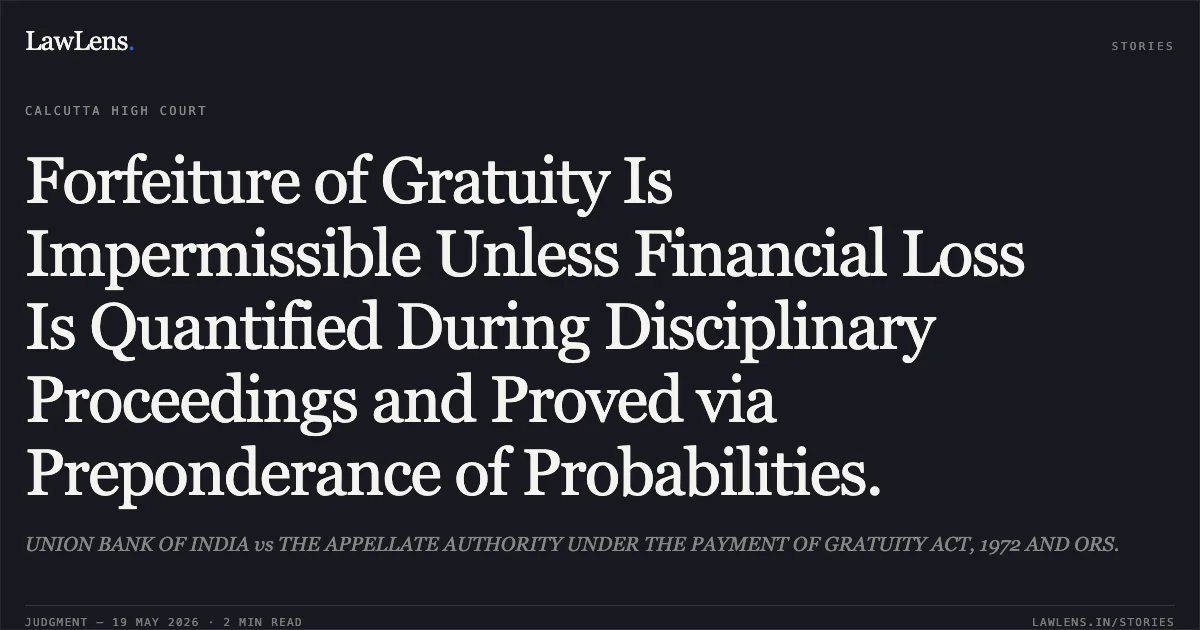
The Court answered the issues in the negative, holding that the Bank cannot forfeit gratuity if the loss was not quantified during the disciplinary proceedings.
The Court upheld the orders of the lower authorities insofar as they directed the payment of gratuity to Respondent No. 3. However, it set aside the authorities' observations regarding the validity of the enquiry proceedings themselves, as those were beyond their jurisdiction. The Bank was ordered to release the deposited gratuity amount plus interest to the respondent within 30 days, and the writ application was dismissed.
Source reference: para. 68-72Acts & Sections Cited
4 provisions across 2 statutes referred to in this judgment. Linked provisions open on LawLens.
PAYMENT OF GRATUITY ACT, 19723
Oil Industry Development Board Employees (Death-cum-Retirement) Gratuity Rules, 19831
Original Court PDF
UNION BANK OF INDIAvsTHE APPELLATE AUTHORITY UNDER THE PAYMENT OF GRATUITY ACT, 1972 AND ORS.
Click to open original judgment
Original judgment, available to read, download and summarize on LawLens.in